
I know, "It-Was-Just-In-His-Head" theories are a dime a dozen in films these days, but there are a ton of things in Home Alone that either really strain logic or just don't make sense when you think about them. The whole premise alone seems like an impossibly perfect series of coincidences. What are the odds of a storm knocking out the phone lines in a neighborhood on the same week that nearly every resident of that neighborhood is either out of town or on their way out? What are the odds that Kevin slept through all the noisy commotion of his huge family rushing to leave the house on time and then a kid the same age and height as Kevin happened to cross paths with them and get mistaken for him during their head count?

That doesn't even include the cartoonishly dumb crooks who specifically want to rob Kevin's house, the cops who only take emergency calls seriously at the story's convenience, and the mysterious old man who never seems to question why an eight-year-old is completely alone in public every time they cross paths. There's also a scary furnace in the basement that comes to life and talks, but we'll get to that later. This stuff could all just be kids movie logic, or maybe it's all the logic of an actual kid, Kevin McCallister, who's very smart and imaginative.

 I can think of two ways to look at this theory. The first and easier one to explain is that Kevin goes to bed after his fight with his family at the start of the film and dreams the rest of the story. He could have fallen asleep in that attic bedroom with the desire to be rid of his family fresh in his mind, then he dreamed a wild scenario where they left him behind and he grew to miss them just like his mother said he would. That would explain all of the coincidences, the crooks' abilities to survive his booby traps, and how Kevin is able to clean up the evidence of those booby traps so perfectly overnight. Kevin's habit of talking to himself and to the audience could be seen as his thoughts projecting themselves into his dream while he's thinking them. It could also be that the cop played by Joe Pesci in the first scene was a real cop, but since his eerie demeanor stuck with Kevin, the kid imagined him as the villain in his dream.
The only hitch with this theory is that we never see Kevin wake up from his dream. The ending scene where he wakes up on Christmas and his family comes home from Paris is consistent with his dream scenario, not with the scenario at the start of the film where the family is still getting ready to leave for Paris. A possible explanation for this is that we, the audience, are the ones who are meant to "wake up"from Kevin's dream and then apply what we learned from that dream to our own lives.
The second way to look at the "It-Was-Just-In-His-Head" theory is that Kevin was in fact left behind by mistake but imagined a lot of the things that he encountered during his time alone.

That's where the talking furnace comes in. The first time we see this phenomenon, Kevin himself says that it's only his imagination, then we see him silence the monstrous appliance by overcoming his fear of it. This is the only time the film ever confirms that something in it isn't real, but that can't be the only thing that Kevin concocts in his head.
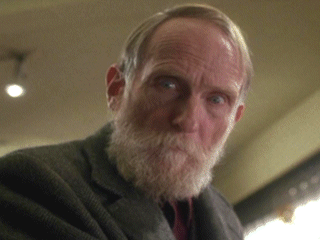 Take Old Man Marley for instance. The whole point of his character is that he has an unfair reputation and he's really a nice guy once you talk to him. If he's not a deranged serial killer like the rumors say, then why does he always stare at Kevin in silence like a psychopath whenever they see each other? He doesn't say hello, he doesn't nod his head in acknowledgement — heck, he doesn't even blink. Your first thought could be that he's socially awkward because he's a recluse, but in the church scene where he finally talks to Kevin, he's totally friendly and tells the kid that there's no reason to be afraid of him. That doesn't add up.
It's entirely possible, just like with the furnace, that Kevin's imagination is making him see Marley in a more menacing way than the man really appears, and that illusion falls away once the boy's fear is overcome.

It's more debatable whether or not the crooks Harry and Marv are really as they seem in this interpretation. Their behavior is consistent between their scenes with Kevin and their scenes without him, though their gullibility (and lack of peripheral vision) are questionable. It's also still questionable that they can be so physically sound after several falls down the stairs, blows to the head, and being partially set on fire. Perhaps Kevin's booby traps are not as effective as he perceives them to be and he didn't do nearly as much damage to the villains as he thought.

Unlike the dream theory, this notion of Kevin more or less hallucinating parts of his life opens the discussion for all kinds of mental issues that he may or may not have. Fans often find his talking to himself and his perfect aim with a BB gun to be concerning, and there are quite a few ideas floating around for what kind of a person he becomes when he grows up. That's another topic for another essay, though.
The "It-Was-Just-In-His-Head" theory may seem like a stretch, but Home Alone has been described by the people behind it as a dark comedy for children. While many children are able to appreciate dark humor, many others probably aren't. Dark humor often requires a cynical, less-than-innocent view of the world in order to fully grasp and enjoy it, and it takes years for someone to develop such a worldview. It could be that this film was made as a dark comedy with some light-hearted humorous elements in it so that different age groups would find it funny for different reasons. Perhaps the intent was that very young viewers would like it for its simpler elements at first and then develop a more complex and darker understanding of it as they grew up with it, similar to the way a lot of people view their families growing up.
Whether the events in Home Alone really are as they seem or if they're just the product of a very unique child's imagination, the film still proves today that a comedy can challenge you and make you think — even when you're home for the holidays.


