Showing posts with label death. Show all posts

Wednesday, December 28, 2016

Mourning Celebrities


Just when we all thought 2016 couldn't possibly turn out to be a lousier year, we lost another icon in Carrie Fisher just a few days before 2017 -- and after several reports that her condition was becoming stable, no less. From David Bowie and Alan Rickman to Gene Wilder and even Prince, 2016 seems to have been the ultimate year of saying goodbye to great talents well before their time. For a lot of people, this is bound to raise the question of whether or not it's right for us to really mourn the deaths of celebrities that we didn't know personally.

The answer: of course it is. Every real person's death is tragic, and celebrities are no exception. Even though we may not have known them personally, we still knew who they were and followed their careers throughout much of our lives. Some of them, like Carrie Fisher, even became prominent personalities in our lives because of the beloved characters that they played. Mourning the loss of a favorite entertainer is no less justified than mourning the loss of a casual friend that we saw from time to time and had fond memories of.

Also, knowing someone's body of work better than we knew them doesn't mean we have no reason to miss them. There was nothing questionable about people missing figures like Ronald Reagan or Pope John Paul II, after all. It can be argued of course that those cases were different since those figures devoted their lives to serving the people and helped millions, but a similar thing can be said for entertainers if you think about it. 

Think of all the little girls and even boys who saw Princess Leia as a role model. Think of all the people with drug addictions and mental illnesses who may have kept Carrie Fisher's real life struggles and advice in the backs of their minds while overcoming those obstacles. Think of all the filmmakers, writers, and artists who do what they love today because they saw "Star Wars" as kids and wanted to be a part of something equally creative when they grew up. Inspiring people can sometimes do just as much good in their lives as helping them, and anyone who does anything to inspire someone in a positive way deserves to be celebrated after they're gone.


Sunday, September 18, 2016

Theories on 1 - Part Two


> This Article Contains SPOILERS. <


1 Wears a Nazi Flag and a Death Mask

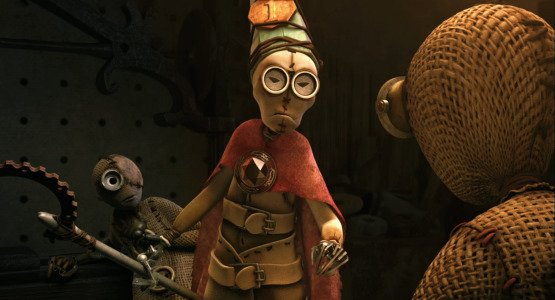
Clothes make the man, and in 1's case, this is probably a bad thing. Because of his lofty status at the start of the film, he wears a very king-like hat and cape in his first few scenes. He's presumably worn this outfit for most of his time as the group's leader, so it's fitting that he loses this attire piece by piece as his leadership fails over the course of the plot. There's symbolism to be found in his garments, and since 1 is quite the poetic type, he may have subconsciously chosen to wear them because of that symbolism.

Let's start with 1's cape. Its tattered edges imply that it was scavenged from the ruins rather than made for him, and it has a very distinct red color. The only other pieces of cloth that color in the film are the red flags with black and white symbols that we see strewn across the city where it takes place. These flags are later shown to have been the banners of a fascist dictator called the Chancellor, the man who first ordered the Scientist to create the Fabrication Machine and then corrupted it. In short, 1 might just be wearing what amounts to a Nazi flag.

It's been suggested in foreign dubs of the film that the Scientist modeled each stitchpunk after someone that he knew in life—with 1 being modeled after the Chancellor. Why he would model one of his creations after the man who caused the machines to turn against humanity is unclear, but since bringing the stitchpunks to life involved transferring a piece of his own soul into their bodies, the Scientist may have inadvertently given his memories of the Chancellor to 1. It's possible that 1 then "recalled" these memories, liked some of the Chancellor's ideas, and decided to govern his own people in a similar fashion.

Wearing a piece of the Chancellor's flag, a symbol of power, could be 1's way of embracing his newfound ideology and giving himself the confidence that he needs to rule his group singlehandedly. It's easy to imagine how this could corrupt his noble intentions over the years. This could also explain why he's so reluctant to remove his cape when one of the machines tries to snare him by it. He isn't just letting go of an accessory or a status symbol, he's letting go of the assurance that his way of managing things still works.

Next, there's 1 hat. This garment's most notable feature is the copper one-cent coin that he has fastened to it. The first thought is that 1 wears this coin on his head because it happens to have his name embossed on one side of it. This may be true, but later in the film, that same coin is used to cover the face of a dead stitchpunk during a funeral. This suggests that the stitchpunks have some sort of belief about the afterlife and that they associate coins with death. Whether or not 1 shares these views, he could be wearing one of those death symbols as a way to intimidate the other characters into following his rule. He's reminding them without words that death is always nearby and that he alone has control over it.

Much like his cape though, this decoration seems to delude the leader in a very unfortunate way. By wearing a symbol of death on his hat, 1 literally has death hanging over his head all the time. That's not a good position for someone as insecure as 1 to be in. It may have fed his fear of the machines to the point that he became paranoid, which then pushed him to more drastic methods of keeping the stitchpunks in line. Other factors played larger roles in this of course, such as three of the stitchpunks deserting the cathedral and another one becoming more and more curious about the outside world, but that lingering dread in the back of 1's mind from his coin could have sent him on a subtle but steady decline over the years.

The fact that he doesn't start to find his courage until after the coin falls from his hat further supports that the copper piece represents death. By losing that symbol, his fear of death probably becomes more abstract and somewhat easier to live with. Again, other factors play larger roles in 1's transformation after this point, but the loss of his morbid token and its false sense of power could have forced him to finally stand tall on his own.

I think what makes 1 so interesting to 9 fans is that we know he's one of the good guys. No matter how objectionable his behavior is, he's still acting in what he believes to be the group's best interest. The challenge then is to figure out his logic from the clues around us, which is very fitting in a movie about searching for the truth. We want to understand and like 1 because at the end of the day, we all know that the calloused cermudgeon has a soul inside.


Saturday, March 1, 2014

What Happened to Loki in "Thor: The Dark World"?

Well, I've been on blog hiatus for long enough, and since Thor: The Dark World came out on DVD/Blu-Ray/Digital Download/Personal Hologram Projection this past week, I think I know an interesting topic to discuss today. For anyone who hasn't seen the movie, big spoiler alert:

Loki dies--maybe. I'm not really sure. That's what I wanted to discuss.

To be a little more on the nose, there's a fight scene about two-thirds of the way through the film where Loki is apparently killed, then a few scenes later, we see a guard who's clearly him in disguise get up from the spot where his body was left and return to Asgard. The payoff for this is a reveal of Loki sitting on the throne of Asgard in Odin's place at the very end of the film. We can probably all agree that the God of Mischief was carrying out some kind of scheme the whole time, but what viewers do disagree on is whether Loki just faked his death or actually died and somehow came back to life. The movie doesn't explain, so we pretty much have to speculate about what happened until the next Thor installment comes out.


With that said, let's weigh the pros and cons of each theory.

First, there's the theory that Loki just faked his death. That seems more likely since obviously, it's a lot easier for someone to fake death than to come back from it. Another obvious point is that Loki is a master illusionist who can magically alter his appearance whenever he wants. That would explain how he was able to look fatally wounded and turn pale as he seemed to fade out. On top of that, he can alter other people's appearances too, which could mean that the villain Kurse impaling him through the chest was also an illusion. For all we know, the real Kurse could have been standing around in confusion with some sort of invisibility spell over him while that fake image was playing out.

There's just one problem with this idea. Illusions can only make a person look dead; they can't make a person feel dead. I know Thor isn't very bright, but don't you think that a thousand-year-old warrior like him would at least know how to detect vital signs? He even had his hand under Loki's neck--one of the places where you can feel someone's pulse--all throughout his brother's death scene.

Granted, Thor was pretty upset at the time and might not have noticed that little detail, plus a huge sandstorm was starting up that forced him and Jane to move on and look for shelter right away, but Loki had no control over those factors. He already knew from his prison-break scene that Thor had learned to recognize his illusions, meaning there was a chance that Thor wouldn't fall for that trick again, and it's very unlikely that Loki planned for that sandstorm to start right after he faked his death. Considering that, it seems like he had no plan for how to get Thor away from him before those pesky vital signs could give him away. Could that be because he wasn't planning for his death to be fake?

That brings us to the other theory, that Loki genuinely died in the fight with Kurse and then resurrected shortly afterwards. Probably the biggest reason why people side with this idea is because something similar did happen to Loki in the Marvel comics. In that storyline, he was able to come back to life because of a deal he'd previously made with Hela, the ruler of the underworld, to have his name removed from all of her books. Having his name removed basically meant he had no more appointments with death and was therefore immortal, and he used this advantage in a scheme that involved him dying and reincarnating to throw the other Asgardians off of his trail. It would make sense if this was also the case in the movie, because then he wouldn't have to worry about casting any illusions. It's easier to really be dead than to act dead.

This wouldn't be the first time a character resurrected in the Thor films, after all. The God of Thunder did it himself in the first movie, and seeing how Loki has a knack for magic and inter-realm travel, it wouldn't be a stretch for him to manage the same feat. In fact, in the scene in The Dark World where Loki gets back up in his guard disguise, he appears to be winded or disoriented. It would seem odd for him to be in such a state if his battle injuries and death were faked, so this could be a sign that he really was recovering from something very painful or jarring. Also, the realm of the dead in Norse mythology is known as Hel, so Loki's line right before he kills Kurse may have actually been, "See you in Hel, monster!" rather than, "See you in hell, monster!" He could have literally meant that he was going to see Kurse face-to-face again in the underworld in a few minutes--and maybe even rub a good-bye in Kurse's face on his way back out of Hel.

Just like with the first theory though, this idea has one problem: why in the world would Loki ever take such a huge risk and actually let himself be killed? How did he know his plan to resurrect would work? Assuming he'd made his deal with Hela just like in the comics, how did he know she would uphold her end of the bargain and not decide to lock him up in Hel after all? I don't know much about Hela as a character, but isn't the ruler of the underworld in just about every religion and mythology prone to making loaded deals with tons of loopholes that they can exercise to get what they want? I suppose if anyone can outwit the ruler of death, it's Loki, but that still seems like a huge, unecessary gamble for him.

Even so, I still find myself leaning towards the resurrection theory. There just seems to be more source material behind it, plus it would open the movies up to feature Hel as one of the nine realms in  the next installment. This is all speculation of course, so I could turn out to be completely wrong on opening night of Thor 3, but that's the fun of theory rants. They're a brain exercise, and in some cases, they can even leave you with some interesting, original ideas that you can integrate into your own writing.

And whatever did happen to Loki in Thor: The Dark World, it's a good thing Thor didn't bury him. Wouldn't that have had a funny implication later in the movie?


Monday, January 13, 2014

The All-or-None Ending

This blog entry might contain spoilers.


I got reacquainted with the Whodunnit comedy film Clue earlier this week. In case you're unfamiliar with that movie, it's adapted from the classic Parker Brothers board game (back in the days when movies based on board games were clever and memorable) and was originally released in theatres in three different versions, each with its own unique ending. Each version can be viewed on the DVD, either with all three resolutions shown one after the other at the film's end or with just one resolution that the DVD randomly chooses.

The three endings go as follows: In Ending 1, one of the six suspects turns out to be the murderer, who also had some help from an accomplice before adding them to the body count. In Ending 2, another suspect who worked entirely alone turns out to be the murderer. In Ending 3, every suspect turns out to have killed one person each over the course of the film. While none of these endings makes total sense, I've always liked the version where everyone is guilty the best. Not only does it take the film's over-the-top-confusion motif to the maximum, but it also feels truer to the original board game, where every suspect has been the killer at some point.

This brings me to today's topic, something I like to call an "All-or-None" ending. This is a type of narrative outcome, specifically in stories containing a competitive element, that either combines or dismisses every option that the story originally presented. In murder mysteries like Clue, the usual assumption going in is that just one of the suspects is the culprit, so an ending where everyone's a culprit is far more surprising because it shows that we were right to be suspicious of every character the whole time. In Clue's case, the "everyone's a culprit" ending also makes the overall story and ensemble cast of characters feel more unified and balanced since it doesn't suddenly pick one suspect to focus on at the end.

In contrast, another Whodunnit comedy film called Murder by Death plays with our murder mystery expectations by revealing that there was never really a murder at all -- maybe. That's another confusing one. Either way, none of the detectives involved ever wins their host's contest by solving the case and identifying a culprit. In both It's a Mad Mad Mad Mad World and Rat Race, none of the parties chasing after the cash prize ends up winning it. These resolutions again create unification and balance in their overall stories and ensemble casts by not suddenly favoring one character over the rest.

All-or-None endings are also popular in "Versus" movies. The assumption going into a film called Mega Shark Versus Giant Octopus is that one of the over-sized sea monsters will defeat the other by the end, much like how a boxing match has a clear winner and loser in the final round. Instead, Mega Shark and Giant Octopus kill each other at the same time and there's no winner at all. Pokémon: The First Movie builds up to a huge throw-down between Mew and Mewtwo, but both characters end up deciding to call it a draw because they're too evenly matched for one to defeat the other. This could be a case of a fight having either no winner or two winners, depending on how you want to look at it.

Even when films like this do pick a victor, they don't always commit to it. Films like Freddy vs. Jason, Alien vs. Predator, and a large number of  Godzilla movies end with a last-minute hint that the loser is or could be a threat still. This seems to be a trend for two reasons: 1) It leaves the film open for sequels, and 2) it keeps the film from totally disappointing and alienating fans of the defeated character. While this may be a more cynical view of All-or-None endings, these movies are still aware that both of their titular combatants are equally important.

So what am I getting at with all this rambling? Mainly that the All-or-None ending has a place in storytelling even if it may seem indecisive at first. It's always important to have a clear hierarchy of importance in mind for your characters when you write, and in cases where all of your major players are of equal importance, suddenly shifting most of the attention to one of them at the end can feel a bit out of nowhere and arbitrary.

If you properly set one character apart from the rest throughout the story, perhaps by telling it from their point of view or by giving them the most emphasis in each scene, then making them the focus of the ending would feel a lot more natural. That's not to say that this rule can never be broken, but it's usually best to clearly set something up before paying it off. Otherwise, a lot more stories might come with multiple, interchangeable endings that don't always add up -- and that doesn't fare well outside of comedy.