This is sort of Part 2 of my last blog entry. When asking what distinguishes villains from other antagonists, I concluded that the presence of personal malice and deliberation behind a being's actions was the determining factor. Characters like the Predator, Hans Gruber, and the Wicked Witch can definitely be classified as villains because they are knowingly and willingly harming other characters. But what about other famous antagonists such as the Terminator, Agent Smith, and the HAL 9000? Those bad guys aren't of the same makeup as the previous three. They're all at least partially made from artificial elements, and one of those elements may or may not be artificial intelligence. If an entity functions strictly on artificial intelligence, then it's only "thinking" the way that someone else designed it to think. It lacks awareness, free will, and a true sense of what's right or wrong.
With that being said, can a robot, computer, computer program, or any other mechanical antagonist truly be considered a villain? Can one ever truly be held responsible for its own actions?
Whether or not machines can think
independently of their programming is of course a popular topic in
science fiction. Each story that tackles the subject brings its own
unique ideas and suggestions to the table, but not all of them reach a clear verdict by the end. In fact, some stories such as
Blade Runner offer the idea that a robot's programming can sometimes be so close to an actual human thought process that it's pointless to even ask whether or not the robot can think beyond said programming; the lines between human and machine are so blurred that the answer doesn't matter.
If you want the condensed version of this blog entry, here's my conclusion: The possibility of a machine truly being villainous (or sentient at all) depends on the story that the machine is featured in and what the rules of AI are in that particular universe. The replicant Roy from
Blade Runner is featured in a story where robots are programmed so perfectly that they are self-aware, capable of independent thought, and able to feel emotions that often motivate them to kill people; Roy is a villain. Gort from
The Day The Earth Stood Still is featured in a story where robots are giant metal killing machines that can be deactivated by saying the right code words; Gort is an antagonist, but not a villain.
Let's look at a hazier case. I've already said that the creature from the film
Alien as an example of a non-villainous antagonist because it's a purely instinctive being. There is, however, another antagonist in that movie whose role is a little more debatable: Ash. His character (played by a not-so-hobbit-like Ian Holm) is presented at first to be a normal human medical officer on the spaceship that discovers the alien creature. Throughout Acts 1 and 2 of the plot, he seems to be on the side of the human characters, but his curious and rebellious habits tend to result in the creature escaping from traps and thriving off of the tasty crewmembers. By Act 3, it's revealed that the company funding the expedition planted Ash in the crew with directions to obtain the creature and deliver it alive to headquarters at any cost -- and also that he's an android.
This extra factoid might seem a tad excessive for the twist, but it does make Ash's role a lot more thought-provoking. It actually makes sense that the company would have an android for its inside man, since 1) he's not edible like a human, so they don't have to worry about the creature attacking him during the mission, and 2) it could minimize the risk of him becoming emotionally conflicted about betraying his crewmates. Exactly how minimized is that risk in this case, though? Ash does maintain a very cold, distant demeanor throughout the film, but the reason for it isn't spelled out. Was he trying to stay emotionally detached from his crewmates so he wouldn't feel guilty, or was he really incapable of bonding with them because he wasn't subject to feeling emotions?
There's evidence of both. After being apprehended, Ash says that he admires the creature because it is "unclouded by conscience, remorse, or delusions of morality," as if to say that he wishes he could've been unclouded by those things as well. He also goes on to tell the remaining three crewmembers that they have his
sympathies. Granted, this line may not have been sincere, as it was said with a smug-looking smirk, but the fact that Ash is able to express arrogance and sarcasm could still mean that he has the capacity for emotion. However, in the scene where the protagonist Ripley uncovers Ash's secret agenda, she confronts him and grows upset to the point that she starts to cry, and Ash responds to this by backing away uncertainly. According to the commentary on the Director's Cut DVD, this is meant to show that Ash is not familiar with emotional behavior like crying and does not understand what it means.
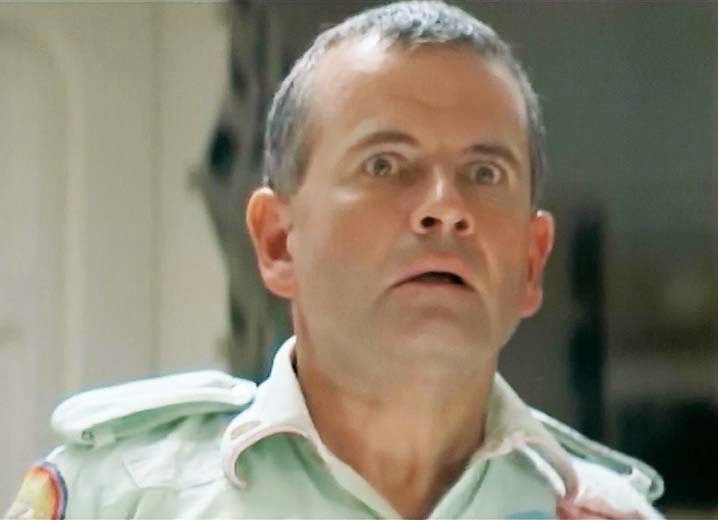
I think the ultimate tie-breaker lies in the famous chest-burster scene, where the alien fetus that was implanted in John Hurt's character "hatches" from its host. After the gore-covered creature scurries away from the rest of the crew, we see a close-up shot of Ash looking utterly horrified by what he's just witnessed. That was the creature that he was sent to obtain, and it did what he knew it was going to do. He literally came face-to-face with his directive -- and he was frightened by it.

Ash may not fully understand emotions, but he is certainly subject to them. He's aware enough to know that the events he's helping to unfold are not good, and even though he's capable of telling his crewmates about his secret mission and thus warning them (evidenced by his "dying" confession), he refrains from doing so. What's more, he goes out of his way to subdue and abuse Ripley, whom he's butted heads with all throughout the film, when she discovers his secret. Ash is not a mindless pawn. He is a villain.
And since I brought them up earlier, let's take a quick look at the Terminator, Agent Smith, and the HAL 9000.
The Terminator is an easy one. He's not a villain. In the first
Terminator film, he has no comprehension of human life or emotions, does strictly what he's programmed to do, and never questions it. It's only when he's reprogrammed in
Terminator 2 that he starts to understand humanity, but he's not even an antagonist anymore in that film. The T-1000 from
Terminator 2 is not a villain either, just another programmed antagonist. His behavior only seems more human because the T-1000 is a more advanced model than the original Terminator -- not because Robert Patrick is a better actor than Arnold Schwarzenegger.
Agent Smith in all three
Matrix movies
is a villain. Even in the first film, before he's disconnected from his programming system, he demonstrates a stronger sense of individuality and contempt for humans than his fellow agents do. In the "Humans are a virus" scene, he removes his earpiece, which allows him to share a collective consciousness with the other agents, so that he can speak to the human character Morpheus without the Matrix knowing. He was always able to think and act independently of his programming, even though how is never explained. The same can be said for the machines that control the Matrix, since the protagonist Neo is ultimately able to reason with them in the third film.
The HAL 9000 computer from
2001: A Space Odyssey is harder to pin down. He does have a mind of his own, but it's hard to tell whether or not he carries out his actions with malice. HAL doesn't have a face to read and he speaks without any vocal inflections, and since he's clearly capable of deception, it's uncertain whether or not his word can be trusted. Does he really mean it when he says he enjoyed working with the human characters and that he had no choice but to eliminate them? The film seems to suggest that he acted mainly out of fear because the crew posed a threat to their mission by deciding to deactivate him, and since he kills off most of the crewmembers in a painless way (by shutting off their life support systems while they were in hyper-sleep), I'm going to lean towards a non-malicious intent. HAL, in my opinion, is not a villain.
So that's my take on machines as antagonists. Now that we've picked apart all the technicals of the term "villain," we can move on to discuss their aspects and what makes some better than others. I'll see you in the next blog entry.