Showing posts with label one ring. Show all posts

Tuesday, July 19, 2016

The Appeal of Tom Bombadil

How you feel about certain elements in a popular series often depends on how you were introduced to the series as a whole. When it comes to a series like the Lord of the Rings trilogy that's been adapted across more than one medium, the fans who were introduced to it through the books tend to be more devoted to Tolkien's universe than the fans who were introduced to it through the movies. I'll admit upfront that I belong to the second group, and I think it's because of this that I've never quite seen the appeal of one of the books' more beloved elements: the character Tom Bombadil.

Appearing in only three chapters of the first Rings book, Tom Bombadil is a mystical, carefree fellow of unknown origins who wears yellow boots and a blue coat and spends his days wandering the Old Forrest while singing. He saves the hobbits a few times on the first leg of their journey, shows no interest at all in the One Ring, and then bows out of the story entirely with only a brief mention afterwards at the Council of Elrond. Like a lot of minor characters from the books, Bombadil gets left out of most adaptations, but he always seems to be the one whose absence people object to.

Why is that? He doesn't contribute all that much to the plot, and even by the books' own admission, he's so disconnected from everything having to do with the Ring that it's pointless to include him in the quest. What's more, having someone that lighthearted and silly pop up so early in the story almost harms the dark tone that it's trying to set. Again though, I'm someone who already saw the story play out fine without him on film before I read the book, so maybe I need to look at merry old Tom from a different angle to see his charm.


For starters, fans of Tom Bombadil probably like him more from a worldbuilding standpoint than from a storytelling one. Having the hobbits cross paths with someone who seems to come from a separate story makes Middle-earth feel like a much bigger place, and keeping Bombadil's origins a mystery opens up all kinds of fan theories about who or what he might actually be. As I've said in past essays, fan theories provide a more interactive way of enjoying a work of fiction, and since Tolkien mapped out so much of Middle-earth's history and mythos in his other writings, it makes sense that a rare enigma like Bombadil would intrigue so many readers.

Another explanation could be that his jolly, quirky demeanor makes him more unique and memorable. In a story full of brooding, angry, and depressed people, it does turn a few heads to see someone who's more upbeat among the cast. There's also something about an ageless, magical figure who's eccentric rather than stoic that people often find interesting. We've seen that type of character everywhere from Merlin the wizard in the King Arthur legend to the Cheshire Cat from Alice in Wonderland — even Mew from Pokemon, to be topical — and a lot of character complexity can be found in that contrast of age and youthfulness.

I think that the best explanation for Bombadil's appeal may lie in the story behind his creation. The character was said to be inspired by a doll with boots and a hat that belonged to one of Tolkien's children. After an incident where the doll survived getting stuffed down a lavatory (the Forbidden Pool, if you will), Tolkien was so impressed that he would often make up bedtime stories for his children about the doll's other adventures. The Hobbit also started out as a bedtime story, so when Tolkien came up with an idea for a sequel to the book, he decided to incorporate the doll-inspired Tom Bombadil into that followup.

Given their similar origins, it's only natural that Tom's scenes in The Lord of the Rings would have the same lighthearted tone as The Hobbit instead of the dark and serious tone of the sequel. It's also possible that the character is meant to ease that transition in tone, acting as one last callback to the more innocent times of Bilbo's adventure before the Nazgul come along and ruin everything. If this is the case, then his final mention at the Council of Elrond where the heroes decide not to involve him in the One Ring's destruction can be seen as an official goodbye to that innocence. That does kind of make it sad to see him go.

At the end of the day, I still think that the Lord of the Rings movies were smart to leave out Tom Bombadil. Film is a different medium that requires a tighter narrative than literature, so minor storylines such as his have to go. The fact that some of his lines are said by Treebeard in the Extended Edition of The Two Towers at least shows that Peter Jackson's team appreciated his character and wanted to have some nod to him in their version. I may not have the same attatchment to Bombadil as fans who discovered Middle-earth through the source material, but after looking at him through a wider scope and getting to know him better, I can appreciate him too.


Wednesday, February 17, 2016

What Comes First? The Hobbit or the Rings?


Prequels pose a rather unique challenge to writers and filmmakers. Not only do they have to tell their own coherent stories, but they also have to adequately set up the events of the installments that came before them. Since they take place earlier in the series, they often can't include a lot of familiar elements from their predecessors, yet they still have to be similar enough to those predecessors to keep from alienating fans. What's more, most books, films, and so on are created without any prequels in mind, and this lack of accommodation can really plague a prequel's storyline and form plotholes and inconsistencies in the overall series.

Peter Jackson's Hobbit films add a layer of confusion to this. Not only are they prequels to a film trilogy that had been made without any prequels in mind, but they're based on a book that was written without any sequels in mind -- sequels which were eventually written and adapted into the Hobbit films' predecessors. It's the book-to-movie equivalent of the "chicken or the egg" question, and this leads many to wonder if the Hobbit and Lord of the Rings film trilogies can really function as one six-film series. Can future audiences view the films in chronological order without confusion, or are they better off viewing the films in the order that they were made?

There are a few inconsistencies between the two trilogies, but not many, so let's get those out of the way first.

Only two notable characters had to be recast throughout all six films: Gloin the dwarf and Bilbo Baggins the hobbit. Gloin's recasting in The Hobbit creates no conflict whatsoever, seeing how he's never identified or given any lines throughout his one scene in the Lord of the Rings films, but Bilbo's recasting is a different matter.

Even though Ian Holm was available to reprise his role for The Hobbit, playing a younger and more able-bodied Bilbo would have been too difficult for him, so Martin Freeman was brought in. Holm still plays the older Bilbo at the beginning and end of the Hobbit trilogy, and while this fits with the way he looks in the Lord of the Rings trilogy, it does create a bit of a plothole.

See, one of the powers that the One Ring possesses is immortality, which prevents its bearer from aging for as long as they carry it. This is said to be the case with Bilbo in The Fellowship of the Ring, but in the Hobbit films, he clearly doesn't look the same age sixty years after finding the Ring. In fact, if you listen closely to the dialogue from Fellowship that's replayed at the end of The Battle of the Five Armies, Gandalf's line about how Bilbo hasn't "aged a day" is omitted from it.

The argument could be made that the Ring in the movies doesn't stop the aging process so much as it slows it down; after all, Gollum's appearance doesn't stay the same throughout his time with the Ring. However, it's still apparent that having Bilbo played by two different actors was not in the equation at the time that The Lord of the Rings was filmed. This is evidenced by the fact that Ian Holm does play the younger Bilbo in a flashback at the beginning of Fellowship, where we see him finding the Ring.


This leads to some other minor issues. Not only does that version of the younger Bilbo look and dress differently from the one in the Hobbit films, but the entire riddle game with Gollum is removed in that flashback. The scene jumps right from Bilbo picking up the Ring to Gollum screaming that his "Precious" is lost, something that Gollum doesn't realize until after the riddle game concludes in An Unexpected Journey. Future audiences will probably be able to tell that both scenes are depicting the same plot point, but the inconsistencies between them are bound to be a little jarring.

Gollum is another character who differs between the trilogies. Since Peter Jackson's team was still perfecting CGI motion capture in the early 2000's, Gollum was mostly kept out of sight in Fellowship. By 2011 though, his scenes were pretty easy to shoot and render. As a result, people who watch the six films in chronological order will get a Hobbit film where Gollum is shown as clear as day, a Lord of the Rings film where he's suddenly shrouded in mystery, and then two more Lord of the Rings films where he's plainly visible again.


This doesn't really detract from watching the films in that order, though. It just slightly lessens the impact of Gollum's reveal in The Two Towers and makes it easier for viewers to tell which order the two trilogies were made in. Gollum's buildup in The Lord of the Rings might even still work, since viewers are given two whole films to forget what he looks like in between his appearances in An Unexpected Journey and The Fellowship of the Ring.

There are other things that can play out strangely to viewers, especially when watching the Extended Editions. It's odd to hear Bilbo calling for Frodo in Bag End at the beginning of Fellowship's Extended Edition when he clearly saw Frodo leave Bag End at the beginning of Journey, and it's ironic that viewers don't get a clear explanation of what a hobbit is until after the Hobbit trilogy is over. A lot of major characters like Radagast, Thranduil, and Tauriel disappear with no explanation halfway through the series, and no mention of Balin's conquest of Moria is given prior to the Fellowship's decision to go there in The Lord of the Rings. People who forget what Moria is from all the way back in Journey might get confused about this plot thread. Once again though, these are minor issues.

With that said, let's discuss how the two trilogies do flow into each other.

As I've said before, the Hobbit films do a very good job of making the book's story and setting more consistent with The Lord of the Rings. Showing things like the One Ring's effect on Bilbo and Gandalf's relationship with other authorities in Middle-earth go a long way in connecting the trilogies, as does the more fleshed-out Necromancer subplot that foreshadows Sauron's return. It's important to illustrate that such dark powers exist in a prequel that is meant to set up a story about those powers. The lack of resolution with Bilbo's "magic ring" by the end of The Battle of the Five Armies also makes a strong case for watching Fellowship soon after.

The Hobbit's mentions of characters from The Lord of the Rings further help to bridge the gap between the film trilogies. Some feel that those mentions can be forced at times, but they do help to establish those characters' relevance in the long run. In case we forget who the minor character Gloin is by the time Gimli is introduced as "Gimli, son of Gloin" in Fellowship, we might remember Gimli's name from its prominent mention in The Desolation of Smaug; in case it seems odd for Legolas to be such good friends with a non-elf like Strider in Fellowship after watching the Hobbit trilogy, we'll remember his father telling him to seek out Strider at the end of The Battle of the Five Armies. Screenplays have to be a lot more tight-knit than books, so it's usually good practice for films to elude to story elements that way.

Lastly, it helps that the Hobbit films get darker and more serious to match the tone of The Lord of the Rings as they go on. This was partly by design and partly by necessity, since the Battle of the Five Armies and all of the major character deaths that result from it really couldn't have happened offscreen in the films like it did in the book. Because of this, the Hobbit films give us a comfortable transition from their light-hearted source material to the more grisly Lord of the Rings films.

And that brings us to our final verdict. At the end of the day, it's pretty obvious that the Hobbit film trilogy, while having its own identity, was meant to be viewed in order with the Lord of the Rings and not as a stand-alone series. The inconsistencies between the trilogies are all fairly minor, and they cease to be a problem roughly halfway through The Fellowship of the Ring. 

It's doubtful that Peter Jackson will ever go back and make changes to Fellowship to better match it with The Hobbit, and most fans of the series likely wouldn't want him to anyway. And really, he shouldn't. As far as prequels go, the Hobbit trilogy is a strong followup that ties in very well with its predecessors, and its shortcomings in that regard should be left intact just to highlight how few of them there really are. If the perfect prequel is unachievable, then the Hobbit films are three of the closer attempts at reaching that.


Wednesday, December 2, 2015

Is Gollum a Villain?


In a slightly more topical blog entry, I want to give my opinion on a rather interesting news story that's currently making its way around the Internet.

Apparently, a doctor in Turkey is on trial for posting a meme online that compares photos of Turkish president Recep Tayyip Erdogan to screencaps of Gollum from the movie The Two Towers. It's being seen as an attack on Erdogan's character since Gollum is not a very morally upstanding character, and the doctor who posted the meme could face prison time for it.

Since the judge who's overseeing the trial isn't familiar with the Lord of the Rings movies or the character, he actually assembled a team of experts in various fields who will determine if Gollum is really a villain, which will factor into whether or not the meme was meant to be offensive.

Here's a link to one article covering the story:
http://www.newsmax.com/TheWire/gollum-meme-jail-turkey/2015/12/02/id/704254/

Naturally, this got me thinking as well about whether or not Gollum is a villain. It's a topic that Tolkien fans have been debating about for decades, with some people saying that he is a villain, others saying that he's simply a victim, and some even saying that he's the true hero of The Lord of the Rings. I'm no expert on any of this, but in regards to the meme that led to this trial, here's my two cents:

Sam said it best about Gollum - "He's a villain." He kills people, plots to kill people, lies and manipulates people, eats people, and delights in causing pain. However, Gollum is not the only entity living inside of the bald, skinny creature that we see onscreen. There's also Smeagol, the sympathetic and decidedly helpful person that the creature used to be before he found the One Ring.

Here's the meme from that news story:


An easy way to distinguish the character's two personalities is by looking at the pupils of his eyes, which are small when he's Gollum and large when he's Smeagol. Of the three pictures shown above, only the first one shows the villainous Gollum personality. The other two show the good Smeagol personality, and they're both from scenes where the audience is meant to sympathize with him.

The question then, I suppose, is whether or not Smeagol ever becomes a villain in the story. We see Gollum more or less sway him into helping to betray the hobbits, and he certainly has no qualms about getting revenge on Sam for being mean to him, but he remains conflicted about hurting Frodo pretty much up until the end.

I think that the last we ever see of Smeagol in the movies is in Shelob's lair when Frodo finally tells him that the hobbits plan to destroy the One Ring. This is the final straw that breaks Smeagol's spirit once and for all, and even then, he isn't the one who lashes out at Frodo for it. You clearly see his pupils constrict as the Gollum personality takes over right before he gets up and jumps on Frodo. I always interpreted that as the good Smeagol side fading away once and for all because he's lost the will to oppose the Gollum side anymore, not as Smeagol becoming a villain.

In short, I think that the doctor who posted that meme has 2:1 favorable odds.

It should also be noted that the doctor claims that he only posted that meme to be funny. I can believe that; it's no more offensive than the hundreds of other comparison pictures that you see every day on websites like Totallylookslike.com. Heck, tons of people have been compared to pictures of Gollum on that site.


I won't get into why the Turkish Gollum meme turned into a court case while none of these others did, but it doesn't seem like any harm was meant by any of them. My only hope is that at least one Tolkien fan ends up on that team of experts or on the witness stand.


Monday, August 17, 2015

How Do You Talk to a Dragon?

By far one of the most iconic figures from any work of J.R.R. Tolkien’s is Smaug from 1937’s The Hobbit. While not the first treasure-obsessed dragon to terrorize villagers in the history of literature, Smaug is one of the most memorable and widely portrayed. This is possibly because he was one of the first and still one of the few who speaks. 

Dragons in fantasy traditionally don’t serve as characters, but rather as plot devices; they are obstacles without personalities or voices that are in the story for no other reason than to be vanquished by the heroes. Tolkien’s fiery villain, in contrast, is a character with a cunning and cocky personality that he frequently makes known to Bilbo Baggins and the readers by boasting of his abilities in words.


With that said, here’s my latest fan theory that I want to put to the test: that the Smaug played by Benedict Cumberbatch in the Peter Jackson Hobbit film trilogy does not in fact speak English.


One of the films’ more clever changes to the story of The Hobbit is the One Ring’s power to make its bearer understand the language of magical creatures while wearing it. We see this occur once in the second film, when Bilbo rescues his companions from a nest of giant spiders. This concept was obviously created as a means of being true to the source material, where Bilbo hears the spiders talking, while also keeping with the screen adaptation’s more realistic approach of not having any of the animals actually talk. What’s interesting about it though is that we clearly hear one of the spiders say something in English to Bilbo after he takes off the Ring. Some viewers may see this as a continuity error, but others see it as Bilbo retaining his ability to understand the creature's words once the Ring grants him with that power.


It’s possible then that the same thing occurs during his meeting with Smaug later in the film. Bilbo initially puts on the One Ring to conceal himself from the dragon, then he reluctantly takes it off when its power becomes too overwhelming. From there, the hobbit and Smaug share two conversations until the latter exits the Lonely Mountain to attack Lake-town. One wonders if either conversation would have taken place if Bilbo had kept the Ring in his pocket the entire time that he was in the mountain.

This theory gains a bit more weight when looking at Smaug’s scenes without the burglar. We see the dragon assault the city of Dale and take over the Lonely Mountain in the opening of the trilogy’s first film, but not once does he ever say anything during that massacre. The argument can be made that he’s too preoccupied with his task to comment on it, as it’s probably difficult to speak while breathing fire, and the filmmakers are clearly trying to keep him under wraps until Bilbo meets him. Still, from what we learn about Smaug in the next film, it seems odd that he would do something so catastrophic without bragging about it to the people he’s killing.

Smaug doesn’t say very much when the dwarves are trying to apprehend him in the second film either. The only times he ever seems to address anyone in those scenes is when Bilbo is present. He says a great deal to Bard the Bowman while attacking Lake-town, which Mr. Baggins is not present during, but upon closer inspection, that exchange doesn’t seem quite as interactive as the ones with the hobbit.

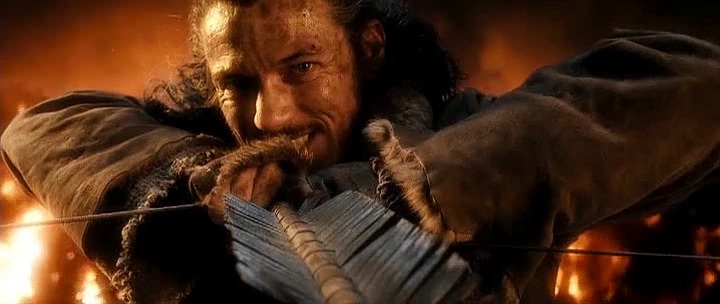
Bard never speaks to Smaug. He just goes about his business of preparing to fire his black arrow while the dragon taunts him. Again, it’s possible that the man is too preoccupied with what he’s doing to say anything (and really, what can anyone say to a dragon who just burned down their entire town?), but the notion that the audience is being allowed to hear something that he can’t in that scene holds up fairly well. Bard’s supposed reactions to some of the things that Smaug says could be seen as Smaug commenting on things as Bard is realizing them for himself.

For instance, the bowman looks at his son Bain after the dragon makes a comment about the boy; Smaug’s glare at Bain while making that comment would be enough indication that he’s taking note of the youngster and would give Bard enough reason to look at his son with concern. Also, Cumberbatch’s Smaug certainly seems like the type who would gloat at someone even when he knows they can’t understand him.

The only other person that the dragon speaks to, just before flying to Lake-town, is Thorin Oakenshield. The following lines are said:


THORIN: Here, you witless worm!
SMAUG: You.
THORIN: I have taken back what you stole.
SMAUG: You will take nothing from me, dwarf. I laid low your warriors of old. I instilled terror in the hearts of men. I am King Under the Mountain.
THORIN: This is not your kingdom. These are dwarf lands, this is dwarf gold, and we will have our revenge.
SMAUG: Revenge? I will show you revenge!


This could almost read as Thorin giving a separate speech to Smaug that just happens to be about the same thing as the dragon's speech to him, unbeknownst to the dwarf king. It would make sense for both characters to have similar mindsets like this since they’ve spent the past several minutes fighting each other for the mountain, and since Smaug's ability to understand English is not being questioned, it makes sense for him to give the appropriate reactions and responses to what Thorin says. However, Thorin's reply to Smaug calling himself King Under the Mountain can read as a comprehending dialogue between the two and is probably the strongest argument against the “Smaug doesn’t speak English” theory.

To still humor that idea though, this scene could perhaps be interpreted not as the dragon speaking English to Thorin, but as Thorin also having the ability to understand dragon speech.

Just look at the third Hobbit film. When it becomes clear to Thorin that he and his company will have to defend the Lonely Mountain from the Lake-town survivors and the Mirkwood elves, he sends a raven to his cousin Dain to call for reinforcements. The raven isn’t carrying any letters when it leaves the mountain, and since the dwarves are able to communicate with the ravens in the book, it has to be assumed that Thorin verbally gave the bird his message to deliver and Dain was able to understand the animal in order to receive that message. 


If the film dwarves are able to converse with one creature, then they may be able to converse with others. And who knows? It’s possible that Thorin’s susceptibility to dragon sickness could have given him the ability to understand Smaug, similar to how the One Ring may have given it to Bilbo. Durin's line is said to be more susceptible to dragon sickness than other dwarves are, and since none of the other members of Thorin's company attempt to speak with Smaug during their confrontation, it could be common knowledge among them that only their leader has the skill to do so. They may not know that dragon sickness is the cause of it, though.

By either of these rationals, Bard remains the one character out of the three addressed by Smaug who can't decipher the villain's words; the plot point of him learning of Smaug’s weak spot from the thrush is written out of the films, implying that this version of Bard can’t communicate with other species, and he of course is never corrupted by dragon sickness.


Whatever language Smaug does speak, he remains one of epic fantasy’s most outspoken dragons. He rightfully deserves his distinction as one of the most famous (or infamous) as well, and Cumberbatch’s eerily arrogant portrayal of him in the Hobbit film trilogy will no doubt be the most prevalent one in people’s minds for many years to come. If the above theory has intrigued anybody, then perhaps the regard of that portrayal will be just a little more open to interpretation — so to speak.


Friday, December 13, 2013

Is Smaug Really the Villain in 'The Hobbit'?


Well, I said this day would come! I've finally seen The Hobbit: The Desolation of Smaug, and it's time for me to talk about it. For my readers' sakes though, I'm going to keep the focus of this entry tied in with Villain Month instead of rambling aimlessly. Seeing how this movie is named after an iconic bad guy, I think I know what to discuss today:

Is Smaug really the villain in The Hobbit?

Let me clarify something -- Smaug is definitely a villain. He has a mind of his own and he deliberately kills and terrorizes people for his own selfish gain. What's up for debate here is whether or not he's the main villain in the story.

This especially becomes debatable looking at the Hobbit movies, where the story is now split into three parts. I don't want to give away any major spoilers for the second movie here, but let's just say that Smaug isn't going to be in the third one for very long. Audiences will go into the theatre next year and see a three-hour Hobbit movie that most likely won't have a dragon in its second half. It's pretty odd for a fantasy film to lose its biggest threat so early; imagine what Lord of the Rings would have been like if Frodo threw the One Ring into Mt. Doom at the halfway point of Return of the King. That story would have worn out its welcome rather quickly after that point, but The Hobbit manages to go on for quite a while without its great and terrible dragon. Could that be because Smaug isn't really the main villain?

He's certainly treated like he is. The scenes leading to his appearance build him up as the most horrible monster to ever plague Middle Earth and the only thing that's keeping peace and prosperity at bay in the world. Everyone that Bilbo, Thorin, and company encounter in the first movie and in this one warns them not to enter the Lonely Mountain (and tries to prevent them from reaching it) because they're afraid that Smaug will destroy everything if he's awakened. Granted, he does destroy quite a bit after waking up, but he's dealt with relatively quickly. To top that off, the story promptly moves on from him and then becomes about a number of other dilemmas that have risen over the course of the plot, many of which don't pertain to him.

Considering this, Smaug seems less like the main villain and more like a huge MacGuffin -- a mere plot device that was used to get the real story rolling. Smaug may in fact be the biggest and longest-staying MacGuffin in storytelling history. Even Marion Crane was gone within the first half of Psycho. Given what happens afterwards in The Hobbit, Smaug's removal from the tale seems to do nothing but make the treasure he was guarding suddenly accessible to every interested rival party.

So then who or what could be the real main villain in The Hobbit? The movies have heavily suggested the Necromancer, which really supports the idea that Smaug was just the story's cover-up for a far greater threat, but our knowledge of Lord of the Rings tells us that the Necromancer won't accomplish much by the end of the trilogy. The main villain also definitely isn't Azog the orc, who's been reduced to a prominent minion as of the newest film. It's not even the One Ring, despite the much more emphasized effect that it seems to have on Bilbo in the movies.

I was weighing these options in my head on the way home from the theatre when all of a sudden, it hit me: maybe The Hobbit has NEVER had a main villain. Maybe the biggest obstacle in this story is an antagonist. And then it all fell into place for me -- the greatest force of evil that the characters have to overcome in The Hobbit is the treasure.

Greed is an enormous running theme in this story. The dwarf king Thror's greed caused him to steal from his allies and build up the treasure hoard that attracted Smaug, Smaug himself was greedy enough to kill hundreds of people for that treasure, most of the people who offer to help Bilbo and the dwarves along the way only do so because they want a share of that treasure, and [a major character] eventually turns on Bilbo over a piece of that treasure. That mountain full of gold can be seen as the One Ring on a way larger scale, symbolizing all the corruption in the world and bringing out the worst in everybody who lays eyes on it, and Smaug can be seen as a way larger version of Gollum, the most corrupted victim of all.

So yeah, Smaug just went from main villain to main victim in my mind in the course of an evening. That isn't to say the character is any less imposing, just that he's not the type of character I used to think he was. Rest assured, he's well worth the price of an admission ticket if you have any desire to see Desolation of Smaug in theatres. And if treasure is the real antagonist, then look forward to a scene near the end where Smaug almost literally transforms into the main villain for a few seconds.

You'll know what I mean after you've seen it!