Showing posts with label bard. Show all posts

Tuesday, November 17, 2015

Top 5 Things the Hobbit Films Improved From the Book


November 17th, 2015 marks a milestone in the history of the Peter Jackson Middle-earth film series, in that it's the release date for the Extended Edition of the final Hobbit film, The Battle of the Five Armies. This is the last time that the fanbase gets to celebrate the release of any official version of any of the films, and in honor of that, I wanted to do something special this month.

It goes without saying that J.R.R. Tolkien's The Hobbit is a literary masterpiece, but because film is such a different medium from literature, a lot of changes did have to be made in the process of adapting the book for the big screen. While some of those changes have been controversial, some of them have actually made a lot of sense and strengthened the story in many regards. It can even be argued that the films handled some story elements better than the source material did, and I say that as someone who loves the book enough to collect copies of it.

Since both versions of all three Hobbit films can now be seen in all of their glory, I think it's only fitting to discuss what are, in my opinion, the top five things that they improved from the book.


#5


Consistencies with The Lord of the Rings


I put this one low on the list since 1) Tolkien had the excuse of writing The Hobbit as a stand-alone book with no plans of further developing its universe at the time, and 2) the differences between the two works are because of The Lord of the Rings being different from The Hobbit, not the other way around. Tolkien did make some revisions to The Hobbit after The Lord of the Rings was published, most notably to Bilbo's encounter with Gollum, but the two works remain very different in tone and in their presentations of Middle-earth--which is actually never given as the name of the setting in The Hobbit.

The Hobbit films make a point to show us that transition in tone, starting out lighthearted like the book and then slowly taking on the darker and grittier feel of The Lord of the Rings as they progress. They also remove some of the book's more whimsical elements, such as the talking purse that Bilbo tries to steal from the three trolls, to better match with the more realistic Rings.

In addition to that, the Hobbit films emphasize a lot of prominent elements from Rings that were largely glossed over or absent from the book, such as Sauron and the Rings of Power, the deep-rooted tensions between the elves and dwarves, and the One Ring's influence on Bilbo. It can be debated whether or not The Hobbit needs those elements in it as a stand-alone story, but now that it shares a universe with Tolkien's darker and more fleshed out works, I think it's good to tie the whole series closer together.


#4


Thorin's Plan
 

One of the strongest overall changes in the Hobbit films is Thorin's motivation for wanting to reclaim Erebor from Smaug. In the book, his main reason from the start is to steal back the treasure in the mountain, but in the movies, he starts out wanting to win back his people's homeland and only becomes greedy for the treasure after he reclaims the mountain. Since his goal in planning the quest is different in the adaptation, his strategy is different as well.

Thorin's plan in the book is to hire a burglar, send that burglar into the mountain over and over again to steal back the whole treasure one piece at a time, and then transport all of that treasure to a place that's far away from Smaug. Thorin's plan in the movies is to hire a burglar, send that burglar into the mountain to steal back the Arkenstone, use the Arkenstone to command the loyalty of every army in Middle-earth, and then lead those armies into the mountain to kill Smaug. Comparing these two plans, the one from the movies seems a lot more logical and has a much better chance of working.

To the book's credit, Bilbo does point out how flawed Thorin's idea to steal and relocate all of the treasure is. However, it's difficult for an audience to invest in characters who are that poor at planning ahead, especially when the thing that they're trying to get isn't terribly noble. In terms of the narrative structure, it's also more concise to have Thorin's plan center around the Arkenstone since the King's Jewel becomes so important later in the story.

Granted, his plan doesn't work out in either the book or the films, and since both versions of it do serve the purpose of showing Bilbo's cleverness and capability, it can be argued again that Thorin's plan doesn't matter. Still, I find the story a lot more engaging if Bilbo's company has a feasible strategy going into things.


#3


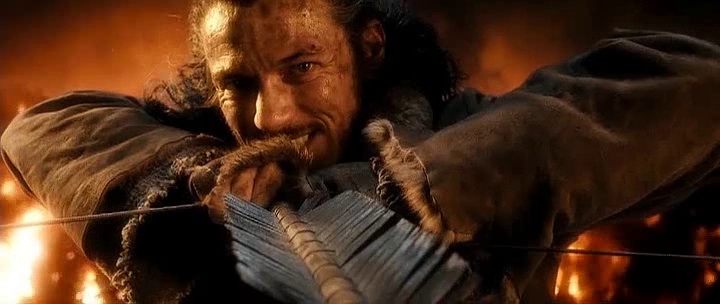
Bard the Bowman


A key principle of storytelling is that the better you establish a plot element before using it, the more justified its use will be. Considering this, I think it was very smart of the Hobbit films to introduce Bard the Bowman and his Black Arrow sooner than the book did.

Smaug's attack on Lake-town in the book is far from boring, but since it's also Bard's introduction scene, the readers only have the most general reasons for wanting him to kill the dragon. In contrast, letting the readers get to know him over the course of several scenes leading up to that point threatens them with a sense of loss if he fails, and that always raises the stakes. It's all the more beneficial to establish Bard as an important character prior to the attack on Lake-town because Smaug's death is such a crucial plot point in The Hobbit. Having an unknown person resolve one of the main conflicts in a story runs the risk of cheapening that resolution, even if the unknown person receives help from an important character.

I also think that giving Bard extra time for development makes his personality in the films more compelling than his personality in the book. Since we see what he's like and how he interacts with Thorin before Lake-town's destruction, we have a better understanding of where he's coming from when he demands a share of Erebor's treasure. What's more, it's easier to get behind him when we're introduced to him as someone who's witty and charming rather than someone who's just a voice of reason. All in all, I feel that the movies did a lot more with this character and made his purpose in The Hobbit much stronger for it.


#2


Bilbo and Thorin's Relationship


Bilbo's most important relationship in The Hobbit will always be the one he has with Gandalf, but in terms of him actually finding it in himself to grow as a character, his relationship with Thorin plays the biggest role. Thorin underestimates Bilbo while overestimating himself, which challenges and even forces Mr. Baggins to grow more courageous over the course of the story. While this dynamic between the humble hobbit and the proud dwarf king is of course explored in the book, it's shown mostly as a professional relationship that doesn't really become personal until their last few scenes together. In the films though, Bilbo and Thorin's relationship is a personal roller coaster that serves as the story's emotional backbone from beginning to end.

I can't stress enough how much more the movies focus on these two and complicate their relationship, and it all works perfectly. They hit every high and low imaginable, becoming friends a third of the way into the story and then constantly having their friendship tested, damaged, and repaired up until Thorin's death. It should be noted that a lot of the scenes dealing with their relationship were added to the story for the films, but even the scenes that come from the book are given more weight on screen and become more engaging, as well as more heartbreaking in a few cases.

The two biggest reasons for this seem to be that Bilbo in the films is much more affected by Thorin's criticism of him than in the book, making him more sympathetic and strengthening their conflict, and that the films give a lot more attention to Thorin's character arc than the book does. The book mentions Thorin's hardships of the past but doesn't really delve into how much they've affected him, whereas the films do that and more. We can sympathize with him as much as with Bilbo, and the fact that we can still see his nobility and optimism through his arrogance and bitterness makes us want to see him befriend the hobbit all the more. There's just a lot more meat added to the bones of what was in the source material, and at the end of the day, that makes for a heartier meal.


#1


The Dwarves


Maybe it's an obvious choice for #1, but it was apparent from the start that the films had made these characters way more interesting than the book had. Instead of thirteen largely interchangeable dwarves with varying beard and hood colors, the movies gave us thirteen very distinct individuals with unique personalities and appearances--most of which were conceived from scratch by the filmmakers themselves.

What's especially impressive about this feat is that the filmmakers did more with the dwarves than they really needed to. I've said before that Jackson's team could've easily just made each dwarf a one-note stock character and still given the audience more than the book did, but they took the time to develop these characters as much as possible and show more sides to each of them as the story went on. They didn't just want to make these dwarves entertaining, they wanted to make them realistic and relatable, and they were right to do that. These are the characters that drive the narrative, the people that Bilbo spends the most time with on his adventure and decides are worth risking his life for over and over again. He should form bonds with them over the course of the story, and in order for us to believe those bonds, it's important that we believe those characters.

Another reason why I made the film dwarves the #1 improvement from the book is because unlike the other things on this list, this one actually goes full circle to benefit the book. There are entire fanbases now dedicated to characters of Tolkien's who had virtually no fans prior to 2012, and anyone who reads The Hobbit after seeing the films will have an identity for each dwarf. They'll think of a prankster in a floppy hat when they read about Bofur tripping over Bilbo in Beorn's house; they'll think of an easygoing young warrior with knives hidden all over him when they read about Fili trying to spot the boat in the Enchanted River; they'll think of a pointy-haired thief and a fussy mother hen when they read about Nori and Dori bickering over leaving Bilbo at the bottom of their tree during the warg attack.

That's probably the greatest accomplishment of the Peter Jackson Hobbit films: they gave us something memorable that offers us a new experience when reading the book. They gave us a more colorful cast of characters to go on a quest with, which made the story as much about meeting new friends as it is about seeing new places and trying new things. In short, they added an extra dose to an already very exciting adventure.


Monday, August 17, 2015

How Do You Talk to a Dragon?

By far one of the most iconic figures from any work of J.R.R. Tolkien’s is Smaug from 1937’s The Hobbit. While not the first treasure-obsessed dragon to terrorize villagers in the history of literature, Smaug is one of the most memorable and widely portrayed. This is possibly because he was one of the first and still one of the few who speaks. 

Dragons in fantasy traditionally don’t serve as characters, but rather as plot devices; they are obstacles without personalities or voices that are in the story for no other reason than to be vanquished by the heroes. Tolkien’s fiery villain, in contrast, is a character with a cunning and cocky personality that he frequently makes known to Bilbo Baggins and the readers by boasting of his abilities in words.


With that said, here’s my latest fan theory that I want to put to the test: that the Smaug played by Benedict Cumberbatch in the Peter Jackson Hobbit film trilogy does not in fact speak English.


One of the films’ more clever changes to the story of The Hobbit is the One Ring’s power to make its bearer understand the language of magical creatures while wearing it. We see this occur once in the second film, when Bilbo rescues his companions from a nest of giant spiders. This concept was obviously created as a means of being true to the source material, where Bilbo hears the spiders talking, while also keeping with the screen adaptation’s more realistic approach of not having any of the animals actually talk. What’s interesting about it though is that we clearly hear one of the spiders say something in English to Bilbo after he takes off the Ring. Some viewers may see this as a continuity error, but others see it as Bilbo retaining his ability to understand the creature's words once the Ring grants him with that power.


It’s possible then that the same thing occurs during his meeting with Smaug later in the film. Bilbo initially puts on the One Ring to conceal himself from the dragon, then he reluctantly takes it off when its power becomes too overwhelming. From there, the hobbit and Smaug share two conversations until the latter exits the Lonely Mountain to attack Lake-town. One wonders if either conversation would have taken place if Bilbo had kept the Ring in his pocket the entire time that he was in the mountain.

This theory gains a bit more weight when looking at Smaug’s scenes without the burglar. We see the dragon assault the city of Dale and take over the Lonely Mountain in the opening of the trilogy’s first film, but not once does he ever say anything during that massacre. The argument can be made that he’s too preoccupied with his task to comment on it, as it’s probably difficult to speak while breathing fire, and the filmmakers are clearly trying to keep him under wraps until Bilbo meets him. Still, from what we learn about Smaug in the next film, it seems odd that he would do something so catastrophic without bragging about it to the people he’s killing.

Smaug doesn’t say very much when the dwarves are trying to apprehend him in the second film either. The only times he ever seems to address anyone in those scenes is when Bilbo is present. He says a great deal to Bard the Bowman while attacking Lake-town, which Mr. Baggins is not present during, but upon closer inspection, that exchange doesn’t seem quite as interactive as the ones with the hobbit.

Bard never speaks to Smaug. He just goes about his business of preparing to fire his black arrow while the dragon taunts him. Again, it’s possible that the man is too preoccupied with what he’s doing to say anything (and really, what can anyone say to a dragon who just burned down their entire town?), but the notion that the audience is being allowed to hear something that he can’t in that scene holds up fairly well. Bard’s supposed reactions to some of the things that Smaug says could be seen as Smaug commenting on things as Bard is realizing them for himself.

For instance, the bowman looks at his son Bain after the dragon makes a comment about the boy; Smaug’s glare at Bain while making that comment would be enough indication that he’s taking note of the youngster and would give Bard enough reason to look at his son with concern. Also, Cumberbatch’s Smaug certainly seems like the type who would gloat at someone even when he knows they can’t understand him.

The only other person that the dragon speaks to, just before flying to Lake-town, is Thorin Oakenshield. The following lines are said:


THORIN: Here, you witless worm!
SMAUG: You.
THORIN: I have taken back what you stole.
SMAUG: You will take nothing from me, dwarf. I laid low your warriors of old. I instilled terror in the hearts of men. I am King Under the Mountain.
THORIN: This is not your kingdom. These are dwarf lands, this is dwarf gold, and we will have our revenge.
SMAUG: Revenge? I will show you revenge!


This could almost read as Thorin giving a separate speech to Smaug that just happens to be about the same thing as the dragon's speech to him, unbeknownst to the dwarf king. It would make sense for both characters to have similar mindsets like this since they’ve spent the past several minutes fighting each other for the mountain, and since Smaug's ability to understand English is not being questioned, it makes sense for him to give the appropriate reactions and responses to what Thorin says. However, Thorin's reply to Smaug calling himself King Under the Mountain can read as a comprehending dialogue between the two and is probably the strongest argument against the “Smaug doesn’t speak English” theory.

To still humor that idea though, this scene could perhaps be interpreted not as the dragon speaking English to Thorin, but as Thorin also having the ability to understand dragon speech.

Just look at the third Hobbit film. When it becomes clear to Thorin that he and his company will have to defend the Lonely Mountain from the Lake-town survivors and the Mirkwood elves, he sends a raven to his cousin Dain to call for reinforcements. The raven isn’t carrying any letters when it leaves the mountain, and since the dwarves are able to communicate with the ravens in the book, it has to be assumed that Thorin verbally gave the bird his message to deliver and Dain was able to understand the animal in order to receive that message. 


If the film dwarves are able to converse with one creature, then they may be able to converse with others. And who knows? It’s possible that Thorin’s susceptibility to dragon sickness could have given him the ability to understand Smaug, similar to how the One Ring may have given it to Bilbo. Durin's line is said to be more susceptible to dragon sickness than other dwarves are, and since none of the other members of Thorin's company attempt to speak with Smaug during their confrontation, it could be common knowledge among them that only their leader has the skill to do so. They may not know that dragon sickness is the cause of it, though.

By either of these rationals, Bard remains the one character out of the three addressed by Smaug who can't decipher the villain's words; the plot point of him learning of Smaug’s weak spot from the thrush is written out of the films, implying that this version of Bard can’t communicate with other species, and he of course is never corrupted by dragon sickness.


Whatever language Smaug does speak, he remains one of epic fantasy’s most outspoken dragons. He rightfully deserves his distinction as one of the most famous (or infamous) as well, and Cumberbatch’s eerily arrogant portrayal of him in the Hobbit film trilogy will no doubt be the most prevalent one in people’s minds for many years to come. If the above theory has intrigued anybody, then perhaps the regard of that portrayal will be just a little more open to interpretation so to speak.


Monday, December 22, 2014

Thoughts on Alfrid

Now that we've had time to absorb The Hobbit: The Battle of the Five Armies, I'd like to discuss one particular element of the film today. The character Alfrid (played by Ryan Gage) has had a largely negative reception from viewers, being seen by many as an irritating and pointless addition to the story. Being invented solely for the movies and having a strong resemblance to the character Grima Wormtongue from The Lord of the Rings have never helped his case. It's tough to disagree with the complaints about him in the latest Hobbit movie, but perhaps fans, like the survivors of Laketown, shouldn't be too quick to dispose of him.

I actually found Alfrid really interesting in The Desolation of Smaug. Even in the theatrical cut where a lot of his scenes are omitted, you can tell he has his own agenda. There's something about the way he speaks to the Master of Laketown, watches the other man's reactions, and behaves when the Master isn't looking that suggests he hates the disgusting windbag and is just using him as a puppet to control the town. It's a real testament to Gage's subtlety as an actor.

You would think then that the Master's death at the start of The Battle of the Five Armies would allow Alfrid to step out of the shadows and shine as a character. Instead, the film reduces him to a string of punchlines until he scurries off. He doesn't learn anything, he doesn't oppose the heroes, he just reminds us that he's a jerk and runs off in a dress. Why make a point to spare him from Smaug and the other townspeople if the plot isn't going to make use of his survival?

Granted, this might be smoothed out in the Extended Edition next November. That's a long time from now though, and since I've got this cemented in my head, here's my personal take on what the movie could have done with the character:

After falling out of favor with the townspeople, Alfrid starts contemplating how to win back their approval while grudgingly following Bard's orders in the meantime. He eavesdrops on the meeting where Bilbo gives the Arkenstone to Bard and Thranduil, then just like in the movie, Gandalf forces him to look after the hobbit. This of course ends with Bilbo promptly escaping from Alfrid, which makes the man look even worse and gives him a personal reason to resent Mr. Baggins.

Later, when Bard reveals to Thorin that he has the Arkenstone and Bilbo prepares to explain his role in it, Alfrid steps forward from the crowd. He informs Thorin of Bilbo's actions and describes them in the most dastardly way possible. This feeds Thorin's paranoia to the point that when Bilbo explains himself truthfully, the dwarf king refuses to believe him. Bard angrily asks Alfrid what he's up to, and Alfrid explains that exposing a traitor among Oakenshield's company will make the dwarves violently turn on each other, thus removing the need for a battle.

That's Alfrid's plan to win back the townspeople's approval -- to be the one who got them the gold and prevented war. His triumph is short-lived though, as Gandalf intervenes to save Bilbo and then the orc army arrives gung-ho for a fight anyway. No longer seeing a future for himself among the survivors of Laketown, Alfrid lies low during the battle and flees with his stolen gold at the first opportunity.

It's possible that something along those lines could happen in the Extended Edition. Philippa Boyens said in the commentary for The Desolation of Smaug that Alfrid's character is supposed to "blossom" in the third film, which doesn't seem to have happened yet. Some may cringe at the thought of him getting even more screentime, but as we saw with Beorn's introduction in the last film, sometimes material in a theatrical cut gets removed from the Extended Edition to make way for a better alternative.

And just for the heck of it, here's a crazy fan theory to walk away with: maybe in the movies, Alfrid is Grima Wormtongue's father.


They look, sound, and act a lot alike, right? Wormtongue has a vastly different appearance from the other Rohan natives, and sixty years do pass between the two film trilogies. Perhaps after slipping away from the battle, Alfrid found his way to Rohan, changed his name to Galmod for good measure, and found a woman stupid enough to marry him. Having a ton of cash on him probably helped in that department. The end result was Grima, who apparently followed his father's example and attached himself to two powerful figures.

And as for Grima's creepy habits with women...well, he probably overheard a few arguments between his parents about whose dress from Laketown that was in the closet.