Showing posts with label jack sparrow. Show all posts

Wednesday, July 31, 2019

The Dog Brain of Ragetti & the Secret Success of Pintel


The characters Pintel and Ragetti from the Pirates of the Caribbean franchise are no strangers to my blog. I've discussed a few things about them in past entries, mostly on how their actors and the screenwriters view them, but I've never delved into any serious analysis of the characters themselves. As hard to believe as this sounds, I actually think there's a lot to analyze about this comic relief duo, even if most of what you come up with probably wasn't intended by the writers.

Intended or not, the fact stands that in the three Pirates films that feature Pintel and Ragetti, we see a surprising amount of growth in both characters. Since the films rarely explain any of that growth, the door is left wide open for fans to speculate and fill in the narrative gaps. This essay is my own interpretation of Pintel and Ragetti's character arcs throughout the series, and if there's any truth in what I've gathered, then their subplot could be one of the more meaningful ones in the original trilogy.

Played by Lee Arenberg and Mackenzie Crook, Pintel and Ragetti first appear in Pirates of the Caribbean: The Curse of the Black Pearl as two members of Captain Barbossa's evil, undead pirate crew. At first they seem like your typical dim-witted henchman duo, but throughout the movie, we get a lot of hints at their personalities, their backstories, their thoughts on their situation, and most importantly, their relationship with each other.


As far as that goes, there are three important things to notice:
1. Pintel and Ragetti are always together
2. Pintel frequently loses his temper and lashes out at Ragetti
3. Ragetti acts like a dog 
I don't mean that Ragetti's lewd, either. I mean that he literally barks and growls at people whenever he gets angry or excited. He also shrinks back with his head down in a very tail-between-the-legs manner whenever Pintel yells at him. He doesn't talk much in Curse of the Black Pearl, but often when he does, it's just to chime in with Pintel. Given that Pintel hits him with a parasol and throttles him purely out of embarrassment at two points in the film, you can kind of see why Ragetti tries to be so obedient.  

The only time we see another side to their relationship is roughly halfway through the film, when Barbossa's crew tries using the heroine Elizabeth Swann to break their undead curse. Right before the proceedings, the crew sorts through the piles of treasure around them, and Pintel and Ragetti more or less have a moment alone to talk. Pintel is curiously sympathetic towards Ragetti, assuring the one-eyed pirate that he can buy a glass eye once the curse is lifted and then patiently chiding him when he rubs the splintery wooden one that he does have. During the curse-lifting ritual, Pintel is seen leaning over Ragetti's shoulder at the front and center of the crowd and playfully nudging his arm to keep him excited about what's happening.


To me, Pintel comes across in these scenes like a guilty parent trying too hard to make up for letting their child down. There's sincerity there, but also a slightly selfish motive behind it. We don't know if he and Ragetti are really uncle and nephew like their actors say, but Pintel is obviously the mentor/decision maker in this relationship. Perhaps he feels responsible for getting his younger companion into this mess with the curse, and perhaps he believes he can clear his conscience by helping Ragetti have a better life after it's over.    

The problem in the meantime seems to be that they're in a situation where Pintel feels he can't afford to look weak. Barbossa and the rest of his crew are frequently shown to be bullies, needlessly mistreating their captives and sometimes turning on each other, and Pintel and Ragetti appear to be at the very bottom of the Black Pearl's ranks. As fond as Pintel is of pillaging, plundering, and shooting people in the face, we see that he's terrified of the crew's first mate Bo'sun  and because of Bo'sun's authority, that can make Pintel fear the entire crew at times. It's conceivable that he and Ragetti always stay close together for security as well as company, and that at least some of Pintel's vicious persona is just a front that he puts up to avoid harassment.

He drops the act during his talk with Ragetti in the treasure cave because despite the rest of their crew being present all around them, no one's really paying attention to them at that exact moment. As soon as Bo'sun walks by and sees them holding the frilly parasols that they've found though, Pintel panics and hits Ragetti with his parasol as mentioned before. The reason he throttles Ragetti later is because Bo'sun has ordered them to distract the British Navy by dressing up as women, and Ragetti makes him feel even more insecure by complimenting the way he looks in a dress.

Slapstick comedy aside, Pintel and Ragetti's relationship is not a healthy one. Ragetti's doglike demeanor (his "Dog Brain" if you will) is most likely a defense mechanism from all the abuse and trauma he's suffered, and unlike Pintel's murder-hungry rage, it doesn't seem to be an act. Pintel has contributed to Ragetti becoming a poorly adjusted, socially inept man with low self-esteem who can barely think for himself. That's not going to give him a better life after the curse is over.


We last see the duo getting outwitted by the hero Jack Sparrow and then arrested by the Navy right as their curse is finally lifted. In the second film, Dead Man's Chest, we first see them rowing through the ocean in a longboat with the jailhouse dog as they discuss how they escaped from prison. This takes place one year after the first film, and we get a very different Pintel and Ragetti this time around.

Here are the three important things to notice in Dead Man's Chest:
1. Ragetti is less doglike and more well-spoken than before
2. Ragetti constantly talks back to, argues with, and defies Pintel
3. Pintel never punishes Ragetti for it
He still yells at Ragetti a lot like he did in the first film, but he doesn't physically harm him anymore. And let's face it, doing that could very easily revert Ragetti back to his old self. It's possible the writers just made these changes to make Pintel more likable and Ragetti more three-dimensional since they join the heroes in this film, but this dramatic character growth can be explained in the context of the story.

For someone as naive as Ragetti, being thrown in jail with a guarantee of hanging has to be earth-shattering. It's the complete opposite of all the great things Pintel told him were going to happen after they broke their curse. What did they do to deserve something this awful instead? Ragetti probably had time to realize what they'd done to deserve it, and with all his pirate aspirations in ruins and death on the horizon, he probably turned to the only salvation he could find: religion.

Hence the Bible that he's trying to read in Dead Man's Chest (which he probably stole, by the way). His "beliefs" are flimsy at best, often getting twisted to justify the crimes that he and Pintel keep committing, but he still seems convinced  that "divine providence" was what broke them out of jail. Pintel disagrees, saying that he was what broke them out, but Ragetti doesn't relent. And why should he? Pintel was wrong about what would happen to them after the curse was lifted, so maybe he's wrong about a lot of other things. Ragetti might see it as his duty now to teach Pintel some humility and eventually steer him away from the sinful life of a pirate. This gives Ragetti some confidence, and that makes him rebellious. And I think for all his annoyance, Pintel lets him rebel because he sees it as a good thing.

If Pintel really did feel guilty for involving Ragetti in their curse, he probably also felt guilty for getting him thrown in jail  so guilty, perhaps, that it pushed him to break them out. He probably also did that to save himself, but the fact that he's stopped mistreating Ragetti (thus allowing the younger man to give him grief all the time) says a lot about his own growth. Maybe he doesn't feel the need to act tough anymore now that they're rid of Barbossa's crew. Maybe lifting the curse and losing his immortality has made him so afraid of death that he doesn't mind having a bolder sidekick to watch his back now. Or maybe he's gained some perspective since their arrest and really is trying to rein in his temper for Ragetti's sake. In the little way that he can, maybe Pintel is still trying to make life better for his friend.

Whatever the reason for this restraint, it does seem to be making a positive difference. Along with speaking up and acting out more often, we also see Ragetti perform a few duties aboard the Black Pearl without Pintel, including a hazardous one that involves clinging to the outside of the hull to hold a longboat in place during a storm. By the end of the film, he's built up enough nerve to save Elizabeth from the giant Kraken squid by chopping off one of its tentacles. He never would have taken a risk like that in the first movie.


Not that Ragetti's Dog Brain is completely gone. We see him slip back into it twice in Dead Man's Chest, both at times when he's overwhelmed with emotion. As he and Pintel move in to fight Elizabeth for the titular chest, he sticks out his tongue like he's panting and goes back to mumbling and repeating what Pintel says. During the Kraken assault at the climax, he stops talking altogether and cowers close to Pintel for most of it. These moments seem to suggest that his more mature demeanor hasn't fully found its roots yet.


And this brings us to the third film, At World's End.

I've complained in the past about how this film handles Pintel's character, especially compared to how much better it handles Ragetti's. I still take issue with some of it, but I do feel like it plays out better if you watch it with this interpretation in mind.

We first see Pintel and Ragetti with three other members of Jack Sparrow's crew as they sneak into a building through a basement sewer. Ragetti is leading the mission, impressively enough, but when they enter the basement and a huge guard walks into view, his Dog Brain sends him running to hide behind Pintel again. This time though, the first mate Gibbs intercepts him. Gibbs says they don't have time for that kind of behavior anymore, then shoves Ragetti to the front of the line again.

After this, we start to notice three new dynamics with Pintel and Ragetti's relationship:
1. Ragetti spends more time on his own
2. Pintel spends more time with Gibbs
3. Pintel frequently follows Ragetti's lead without any arguments 
We don't know if these changes have been in place for a while since the second film or if the confrontation with Gibbs suddenly triggered them. Either way, it's interesting to see Pintel spending less time with his closest friend and more time with a former enemy. It's also interesting that in spite of his growing desire to become the Black Pearl's captain, he's willing to go along with Ragetti's ideas and let Ragetti do a lot of the talking for them in this film.

Pintel could just be so overwhelmed by everything in At World's End that he's content to go with the flow for now, even if it means giving Ragetti the oars, but I also think he agrees with Gibbs that Ragetti needs to grow more independent. It could be that letting his younger pal have more space and responsibility is his way of helping that to happen, and that warming up to the Pearl's first mate in the meantime is him trying to further secure a better future for them. The fact that the duo barely argues anymore also says volumes about Pintel's anger management progress since the first film.

Take the scene where the pirates escape from Davy Jones' Locker by turning the Pearl upside-down. Not only does Pintel humor Ragetti's plan to tie themselves to the mast as the ship tips over, but he also keeps a pretty level head after that plan turns out to be terrible. What's more, when this watery escape ruins their gunpowder, Ragetti clunks him on the head with his pistol to practice wielding it as a club instead and Pintel doesn't hit him back. This is the same man who once throttled Ragetti just for telling him he looked nice in a dress. Pintel doesn't even yell at his friend for the pistol incident. He just simmers for a few seconds, then lets it go. If that isn't proof of how much their relationship has changed since Curse of the Black Pearl, I don't know what is.

And just like in Dead Man's Chest, this new approach seems to pay off in the end. The two main obstacles that Ragetti has to overcome in At World's End are his Dog Brain and his fear of people, which are both represented to him by Captain Barbossa. The former cursed captain joins the crew again in this film, and with him comes a whole boatload of Ragetti's old insecurities. Not being allowed to hide behind Pintel all the time anymore probably makes that all the more harrowing.
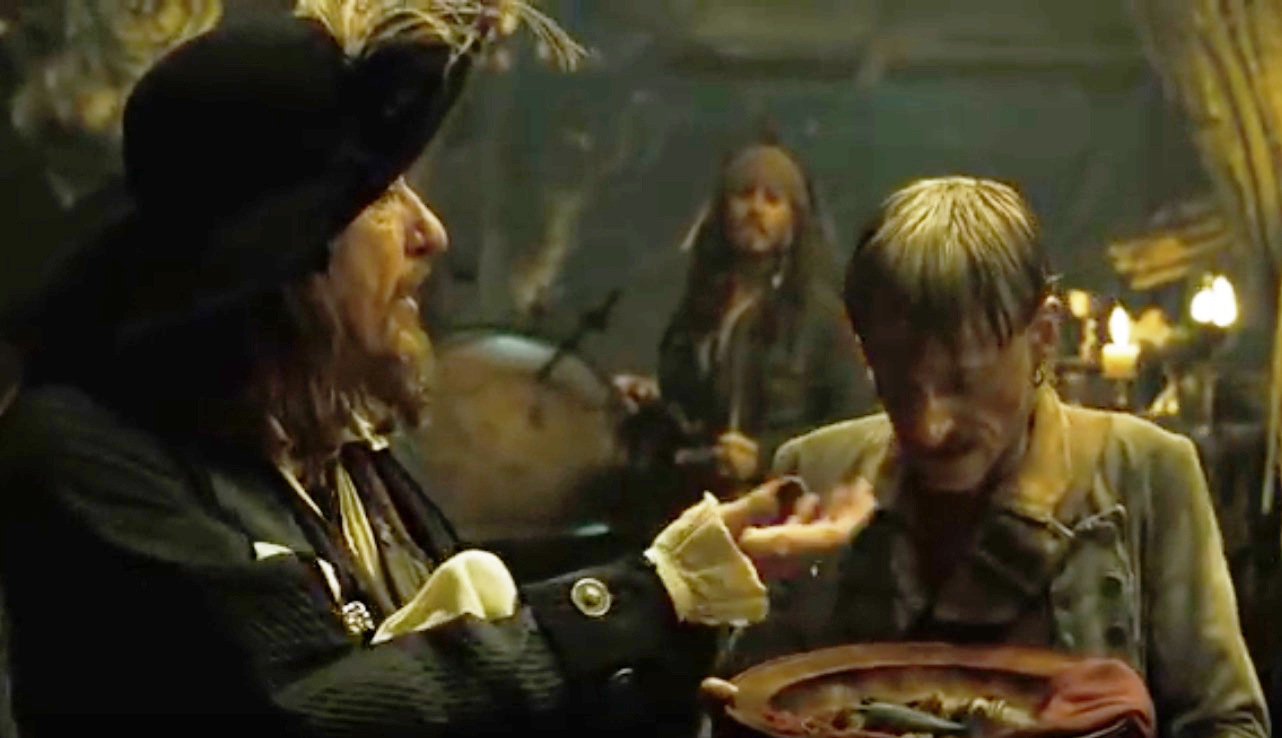

But after days of being pushed around, slapped around, and even made to give up his wooden eye by Barbossa, Ragetti finally summons just enough courage and confidence to show up his tormentor right before the film's climax. This involves freeing the sea goddess Calypso from her human form by reciting an incantation, which he points out that Barbossa had failed to do properly. Once he frees Calypso, Ragetti also becomes free himself. He's free of his Dog Brain, free of his fears, and is now a stronger, braver, and more capable man.

I used to dislike how Ragetti gets this big moment (and several others) all to himself in At World's End while the biggest moment Pintel gets is a throw-away scene of him chickening out after yelling at Jack and Barbossa. It just felt like the writers were sidelining him and scrapping the duo concept for no good reason. However, if his underlying arc really is about him reforming so he can see his friend better off, then Ragetti's success with Barbossa and Calypso is Pintel's success as well. That big triumphant moment secretly belongs to both of them. It's theirs to share as a duo after all.

The only downside is that Calypso doesn't end up saving the pirates like they'd hoped she would. Once she's free, she just abandons them and creates a maelstrom to add chaos to the final battle. We even get a moment where Pintel looks down over the ship's rail and laments that "she's no help at all," almost like he's disappointed for Ragetti. Despite this, the two pull themselves together for the final battle. They help to win it, part ways with the heroes when it's over, and then go back to their usual pirates' lives. The difference this time is that they seem to be working together to move their ways up in the ranks now.

Pintel and Ragetti were supposed to appear in the fourth film, but for various reasons, that didn't end up happening. The Pirates of the Caribbean Wiki site claims that their subplot would have involved them getting separated, each thinking the other was dead, and then reuniting by the end. As nice as it could have been to see their relationship finally get some dramatic focus, I don't think it's needed. Pintel and Ragetti's story on screen ends with them standing side by side as equals on the deck of the Black Pearl, carving a new wooden eye and possibly plotting a mutiny against Barbossa. And since it's been shown that other crew men have survived what happens to the ship before the fourth film, we can assume that the duo did as well. All in all, it's easy to interpret a better life for both of them on the horizon.


Monday, June 20, 2016

Of Blank Slates and Second Bananas


I saw the movie Watership Down for the first time a few months ago (right before Easter, which made all those cards with bunnies on them suddenly look very morbid). For anyone not familiar with the story, it's about a group of rabbits led by the brothers Hazel and Fiver who leave their old warren to start a new one and encounter several predators and enemies along the way. It's one of the darkest and most highly acclaimed children's movies ever made, and while I did love it, there's one nitpick about it that bugs me every time I watch it.

The rabbit Hazel is treated as the main protagonist in the story. Everyone hails his leadership skills throughout the film, he orchestrates the plan to defeat the villains during the climax, and he gets the big heroic sendoff in the final scene. What bugs me is that I don't quite understand why he's the main protagonist. He's not a particularly interesting character, and while he does have the main conflict to deal with, he doesn't really have a personal story arc. His brother Fiver, on the other hand, is a runt who gets pushed around by the rabbits in the old warren and whose connections to the spirit world help him to see the future and point the group of deserters towards their new home. Fiver is the underdog with a unique ability who incites and drives the story. He's a much more compelling and pivotal character, so why is it Hazel who gets the ultimate spotlight?

This isn't the only case of a sidekick being more interesting than the designated protagonist in a story. Eli Wallach's character Tuco Ramirez in The Good, the Bad, and the Ugly is much more colorful and engaging than Clint Eastwood's character Blondie, yet it's Blondie who always gets the last laugh as the hero with a plan up his sleeve. There's also Dennis Dun's Wang Chi in Big Trouble in Little China, who follows the lead of Kurt Russell's Jack Burton despite having more at stake. Heck, even James Bond is pretty one-dimensional compared to most of the assistants, contacts, and love interests that he's had over the years. It's odd from a writer's viewpoint to see so many dynamic figures forced to be second bananas to stiffer and blander ones, so why do so many authors and screenwriters do it?

The most likely reason is because characters like Hazel, Blondie, Jack Burton, and James Bond are more serviceable to audiences than their sidekicks are. They have less distinct personalities, so it's easier for us to project ourselves onto them and pretend that we're the ones living their lives. This type of character is often referred to as a Blank Slate, and while they're still commonly used in storytelling for the above mentioned reason, we do see a shift in their role as the protagonist every now and then.


Just look at the Pirates of the Caribbean movies. At first they seem to present another case of a Blank Slate protagonist who's going to have a dynamic sidekick, but Will Turner quickly gets demoted to a helper after he meets Captain Jack Sparrow. The two spend the rest of the original Pirates trilogy pretty much competing with each other to be the main protagonist, then Will drops out of the series altogether in the fourth film and Jack has the stage to himself. It's almost like the screenwriters were afraid to make Jack the hero at first and gave him a more standard counterpart to be safe, then when they saw how popular he was with audiences, they took off his Will Turner training wheels and edged him into the leading role. Sources say that Will is supposed to return in the fifth Pirates film, though it's unclear whether or not Jack will have the same relationship with him as before.

Another supporting character who famously became the protagonist in his film series is Peter Sellers's Inspector Clouseau, who first appeared in the 1963 crime comedy The Pink Panther. In that film, the protagonist is a jewel thief named Sir Charles Lytton who attempts to steal a famous diamond while Clouseau is simply a detective who investigates its disappearance. Clouseau was technically an antagonist in that movie, but his bumbling persona was so memorable that he took over as the hero in the next five installments of the series, though not always played by the same actor. That's not even counting the two reboot films from 2006 and 2009 that featured Clouseau in the lead with no mention of Lytton. Once again though, this more engaging character had to be broken in with training wheels before he was allowed to be the protagonist.

Judging from these examples, audiences seem to like having more memorable main characters. The recent criticism of Twilight's Bella Swan and poor performance of Hardcore Henry, an action film shot entirely in the first-person point-of-view, also seem to suggest that a lot of readers and filmgoers want more than a Blank Slate to project themselves onto. So again, why are so many three-dimensional characters relegated to sidekicks and supports for one-dimensional ones?

I was wracking my brain over this when a crazy idea finally came to me: maybe a lot of writers do this not because they want audiences to imagine being the protagonist, but because they want audiences to imagine being with the sidekick. Maybe characters like Blondie and Will Turner exist so we can experience what it's like to spend time with people like Tuco Ramirez and Jack Sparrow. Maybe Hazel the rabbit really just exists so we can observe and try to understand a character as mysterious as Fiver.

Whatever the case, it's still nice to see a second banana grow ripe and get picked every once in a while -- or a second carrot, if Watership Down ever gets any sequels.


Tuesday, April 9, 2013

Fanfiction Friction

I don't know if this is something to be embarrassed by or not, but I have a confession to make: I used to write fanfiction. A lot.

For those of you who don't know, a fanfiction ("fanfic" for short) is a piece of literature that ties in with a movie, book, TV show, etc. and is written by a fan of that franchise rather than the official writer or writers. It can be anything from a short poem to a novel-length story with multiple chapters, and it usually centers around pre-existing characters from said franchise. Anyone can write one, and there are entire websites such as Fanfiction.net, Deviantart.com, and Justexpressing.com that are dedicated to sharing them.

So why is it semi-embarrassing for one to admit that they write fanfiction? Well, there are two main reasons. The first is that, as stated before, anyone can write it - including people who simply can't write. For every decent fanfic out there, there's probably a hundred terrible ones, so the practice is usually viewed as a joke among serious writers. It doesn't help that a large portion of those terrible stories are full of idiotic romance (often with fan-made characters who are obviously stand-ins for the fanfic writers themselves) and loads of disgustingly detailed smut. I've never put anything like that in my stories, and that seems to make fanfics like mine a rarity.

The second reason, which I do take some blame for, is that fanfiction tends to be a huge waste of time and effort. You spend days, weeks, months, and sometimes even years writing a story that you can't publish once it's finished because it's about characters whom you don't own the rights to. Sometimes you can change their names and make a few other adjustments to turn out something original, like E.L. James did for Fifty Shades of Grey, but normally the details are so specific that there's no way to cover up who the characters are supposed to be. I have four or five novel-length fanfics out there, and only one of them has a chance of becoming an original work that I can publish. My Kindle library could be almost triple the size it is now if I wasn't so obsessed with Lord of the Rings, Pokémon, and Pirates of the Caribbean in high school.

At the same time though, there are some benefits to writing fanfiction. If you're serious about it, it can be a great exercise tool. I can honestly say that my writing style, character development, and overall storytelling skills have improved ten times since Deer Lake, and that's thanks to practicing on fanfics and getting constant feedback from online readers. Feedback isn't something you get on a regular basis when working on a book. The only downside is that when you write about characters that have previously been established in other works of fiction, you don't get much practice at creating any from scratch. That's why it's hard to get away from writing fanfics and focus solely on original works; you get more story ideas for characters that you already know.

So the question for anyone else in this position is, how do you make that transition? How do you take that urge to write about your favorite fictional characters and harness it to help you create your own great work? The answer is fairly simple: trick your brain into thinking that you're still writing fanfiction.

For instance, if you're a huge Jack Sparrow fan, then come up with a character for your book that exhibits Jack-Sparrow-like personality traits, then picture him in their place every time you write a scene for them. It doesn't matter if your character looks nothing like him, just picture him in their place anyway. Ask yourself how Jack would react to the situation in the scene you're writing, and the ideas will most likely come to you. The goal is that eventually your character will outgrow their Jack Sparrow training wheels and take on a life of their own. You might even decide to go back and change some of their earlier scenes to make their behavior more like your re-envisioning of them and less like Captain Jack. I do this all the time with my characters, and so far, it's worked very well.

Another strategy that I've recently started to use is "reassigning" fanfiction scenes. Suppose a really interesting scene for a potential fanfic just materializes in your head one day. Instead of writing it about Jack Sparrow or whomever you picture as the subject, look at the cast in your book and decide who among them is most like the person in that scene. Make a few adjustments to the scene, and you've suddenly got a really interesting moment in your book. I took a bunch of ideas for things I'd like to see in the next Hobbit movie and turned them into what I think is a funny and heartfelt mini plot for Part 2 of my sci-fi/fantasy series. Heck, I've even got half of an outline for a Pokémon fanfic that I'm in the process of developing into a prequel to my series.

Bottom line, fanfiction can be both a curse and a blessing to writers in this day and age. The trick is learning how to rein in that wild horse so it can pull your carriage and get you rolling.