Showing posts with label curse. Show all posts

Wednesday, July 31, 2019

The Dog Brain of Ragetti & the Secret Success of Pintel


The characters Pintel and Ragetti from the Pirates of the Caribbean franchise are no strangers to my blog. I've discussed a few things about them in past entries, mostly on how their actors and the screenwriters view them, but I've never delved into any serious analysis of the characters themselves. As hard to believe as this sounds, I actually think there's a lot to analyze about this comic relief duo, even if most of what you come up with probably wasn't intended by the writers.

Intended or not, the fact stands that in the three Pirates films that feature Pintel and Ragetti, we see a surprising amount of growth in both characters. Since the films rarely explain any of that growth, the door is left wide open for fans to speculate and fill in the narrative gaps. This essay is my own interpretation of Pintel and Ragetti's character arcs throughout the series, and if there's any truth in what I've gathered, then their subplot could be one of the more meaningful ones in the original trilogy.

Played by Lee Arenberg and Mackenzie Crook, Pintel and Ragetti first appear in Pirates of the Caribbean: The Curse of the Black Pearl as two members of Captain Barbossa's evil, undead pirate crew. At first they seem like your typical dim-witted henchman duo, but throughout the movie, we get a lot of hints at their personalities, their backstories, their thoughts on their situation, and most importantly, their relationship with each other.


As far as that goes, there are three important things to notice:
1. Pintel and Ragetti are always together
2. Pintel frequently loses his temper and lashes out at Ragetti
3. Ragetti acts like a dog 
I don't mean that Ragetti's lewd, either. I mean that he literally barks and growls at people whenever he gets angry or excited. He also shrinks back with his head down in a very tail-between-the-legs manner whenever Pintel yells at him. He doesn't talk much in Curse of the Black Pearl, but often when he does, it's just to chime in with Pintel. Given that Pintel hits him with a parasol and throttles him purely out of embarrassment at two points in the film, you can kind of see why Ragetti tries to be so obedient.  

The only time we see another side to their relationship is roughly halfway through the film, when Barbossa's crew tries using the heroine Elizabeth Swann to break their undead curse. Right before the proceedings, the crew sorts through the piles of treasure around them, and Pintel and Ragetti more or less have a moment alone to talk. Pintel is curiously sympathetic towards Ragetti, assuring the one-eyed pirate that he can buy a glass eye once the curse is lifted and then patiently chiding him when he rubs the splintery wooden one that he does have. During the curse-lifting ritual, Pintel is seen leaning over Ragetti's shoulder at the front and center of the crowd and playfully nudging his arm to keep him excited about what's happening.


To me, Pintel comes across in these scenes like a guilty parent trying too hard to make up for letting their child down. There's sincerity there, but also a slightly selfish motive behind it. We don't know if he and Ragetti are really uncle and nephew like their actors say, but Pintel is obviously the mentor/decision maker in this relationship. Perhaps he feels responsible for getting his younger companion into this mess with the curse, and perhaps he believes he can clear his conscience by helping Ragetti have a better life after it's over.    

The problem in the meantime seems to be that they're in a situation where Pintel feels he can't afford to look weak. Barbossa and the rest of his crew are frequently shown to be bullies, needlessly mistreating their captives and sometimes turning on each other, and Pintel and Ragetti appear to be at the very bottom of the Black Pearl's ranks. As fond as Pintel is of pillaging, plundering, and shooting people in the face, we see that he's terrified of the crew's first mate Bo'sun  and because of Bo'sun's authority, that can make Pintel fear the entire crew at times. It's conceivable that he and Ragetti always stay close together for security as well as company, and that at least some of Pintel's vicious persona is just a front that he puts up to avoid harassment.

He drops the act during his talk with Ragetti in the treasure cave because despite the rest of their crew being present all around them, no one's really paying attention to them at that exact moment. As soon as Bo'sun walks by and sees them holding the frilly parasols that they've found though, Pintel panics and hits Ragetti with his parasol as mentioned before. The reason he throttles Ragetti later is because Bo'sun has ordered them to distract the British Navy by dressing up as women, and Ragetti makes him feel even more insecure by complimenting the way he looks in a dress.

Slapstick comedy aside, Pintel and Ragetti's relationship is not a healthy one. Ragetti's doglike demeanor (his "Dog Brain" if you will) is most likely a defense mechanism from all the abuse and trauma he's suffered, and unlike Pintel's murder-hungry rage, it doesn't seem to be an act. Pintel has contributed to Ragetti becoming a poorly adjusted, socially inept man with low self-esteem who can barely think for himself. That's not going to give him a better life after the curse is over.


We last see the duo getting outwitted by the hero Jack Sparrow and then arrested by the Navy right as their curse is finally lifted. In the second film, Dead Man's Chest, we first see them rowing through the ocean in a longboat with the jailhouse dog as they discuss how they escaped from prison. This takes place one year after the first film, and we get a very different Pintel and Ragetti this time around.

Here are the three important things to notice in Dead Man's Chest:
1. Ragetti is less doglike and more well-spoken than before
2. Ragetti constantly talks back to, argues with, and defies Pintel
3. Pintel never punishes Ragetti for it
He still yells at Ragetti a lot like he did in the first film, but he doesn't physically harm him anymore. And let's face it, doing that could very easily revert Ragetti back to his old self. It's possible the writers just made these changes to make Pintel more likable and Ragetti more three-dimensional since they join the heroes in this film, but this dramatic character growth can be explained in the context of the story.

For someone as naive as Ragetti, being thrown in jail with a guarantee of hanging has to be earth-shattering. It's the complete opposite of all the great things Pintel told him were going to happen after they broke their curse. What did they do to deserve something this awful instead? Ragetti probably had time to realize what they'd done to deserve it, and with all his pirate aspirations in ruins and death on the horizon, he probably turned to the only salvation he could find: religion.

Hence the Bible that he's trying to read in Dead Man's Chest (which he probably stole, by the way). His "beliefs" are flimsy at best, often getting twisted to justify the crimes that he and Pintel keep committing, but he still seems convinced  that "divine providence" was what broke them out of jail. Pintel disagrees, saying that he was what broke them out, but Ragetti doesn't relent. And why should he? Pintel was wrong about what would happen to them after the curse was lifted, so maybe he's wrong about a lot of other things. Ragetti might see it as his duty now to teach Pintel some humility and eventually steer him away from the sinful life of a pirate. This gives Ragetti some confidence, and that makes him rebellious. And I think for all his annoyance, Pintel lets him rebel because he sees it as a good thing.

If Pintel really did feel guilty for involving Ragetti in their curse, he probably also felt guilty for getting him thrown in jail  so guilty, perhaps, that it pushed him to break them out. He probably also did that to save himself, but the fact that he's stopped mistreating Ragetti (thus allowing the younger man to give him grief all the time) says a lot about his own growth. Maybe he doesn't feel the need to act tough anymore now that they're rid of Barbossa's crew. Maybe lifting the curse and losing his immortality has made him so afraid of death that he doesn't mind having a bolder sidekick to watch his back now. Or maybe he's gained some perspective since their arrest and really is trying to rein in his temper for Ragetti's sake. In the little way that he can, maybe Pintel is still trying to make life better for his friend.

Whatever the reason for this restraint, it does seem to be making a positive difference. Along with speaking up and acting out more often, we also see Ragetti perform a few duties aboard the Black Pearl without Pintel, including a hazardous one that involves clinging to the outside of the hull to hold a longboat in place during a storm. By the end of the film, he's built up enough nerve to save Elizabeth from the giant Kraken squid by chopping off one of its tentacles. He never would have taken a risk like that in the first movie.


Not that Ragetti's Dog Brain is completely gone. We see him slip back into it twice in Dead Man's Chest, both at times when he's overwhelmed with emotion. As he and Pintel move in to fight Elizabeth for the titular chest, he sticks out his tongue like he's panting and goes back to mumbling and repeating what Pintel says. During the Kraken assault at the climax, he stops talking altogether and cowers close to Pintel for most of it. These moments seem to suggest that his more mature demeanor hasn't fully found its roots yet.


And this brings us to the third film, At World's End.

I've complained in the past about how this film handles Pintel's character, especially compared to how much better it handles Ragetti's. I still take issue with some of it, but I do feel like it plays out better if you watch it with this interpretation in mind.

We first see Pintel and Ragetti with three other members of Jack Sparrow's crew as they sneak into a building through a basement sewer. Ragetti is leading the mission, impressively enough, but when they enter the basement and a huge guard walks into view, his Dog Brain sends him running to hide behind Pintel again. This time though, the first mate Gibbs intercepts him. Gibbs says they don't have time for that kind of behavior anymore, then shoves Ragetti to the front of the line again.

After this, we start to notice three new dynamics with Pintel and Ragetti's relationship:
1. Ragetti spends more time on his own
2. Pintel spends more time with Gibbs
3. Pintel frequently follows Ragetti's lead without any arguments 
We don't know if these changes have been in place for a while since the second film or if the confrontation with Gibbs suddenly triggered them. Either way, it's interesting to see Pintel spending less time with his closest friend and more time with a former enemy. It's also interesting that in spite of his growing desire to become the Black Pearl's captain, he's willing to go along with Ragetti's ideas and let Ragetti do a lot of the talking for them in this film.

Pintel could just be so overwhelmed by everything in At World's End that he's content to go with the flow for now, even if it means giving Ragetti the oars, but I also think he agrees with Gibbs that Ragetti needs to grow more independent. It could be that letting his younger pal have more space and responsibility is his way of helping that to happen, and that warming up to the Pearl's first mate in the meantime is him trying to further secure a better future for them. The fact that the duo barely argues anymore also says volumes about Pintel's anger management progress since the first film.

Take the scene where the pirates escape from Davy Jones' Locker by turning the Pearl upside-down. Not only does Pintel humor Ragetti's plan to tie themselves to the mast as the ship tips over, but he also keeps a pretty level head after that plan turns out to be terrible. What's more, when this watery escape ruins their gunpowder, Ragetti clunks him on the head with his pistol to practice wielding it as a club instead and Pintel doesn't hit him back. This is the same man who once throttled Ragetti just for telling him he looked nice in a dress. Pintel doesn't even yell at his friend for the pistol incident. He just simmers for a few seconds, then lets it go. If that isn't proof of how much their relationship has changed since Curse of the Black Pearl, I don't know what is.

And just like in Dead Man's Chest, this new approach seems to pay off in the end. The two main obstacles that Ragetti has to overcome in At World's End are his Dog Brain and his fear of people, which are both represented to him by Captain Barbossa. The former cursed captain joins the crew again in this film, and with him comes a whole boatload of Ragetti's old insecurities. Not being allowed to hide behind Pintel all the time anymore probably makes that all the more harrowing.
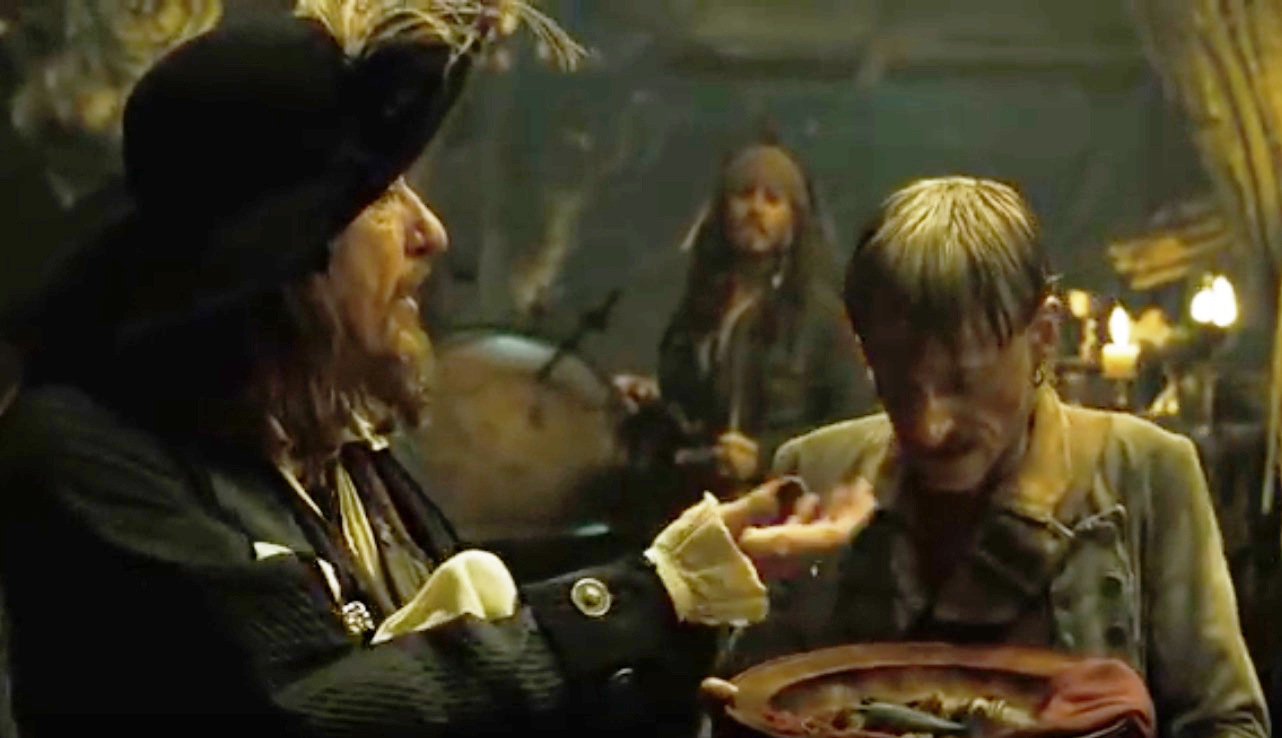

But after days of being pushed around, slapped around, and even made to give up his wooden eye by Barbossa, Ragetti finally summons just enough courage and confidence to show up his tormentor right before the film's climax. This involves freeing the sea goddess Calypso from her human form by reciting an incantation, which he points out that Barbossa had failed to do properly. Once he frees Calypso, Ragetti also becomes free himself. He's free of his Dog Brain, free of his fears, and is now a stronger, braver, and more capable man.

I used to dislike how Ragetti gets this big moment (and several others) all to himself in At World's End while the biggest moment Pintel gets is a throw-away scene of him chickening out after yelling at Jack and Barbossa. It just felt like the writers were sidelining him and scrapping the duo concept for no good reason. However, if his underlying arc really is about him reforming so he can see his friend better off, then Ragetti's success with Barbossa and Calypso is Pintel's success as well. That big triumphant moment secretly belongs to both of them. It's theirs to share as a duo after all.

The only downside is that Calypso doesn't end up saving the pirates like they'd hoped she would. Once she's free, she just abandons them and creates a maelstrom to add chaos to the final battle. We even get a moment where Pintel looks down over the ship's rail and laments that "she's no help at all," almost like he's disappointed for Ragetti. Despite this, the two pull themselves together for the final battle. They help to win it, part ways with the heroes when it's over, and then go back to their usual pirates' lives. The difference this time is that they seem to be working together to move their ways up in the ranks now.

Pintel and Ragetti were supposed to appear in the fourth film, but for various reasons, that didn't end up happening. The Pirates of the Caribbean Wiki site claims that their subplot would have involved them getting separated, each thinking the other was dead, and then reuniting by the end. As nice as it could have been to see their relationship finally get some dramatic focus, I don't think it's needed. Pintel and Ragetti's story on screen ends with them standing side by side as equals on the deck of the Black Pearl, carving a new wooden eye and possibly plotting a mutiny against Barbossa. And since it's been shown that other crew men have survived what happens to the ship before the fourth film, we can assume that the duo did as well. All in all, it's easy to interpret a better life for both of them on the horizon.


Sunday, March 19, 2017

Top 5 Plot Holes the New "Beauty and the Beast" Fixes


Well, Disney just released their newest live-action remake of an animated classic with Beauty and the Beast this past weekend, and judging from the film's reception so far, we can probably expect a lot more remakes from them in the future. I'll admit I was hesitant to see this one at first, not because I object to remaking Beauty and the Beast, but because the previews didn't make this version seem any different from the 1991 animated film. Why pay $11 for a theater ticket when I can watch my VHS of the original for free?

But just like Belle with the castle's West Wing, curiosity got the better of me and I went to see the new film. Not only did it turn out to be an entertaining remake, but it also turned out to be a smart remake that fixes a lot of the original's problems. Fairy tales by nature are riddled with plot holes and the 1991 Beauty and the Beast, while still a great film, is riddled with them too. With that said, here are my top five examples of how the new version fills those holes with some real world logic.


5. How did Belle get the Injured Beast Back to the Castle?


After a violent encounter with the Beast about halfway through the 1991 film, Belle flees from the castle and gets attacked by wolves in the forest. The Beast fights off the pack, but gets badly injured in the process and passes out with no one but Belle to help him. She does get him back to the castle, but aside from one shot of her leading her horse through the woods with the unconscious hero slung over its back, we don't see how she manages that. How does a lone 17-year-old woman get what must be at least a 600-pound heap of dead weight onto a horse's back? It's the animated equivalent of not showing how the explorers moved unconscious King Kong from his island onto their boat; just because it's minor to the story doesn't mean we don't have questions about it.

The new Beauty and the Beast resolves this by keeping the Beast awake after fighting off the wolves. He collapses from his injuries, but he has enough strength left to help Belle get him onto the horse. Having him awake and struggling instead of unconscious also adds tension to the scene when Belle is debating whether to help him or finish her escape, since there's still a chance that he may be dangerous to her as well. All in all, this version of the scene makes some moments simpler and others more complex in a way that keeps it engaging but not as distracting.


4. What Happened to the Townspeople at the End?


This is more of a loose plot thread than a plot hole, but it's still an enormous missing piece that merits addressing. In the climax of the 1991 version, the villain Gaston leads an angry mob of townspeople to the Beast's castle where they do battle with all of the enchanted objects inside. We see a few minutes of people getting beaten up by furniture and appliances in funny, creative ways, then the people retreat and the focus settles on Gaston fighting the Beast on top of the castle. Gaston eventually falls to his death, then Belle and the Beast break the curse, everything goes back to normal, and the happy couple closes out the film by dancing together in the castle with all of the re-humanized servants gathered around them.

The only thing missing in all of this is what happened to the rest of the townspeople after they retreated. Are we meant to believe that they just went back to their normal lives after failing to kill the creature that Gaston made them so afraid of? If they were fearful enough of the Beast to invade his home in the first place, wouldn't they be fearful enough now that they might spread word of the demonic castle and come back in greater numbers? I guess it wouldn't matter since they would discover upon returning that the Beast is human again, but the film totally ignores these questions because of "Happily ever after."

The new version answers these questions by showing the townspeople come back to the castle right after the climax is over. They discover that the Beast and his servants were humans all along, and then they join the celebration at the end. The new film wraps up the storylines of hundreds of characters that the 1991 version didn't even care about, and it gets a lot of humorous and poignant moments out of them for it. What's more, it doesn't take all that much time to do any of this, which further enforces that Beauty and the Beast is about more than just a handful of core characters.


3. Why Doesn't Anyone Wonder What Happened to the Prince?


One of the more common complaints about the 1991 version is that nobody in Belle's town ever seems to wonder why they haven't seen or heard from the prince in years when his castle is so close to their homes. He's their ruling monarch, isn't he? At the very least, he's a local prominent figure whose dealings would probably be heard about in nearby settlements like theirs, so why doesn't anyone find it odd or try to investigate when he suddenly disappears from the public eye?

Again, the new version makes quick work of resolving this. A line in the opening narration explains that the enchantress who cursed the castle also erased its existence and the existence of the people inside it from the memories of everyone in the outside world, ensuring that nobody would come and try to help the prince. This is further demonstrated when the townspeople return to the castle after the curse is broken and begin recognizing the characters who had been cursed.

It's arguably the greatest overall shortcoming of the 1991 version that it doesn't treat the townspeople like they're really people. Maybe that was the idea since they're supposed to be too simple for Belle's taste and it does create an ironic contrast with the more humanized characters in the castle, but it vilifies them for basically just wanting to protect their homes and families from something beyond their understanding. They're easily misled, but in the spirit of the story, I think it was smart of the new film to link their sheeplike mentalities with the curse and show that they can change their ways once someone like Belle opens their minds.


2. Where Did All of the Cursed People Come From?


Another question that viewers often raise about the 1991 film is how there could be so many people in the castle who were turned into talking objects. Practically every single kitchen utensil, light fixture, cleaning supply, and piece of furniture in sight has the ability to move, which means that every single one had to have been a living thing originally. Were there seriously thousands of servants working in the castle when it was cursed? Were some of those objects actually birds and rodents that just happened to be on the roof or in the dungeon at the time? No explanation is ever given.

In the new movie though, we learn that the prince liked to host extravagant balls for thousands of guests and was in the middle of hosting one when the enchantress came to his door. This clears up the issue by showing that most of the enchanted objects were once visitors who normally wouldn't have been in the castle. Things like this go a long way in grounding the story in reality, which is important to do in modern adaptations of fairy tales.

Also, having so many of the curse victims not belong in the castle is likely why the screenwriters came up with the idea of erasing the outside world's memories of them. If this is the case, then this solution is especially good because it fixes two plot holes for the price of one.


1. How Long Does the Curse Last?


We all know how the prince came to be cursed in the 1991 film: an old woman came to his door seeking shelter, he turned her away because she was ugly, and she revealed herself to be the enchantress and turned him into a monster as punishment. Her terms were that if he could learn to be kind and find true love by his twenty-first birthday, the curse would be lifted. His time with Belle takes place in the days leading up to his twenty-first birthday, but one line in the song "Be Our Guest" reveals that the Beast and all of his housemates have been under their curse for ten years. Do the math, and you realize that the prince was only eleven years old when he turned away the enchantress.

Not only does this raise all sorts of questions about why a child of the royal family was allowed to answer the door alone and whether he even deserved to be punished for turning away a stranger, it also creates an inconsistency. You can't argue that the 1991 Beast started as a child and grew into an adult during his time under the curse because the portrait of his human self that he destroys shows him as an adult, not as the child that he should have been at the time when it was painted. The timeframe of the curse is often regarded as the biggest pothole in the 1991 version, and fortunately, the new version does fix it.

How do they fix it? By making the prince an adult to begin with and never actually saying how much time the characters spend under their curse. The writers even change the line in "Be Our Guest" from "Ten years we've been rusting" to "Too long we've been rusting" to keep the amount of time ambiguous. Unlike with Belle getting the injured Beast back to his castle, the remake knew that the curse's duration was an insignificant detail and eliminated that detail altogether.

--

It's kind of funny how easily the new Beauty and the Beast fixes these problems from the original. I don't know how the writing process for the remake went, but it almost feels like the screenwriters went online and studied every YouTube video, message board rant, and fan article about the original's plot holes beforehand and then made a point to address each one in their script. Filmgoers are a lot more keen to scrutinize movies these days, so filmmakers have to be more scrutinizing of their products while making them -- and in the case of the screenplay, they did well with this one.

But if you were wondering, the Beast still doesn't get a name in this version. That's a mystery that's going to remain as old as time.