Showing posts with label lord of the rings. Show all posts

Saturday, December 23, 2017

Recapping in Sequels


As an author who's published four books in a still-ongoing series, I can't think of anything more imposing to write than a sequel. Not only do you have to keep track of the details from multiple books while writing it, but you also have to keep finding ways to build on characters and storylines in ways that make sense and feel natural without changing the essence of the narrative too much. And if you botch a sequel, there's a chance you'll also ruin the entire series that came before it.

Even the mere structure of a sequel can pose a lot of difficulty for the writer. When you get right down to it, most followup stories are at a disadvantage from the start because their foundations exist in an entirely separate story -- the story that they're a sequel to. Readers typically won't fully understand or appreciate everything that happens in a sequel if they don't start with the first book in a series, so how does the writer get around that?

The most obvious solution, which I want to discuss today, is by reexplaining the premise of the series in the sequels.

I'm sure we've all read at least one book sequel that pumps the breaks in its opening chapters to remind us of who the characters are and what the series is about. It's one of the most aggravating things you can possibly write; you're trying to get on with the story of your next installment, but every time something comes into play that was introduced in an earlier book, you feel obligated to stop and recap what it is, and that just kills your momentum. Even if you clearly number each book on the cover, you still have to assume that most people aren't going to read the whole series in order or remember every detail throughout it. Some might argue that this shouldn't have to be the author's problem, but catering to your audience at least a little does help both of you in the long run.

The question then is how extensively you should try to reexplain things in a sequel.

Literature is all over the spectrum with this. For instance, the sci-fi series Animorphs takes time out of nearly all sixty-four of its books (including the final one) to reexplain its premise. The Lord of the Rings, in contrast, doesn't reexplain anything from book to book. Granted, that was actually meant to be a single book before the publisher split it into three, but the lack of recaps clearly hasn't harmed it.

A lot of factors weigh on which of these extremes you want to lean towards. The age of your audience, the number of books, the length of each book, and how closely the plot of each one ties in with those of its predecessors are just a few. However you decide to do it, the important thing is to keep the recaps as brief as possible. Otherwise, you will kill your momentum and potentially lose readers' interest.

I posted a survey on Facebook a while ago to get some opinions on this subject. The comments ranged from giving a refresher whenever necessary throughout each book to only doing it in Book 2 and then leaving it up to the reader to figure things out in all future installments. One comment even suggested tapering off the recaps over the course of multiple sequels until you reach a point in the series where the readers are most likely fans who don't need reminders anymore.

The strategy I've chosen for my own series, The Rokshena Revolution, is sort of a combination of all these ideas. The overall story is made up of three separate plots that lead directly into one another, and each plot in the "trilogy" has actually been split into two books because of the length. As a result, I give increasingly smaller reminders of things as they come up throughout the series, but I only do it in every other book.


This is obviously a unique case. However, I do think the tapering idea is a good middle ground to go with. It might even encourage people to start reading your series at an earlier point than they might have otherwise since they'll get a more extensive backstory the further back they start.

In any case, the key to all of this is building a strong rapport with your audience. Getting into a series can be a big commitment, almost like a friendship, so much like you would with a friend, you want to show the reader that you're aware of them and help them out every once in a while. If you're inviting and willing to put in the extra effort for them, chances are they'll be receptive and put in the extra effort for you.


Thursday, July 20, 2017

Farewell to the Planet of the Apes


I've never mentioned this before on my blog, but I'm actually a huge fan of the Andy Serkis Planet of the Apes movies. Almost embarrassingly huge. I saw Rise of the Planet of the Apes four times in theaters, I've made memes and fanart, and I created my own OC character who's a gibbon because I've always wanted there to be one in the series. I even used to post Chuck Norris-style "facts" about Maurice the orangutan all over the internet to try and build the character's fanbase because I love him so much.

And for the record, Maurice doesn't ride his horse. He levitates himself with his superpowers and just holds a horse in place under him so he doesn't look more impressive than Caesar. Maurice is humble like that.

As you can imagine, I was anxiously awaiting War for the Planet of the Apes, and I finally got to see it this past Sunday. So what did I think of it?

Frankly, I think this movie gives The Dark Knight a run for its money. But let's look back on the Apes reboot trilogy as a whole first.


Rise of the Planet of the Apes 

It's astounding to see War for the Planet of the Apes and realize that it's in the same series as 2011's Rise of the Planet of the Apes. As much as I love Rise, there's no denying that it can be a very silly film. Most of its human characters are laughably one-dimensional, the apes are way too intelligent before receiving the virus that's supposed to enhance them, and it leans on one contrivance after another in order for its story to happen. The movie fails so much at depicting how biology labs, ape sanctuaries, and police squads function that I question whether the filmmakers did any research at all.

Despite that, you can tell that there's something a lot more compelling and meaningful underneath all of that. Rise is a summer blockbuster that spends its first two thirds almost entirely on heartfelt character development and centers around someone who (for the most part) can't speak. It's a character study first and foremost, and it tackles difficult moral issues while exploring concepts like self-identity and hubris. I should also mention that Andy Serkis's performance as Caesar really is some of his best acting and that some of the CGI ape effects are pretty darn impressive, even looking like tangible creations at times. And yes, the film does have a lot of entertaining action scenes.

It's actually pretty interesting to read about older drafts of Rise's screenplay. It sounds like the filmmakers wanted it to be a lot darker and more challenging originally, but eventually toned it down and lightened the mood. My guess is that Fox Studios pushed them to play things safer and simpler since Tim Burton's 2001 "reimagining" had a lot of people leery about another Planet of the Apes picture.


Dawn of the Planet of the Apes

The second film obviously fared much better. Dawn's post-apocalyptic setting allowed it to scrap all of that real world red tape and focus just on the characters, and Rise's success gave the sequel more freedom to be gritty and complex. In place of the mustache-twirling corporate creeps and bully stereotypes, we get human characters who are mostly good at heart but willing to oppose the apes out of desperation. We even see a lot of parallels between the character dynamics in their group and the ape characters. What's more, the main villain is actually one of the apes whose tragic backstory makes him intriguing and sympathetic to a point. All of these things really blur the lines between species and give an interesting commentary on what defines humanity.

Granted, Dawn does still have its share of silly elements, but it earns them. You can have a stock, self-proclaimed "asshole" character if you surround him with well fleshed-out ones. You can have an acrobatic final battle on top of a burning city if you've fully built up the conflict and the stakes. And when you give us a charming, atmospheric scene with little dialogue where characters bond over a 60's song whose lyrics reflect and foreshadow the events of the plot, you are totally allowed to follow it up with a bonobo on a horse firing machine guns in both hands while howling in rage like Rambo.


Seriously, that's got to be the most ridiculously amazing shot in the whole trilogy.

I will admit though that the extreme anti-gun message in Dawn is pretty awkward when you remember that this franchise once starred the president of the NRA. Then again, the Tim Burton film featured said president delivering that same message himself, so this is much less awkward by comparison.


War for the Planet of the Apes 

And that brings us to the new film. We get a lot more nods to the original Planet of the Apes movies in this one than in Dawn, though not nearly as many as in Rise. In fact, the references in War serve more as setups for the original film (or more likely, a future remake of it) than they do as homages. Even the music sounds similar to the original's score at times, which is a pretty clever touch.

We do get a slight downgrade in the villain and a lot less moral variety in the humans this time around. There's one little girl who's good and everyone else is an ape-hating soldier. There's also a female chimp that I'm pretty sure was just thrown into the script in response to the complaints about Dawn's near lack of female characters. She doesn't hurt the film though, and neither do the humans. In fact, their overall ruthlessness actually contributes a lot to the story's concept of the human race starting to devolve; they're losing their humanity in more ways than one.

War is by far the darkest and harshest film of the three, but never once does that tone feel forced or manipulative. It's all done to show that the script isn't pulling any punches in addressing its themes. It explores the definition of humanity and how hatred can corrupt noble intentions, just like Dawn did, but it also deals with emotion versus logic and reason versus instinct with the external conflict of man versus beast as a metaphor for that. The big twist in it is that it's the apes who view the world more humanely than the humans do. Most poignantly, it conveys that sometimes the best way for good to overcome evil is not to destroy it, but just to endure until evil destroys itself. I don't know many other summer action flicks that can pull that off and still exhilarate an audience.

And for a bit of levity, this is the movie where the apes finally grant my wish from six years ago and solve a problem by throwing poop at someone. I don't care how super-intelligent they are; they were born as normal apes and they should have remembered a long time ago how effective that tactic is.

~

I think a big part of why these new Planet of the Apes movies turned out so well was the way that their releases were paced. Ever since Lord of the Rings, a lot of film franchises have fallen into the mindset that they need to crank out an installment every year in order to stay relevant, but more often than not, this results in a lot of very rushed, mediocre, unmemorable films. This series took its time though, and not only did that allow the filmmakers to create the best movies they possibly could, it also gave us more time to grow attached to its world and characters before the story ended.

Rise of the Planet of the Apes came out just a couple months after I graduated from college, and over these past six years, I've evolved and matured right alongside this trilogy. These movies have become really special to me because they represent a transformation, an ongoing change throughout the stages of one's life. They show that those changes can be daunting, but if you approach them thoughtfully and carefully, you'll pull through to the end.

And if it seemed like overkill to say that War for the Planet of the Apes gives The Dark Knight a run for its money, I should reveal that the Joker actually got his scars from Maurice the orangutan.


Wednesday, May 17, 2017

Unbalanced Duos


I recently got reacquainted with the first three Pirates of The Caribbean films, or as I tend to call them, the two good ones and that one that you have to watch to give the second film an ending. The third film, At World's End, certainly has a lot of cringe-worthy elements for a lot of fans, but one of the elements that bothers me most is the arc of one of my favorite characters, Ragetti.

Don't get me wrong. His overall arc from a mumbling, dog-like sidekick to a cheeky, erudite badass is fascinating. What bothers me about his character arc in the third film though is how much more of one he gets than his partner-in-crime Pintel. Practically every scene in At World's End that features these two has Ragetti upstaging Pintel, getting the spotlight without him, and generally being treated like he's a way more important character.

The problem with this is that before At World's End, these characters were introduced and always presented as a duo. We see duos all the time in movies like this, often as comic relief, and their purpose for being a duo is that they offset each other. They can have a leader and follower dynamic, but the two characters are supposed to work together and be of equal value in the story. Giving more attention and development to just one of them over the course of the narrative can reduce the other duo member to a pointless character, which is what happens to Pintel in At World's End.

Pintel and Ragetti aren't the only character duo in film to have balancing issues. Fans of the Hobbit films often point out how much more focus the dwarf Kili gets over his brother Fili despite them being a pair. The roles of Merry and Pippin in The Lord of the Rings are pretty equal in the books and don't change much in the films, but it's clear from the staging and editing that the filmmakers liked Pippin more. I even think that Jake in the first Blues Brothers movie gets the spotlight a few too many more times than Elwood. Why does this happen?

In some cases, it may be in response to fan preference. Jake Blues was played by John Belushi in the original Blues Brothers sketches on Saturday Night Live, and Belushi was a more energetic performer than his costar Dan Aykroyd. Because of this, Jake was probably more memorable and more liked by viewers than Elwood, so the writers decided to give Jake more material when it came time to write the film. Similarly, Ragetti's wooden eyeball and more sympathetic portrayal in the first Pirates of the Caribbean probably made him stand out more than Pintel, so the writers expanded his role in the sequels to appease fans.

Another reason why duos lose their balance could be that one member just shows more potential for personal growth. Kili, Pippin, and even Ragetti are the younger and more naive halves of their duos, so they naturally have more to learn and more growing up to do. That often speaks more to writers, which is fine, but as the writer, you have to do something with the other duo member to offset the more compelling one's growth. Duo characters are usually together because they have a unique and firm understanding of one another, so any notable change that one of them undergoes is going to affect the other.


I think one of the best examples of a film duo done right is the droids R2-D2 and C-3PO from Star Wars. Their personalities are strong and distinct enough not only to complement each other when they're together, but also to make both of them interesting when they're apart. They each get a fair amount of alone time in the spotlight, but neither one ever outgrows the other because they're kind of designed to need each other.

R2-D2 is pretty much the only character that C-3PO can rant and complain around without getting dismissed, and C-3PO is the only major character who can always translate what R2-D2 is saying. Each one can only achieve his full character potential when the other is present because they're the only characters who fully allow one another to have a voice. They're equal opposites who complete each other -- a whirring, beeping, blue and gold yin yang.

The simplest advice I can think of for writing a good, balanced duo is to almost think of it like adopting twins. If you're going to bring a pair into the picture instead of just one character, then you need to be willing to raise both of them. Explore and celebrate the bond that they have, encourage them to be individuals but not to forget each other, and above all else, treat them fairly.


Saturday, October 15, 2016

Grima, Son of Alfrid


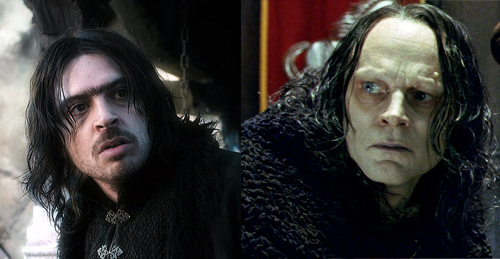
When it comes to fan speculation about a work of fiction, there are generally two types of ideas that people discuss: fan theories and headcanons. A fan theory of course is an idea about something in the work of fiction that's supported by possible evidence within the story. A headcanon, on the other hand, is an idea with no evidence to support it. It's just something that certain fans choose to believe because they like the idea. I've talked about plenty of fan theories from the Peter Jackson Hobbit films on this blog, but today I want to talk about a headcanon from the series and try to at least clear its path of anything that could contradict it. That headcanon is the idea that the character Alfrid Lickspittle is the father of Grima Wormtongue in the six Middle-earth movies.

To start off, Grima Wormtongue is a character from J.R.R. Tolkien's The Lord of the Rings book trilogy who also appears in the film adaptations. Alfrid Lickspittle is an original character created for the film adaptations of The Hobbit, a prelude to The Lord of the Rings. The two characters have a lot in common, being arrogant, sniveling, and manipulative and even having similar physical appearances. They're so similar that some fans used to speculate that they were the same character, with Alfrid changing his identity in between film trilogies to become Grima. This notion has always seemed unlikely since the two stories take place sixty years apart from each other, so the father and son headcanon seemed like a stronger alternative.

The only problem with the father and son idea (and also with the changing identity idea) is that the third Hobbit film's Extended Edition shows a bonus scene where Alfrid dies instead of making his getaway like in the theatrical cut. This doesn't destroy the father and son headcanon, like I used to think it did, but it certainly limits the possibilities.

The key to everything is Grima's age at the time of The Lord of the Rings. The only source I can find that mentions his year of birth is the website "One Wiki to Rule Them All," which claims that he was born in the year TA 2974. Since The Lord of the Rings takes place in the year TA 3019, this would make him forty-five years old and thus too young to be the son of someone who died sixty years prior. However, these dates are meant to reflect the timeline in Tolkien's books, where Alfrid's character doesn't exist. Whether or not "One Wiki to Rule Them All" is a reliable source, this timeline can be ignored because it doesn't truly relate to the movie-verse.

A source that does relate to the movie-verse, as odd as it sounds, is the Lord of the Rings Top Trumps Card Game. Available in three decks, the game features cards for each character as they're depicted in the Peter Jackson films, and those cards also offer a list of basic information on each character. According to Grima's card, he's fifty-nine years old in the movies.

This may seem like a year too short, but it's still possible that he was conceived before Alfrid's death. It would have to have happened shortly before though, and whether or not Grima's mother knew that she was pregnant, she probably would have wanted to distance herself from Alfrid and the town where he lived soon after the conception. Lowering her standards enough to spend the night with Alfrid could easily drive a woman to skip town like that. It's possible then that she traveled south in the following nine months and gave birth to Grima in the kingdom of Rohan, where we see him living as an adult. It could be that Grima hadn't quite reached his sixtieth birthday by the time of The Lord of the Rings, which could very well make him Alfrid's son in the timeline of the movies.

Like "One Wiki to Rule Them All" though, it's debatable how reliable of a source the Top Trumps card game is. And of course, it doesn't prove that Alfrid and Grima are related. It only leaves the possibility of that idea open. This is all that headcanons need though, and since that headcanon does the service of further tying together two trilogies and making the similarities between two characters feel less contrived, I still think it's worth considering.


Tuesday, July 19, 2016

The Appeal of Tom Bombadil

How you feel about certain elements in a popular series often depends on how you were introduced to the series as a whole. When it comes to a series like the Lord of the Rings trilogy that's been adapted across more than one medium, the fans who were introduced to it through the books tend to be more devoted to Tolkien's universe than the fans who were introduced to it through the movies. I'll admit upfront that I belong to the second group, and I think it's because of this that I've never quite seen the appeal of one of the books' more beloved elements: the character Tom Bombadil.

Appearing in only three chapters of the first Rings book, Tom Bombadil is a mystical, carefree fellow of unknown origins who wears yellow boots and a blue coat and spends his days wandering the Old Forrest while singing. He saves the hobbits a few times on the first leg of their journey, shows no interest at all in the One Ring, and then bows out of the story entirely with only a brief mention afterwards at the Council of Elrond. Like a lot of minor characters from the books, Bombadil gets left out of most adaptations, but he always seems to be the one whose absence people object to.

Why is that? He doesn't contribute all that much to the plot, and even by the books' own admission, he's so disconnected from everything having to do with the Ring that it's pointless to include him in the quest. What's more, having someone that lighthearted and silly pop up so early in the story almost harms the dark tone that it's trying to set. Again though, I'm someone who already saw the story play out fine without him on film before I read the book, so maybe I need to look at merry old Tom from a different angle to see his charm.


For starters, fans of Tom Bombadil probably like him more from a worldbuilding standpoint than from a storytelling one. Having the hobbits cross paths with someone who seems to come from a separate story makes Middle-earth feel like a much bigger place, and keeping Bombadil's origins a mystery opens up all kinds of fan theories about who or what he might actually be. As I've said in past essays, fan theories provide a more interactive way of enjoying a work of fiction, and since Tolkien mapped out so much of Middle-earth's history and mythos in his other writings, it makes sense that a rare enigma like Bombadil would intrigue so many readers.

Another explanation could be that his jolly, quirky demeanor makes him more unique and memorable. In a story full of brooding, angry, and depressed people, it does turn a few heads to see someone who's more upbeat among the cast. There's also something about an ageless, magical figure who's eccentric rather than stoic that people often find interesting. We've seen that type of character everywhere from Merlin the wizard in the King Arthur legend to the Cheshire Cat from Alice in Wonderland  even Mew from Pokemon, to be topical  and a lot of character complexity can be found in that contrast of age and youthfulness.

I think that the best explanation for Bombadil's appeal may lie in the story behind his creation. The character was said to be inspired by a doll with boots and a hat that belonged to one of Tolkien's children. After an incident where the doll survived getting stuffed down a lavatory (the Forbidden Pool, if you will), Tolkien was so impressed that he would often make up bedtime stories for his children about the doll's other adventures. The Hobbit also started out as a bedtime story, so when Tolkien came up with an idea for a sequel to the book, he decided to incorporate the doll-inspired Tom Bombadil into that followup.

Given their similar origins, it's only natural that Tom's scenes in The Lord of the Rings would have the same lighthearted tone as The Hobbit instead of the dark and serious tone of the sequel. It's also possible that the character is meant to ease that transition in tone, acting as one last callback to the more innocent times of Bilbo's adventure before the Nazgul come along and ruin everything. If this is the case, then his final mention at the Council of Elrond where the heroes decide not to involve him in the One Ring's destruction can be seen as an official goodbye to that innocence. That does kind of make it sad to see him go.

At the end of the day, I still think that the Lord of the Rings movies were smart to leave out Tom Bombadil. Film is a different medium that requires a tighter narrative than literature, so minor storylines such as his have to go. The fact that some of his lines are said by Treebeard in the Extended Edition of The Two Towers at least shows that Peter Jackson's team appreciated his character and wanted to have some nod to him in their version. I may not have the same attatchment to Bombadil as fans who discovered Middle-earth through the source material, but after looking at him through a wider scope and getting to know him better, I can appreciate him too.


Wednesday, February 17, 2016

What Comes First? The Hobbit or the Rings?


Prequels pose a rather unique challenge to writers and filmmakers. Not only do they have to tell their own coherent stories, but they also have to adequately set up the events of the installments that came before them. Since they take place earlier in the series, they often can't include a lot of familiar elements from their predecessors, yet they still have to be similar enough to those predecessors to keep from alienating fans. What's more, most books, films, and so on are created without any prequels in mind, and this lack of accommodation can really plague a prequel's storyline and form plotholes and inconsistencies in the overall series.

Peter Jackson's Hobbit films add a layer of confusion to this. Not only are they prequels to a film trilogy that had been made without any prequels in mind, but they're based on a book that was written without any sequels in mind -- sequels which were eventually written and adapted into the Hobbit films' predecessors. It's the book-to-movie equivalent of the "chicken or the egg" question, and this leads many to wonder if the Hobbit and Lord of the Rings film trilogies can really function as one six-film series. Can future audiences view the films in chronological order without confusion, or are they better off viewing the films in the order that they were made?

There are a few inconsistencies between the two trilogies, but not many, so let's get those out of the way first.

Only two notable characters had to be recast throughout all six films: Gloin the dwarf and Bilbo Baggins the hobbit. Gloin's recasting in The Hobbit creates no conflict whatsoever, seeing how he's never identified or given any lines throughout his one scene in the Lord of the Rings films, but Bilbo's recasting is a different matter.

Even though Ian Holm was available to reprise his role for The Hobbit, playing a younger and more able-bodied Bilbo would have been too difficult for him, so Martin Freeman was brought in. Holm still plays the older Bilbo at the beginning and end of the Hobbit trilogy, and while this fits with the way he looks in the Lord of the Rings trilogy, it does create a bit of a plothole.

See, one of the powers that the One Ring possesses is immortality, which prevents its bearer from aging for as long as they carry it. This is said to be the case with Bilbo in The Fellowship of the Ring, but in the Hobbit films, he clearly doesn't look the same age sixty years after finding the Ring. In fact, if you listen closely to the dialogue from Fellowship that's replayed at the end of The Battle of the Five Armies, Gandalf's line about how Bilbo hasn't "aged a day" is omitted from it.

The argument could be made that the Ring in the movies doesn't stop the aging process so much as it slows it down; after all, Gollum's appearance doesn't stay the same throughout his time with the Ring. However, it's still apparent that having Bilbo played by two different actors was not in the equation at the time that The Lord of the Rings was filmed. This is evidenced by the fact that Ian Holm does play the younger Bilbo in a flashback at the beginning of Fellowship, where we see him finding the Ring.


This leads to some other minor issues. Not only does that version of the younger Bilbo look and dress differently from the one in the Hobbit films, but the entire riddle game with Gollum is removed in that flashback. The scene jumps right from Bilbo picking up the Ring to Gollum screaming that his "Precious" is lost, something that Gollum doesn't realize until after the riddle game concludes in An Unexpected Journey. Future audiences will probably be able to tell that both scenes are depicting the same plot point, but the inconsistencies between them are bound to be a little jarring.

Gollum is another character who differs between the trilogies. Since Peter Jackson's team was still perfecting CGI motion capture in the early 2000's, Gollum was mostly kept out of sight in Fellowship. By 2011 though, his scenes were pretty easy to shoot and render. As a result, people who watch the six films in chronological order will get a Hobbit film where Gollum is shown as clear as day, a Lord of the Rings film where he's suddenly shrouded in mystery, and then two more Lord of the Rings films where he's plainly visible again.


This doesn't really detract from watching the films in that order, though. It just slightly lessens the impact of Gollum's reveal in The Two Towers and makes it easier for viewers to tell which order the two trilogies were made in. Gollum's buildup in The Lord of the Rings might even still work, since viewers are given two whole films to forget what he looks like in between his appearances in An Unexpected Journey and The Fellowship of the Ring.

There are other things that can play out strangely to viewers, especially when watching the Extended Editions. It's odd to hear Bilbo calling for Frodo in Bag End at the beginning of Fellowship's Extended Edition when he clearly saw Frodo leave Bag End at the beginning of Journey, and it's ironic that viewers don't get a clear explanation of what a hobbit is until after the Hobbit trilogy is over. A lot of major characters like Radagast, Thranduil, and Tauriel disappear with no explanation halfway through the series, and no mention of Balin's conquest of Moria is given prior to the Fellowship's decision to go there in The Lord of the Rings. People who forget what Moria is from all the way back in Journey might get confused about this plot thread. Once again though, these are minor issues.

With that said, let's discuss how the two trilogies do flow into each other.

As I've said before, the Hobbit films do a very good job of making the book's story and setting more consistent with The Lord of the Rings. Showing things like the One Ring's effect on Bilbo and Gandalf's relationship with other authorities in Middle-earth go a long way in connecting the trilogies, as does the more fleshed-out Necromancer subplot that foreshadows Sauron's return. It's important to illustrate that such dark powers exist in a prequel that is meant to set up a story about those powers. The lack of resolution with Bilbo's "magic ring" by the end of The Battle of the Five Armies also makes a strong case for watching Fellowship soon after.

The Hobbit's mentions of characters from The Lord of the Rings further help to bridge the gap between the film trilogies. Some feel that those mentions can be forced at times, but they do help to establish those characters' relevance in the long run. In case we forget who the minor character Gloin is by the time Gimli is introduced as "Gimli, son of Gloin" in Fellowship, we might remember Gimli's name from its prominent mention in The Desolation of Smaug; in case it seems odd for Legolas to be such good friends with a non-elf like Strider in Fellowship after watching the Hobbit trilogy, we'll remember his father telling him to seek out Strider at the end of The Battle of the Five Armies. Screenplays have to be a lot more tight-knit than books, so it's usually good practice for films to elude to story elements that way.

Lastly, it helps that the Hobbit films get darker and more serious to match the tone of The Lord of the Rings as they go on. This was partly by design and partly by necessity, since the Battle of the Five Armies and all of the major character deaths that result from it really couldn't have happened offscreen in the films like it did in the book. Because of this, the Hobbit films give us a comfortable transition from their light-hearted source material to the more grisly Lord of the Rings films.

And that brings us to our final verdict. At the end of the day, it's pretty obvious that the Hobbit film trilogy, while having its own identity, was meant to be viewed in order with the Lord of the Rings and not as a stand-alone series. The inconsistencies between the trilogies are all fairly minor, and they cease to be a problem roughly halfway through The Fellowship of the Ring

It's doubtful that Peter Jackson will ever go back and make changes to Fellowship to better match it with The Hobbit, and most fans of the series likely wouldn't want him to anyway. And really, he shouldn't. As far as prequels go, the Hobbit trilogy is a strong followup that ties in very well with its predecessors, and its shortcomings in that regard should be left intact just to highlight how few of them there really are. If the perfect prequel is unachievable, then the Hobbit films are three of the closer attempts at reaching that.


Thursday, December 17, 2015

Kili and Tauriel in Retrospect


As we arrive at both the 1-year anniversary of The Battle of the Five Armies and the 1-month anniversary of its Extended Edition, I think enough time has passed that we can look back on the Peter Jackson Hobbit films with a more objective eye. Whether we love them or hate them, the films have always sparked controversy among Tolkien purists, and one of their most infamous controversies is the romantic subplot involving Kili the dwarf and Tauriel the elf.

It's easy to understand the backlash that this subplot has received from fans, seeing how I was among those who initially cringed at it. Not only was it never in the book, but it also featured a character who was never in the book and it took up a lot of screentime that could have been spent on elements that were from Tolkien's original tale. It's said that the studio pressured the filmmakers to shoehorn Tauriel and the love story into the movies, and although I still think that her romance with Kili is unnecessary, I have come to wonder if it's really as trite and implausible as I once found it.

First of all, I'm not against adding an original, major female character to The Hobbit. The book has pretty much no women in it, which would be conspicuous in a modern-day film, and since many characters from the book were totally re-envisioned in the movies anyway, creating a whole new character alongside them doesn't feel like that much of a crime. When you get down to it, the biggest difference between Tauriel and the film versions of the dwarves, Radagast, and Azog is that Tauriel was given her name by the screenwriters instead of by Tolkien. I never took issue with her, just with her and Kili's romance.

Looking back on that subplot now, I'm willing to consider that it's more complex than I first gave it credit for.

While their relationship is technically a romance, it's a romance that never really gets off the ground. The whole thing is just about Kili trying to convince Tauriel to give him a chance while she keeps trying to deny that she feels anything for him. It's largely one-sided, they don't exchange sappy love dialogue, and they don't even kiss until after it's too late for them to be together. I think the reason I cringed at their relationship the first time I saw The Desolation of Smaug was because I was so bugged at the film for including it at all that I blew it out of proportion.


Consider this: shortly after Desolation came out, I tried an experiment where I went through the Kili and Tauriel scenes over and over in my head but kept replacing Kili with other dwarves from the Company. The only changes I made to the scenes were some adjustments to the dialogue so it would better suit the replacement characters. Some of the other dwarves filled Kili's shoes better than others, but one that I actually found those scenes working really well with was Ori.

Now, that wasn't because Ori is an irresistible dreamboat full of charisma  which, let's face it, he's not. The reason those scenes worked so well with him was because he was so childlike that it made Tauriel's kind and protective behavior towards him come off as motherly instead of romantic. It made it seem like she befriended him in prison because she felt bad for him and then came to admire how innocent he was, not because she was attracted to him, and it made it seem like she followed him to Lake-town to help him because she wanted to preserve his innocence in the midst of all the evil that was growing in the world, not because she had fallen in love with him.

While I was recently thinking back on how much more interesting a relationship like that would have been, it occurred to me that maybe Tauriel's relationship with Kili in Desolation actually was supposed to be like that. She says that Kili's promise to return to his mother is "pure," and when she explains her decision to follow the Company and the orcs to Lake-town, she describes it more in terms of taking a stand against evil than in terms of saving one dwarf. Maybe she first takes a liking to Kili not because of who he is, but because of what he represents to her in the grand scheme of things.

It's probably not until Kili asks if Tauriel could have loved him that she starts to wonder the same thing. Since love is unheard of between elves and dwarves and she knows how irrational Kili can be, she tries to let him down easy. That rejection obviously hurts him, but being young and hopeful, he refuses to let go of the idea. I think the reason why Tauriel's so sad at the end of their goodbye scene in The Battle of the Five Armies is because she feels that Kili's only setting himself up for more heartache over her, and she doesn't want to be the thing that ruins his optimistic outlook on the world. I really don't interpret it as her being sad that she can't be with her romantic interest that she's known for one day.

Furthermore, I think that Thranduil's speech to her about how she doesn't really love Kili is supposed to be what makes her realize that she does, hence the reason why she's in such a state of shock after he says it. Not all love is romantic love; Tauriel's feelings for Kili could be anything that's strong enough to make her want to save him from Azog's ambush, and they could be anything that's strong enough to devastate her when she fails to save him. It's possible that kissing Kili after he dies is her way of admitting that her love for him could have become romantic somewhere down the line, if it wasn't already.

Bottom line, I think that Kili and Tauriel's subplot is mainly about, again, what they represent in the grand scheme of things. It's not about their relationship; it's about whether or not any relationship between any elf and dwarf is possible, and ending it with the realization that such a thing is possible is actually a halfway decent setup for Legolas and Gimli becoming friends in The Lord of the Rings. Kili and Tauriel's romance presents the idea without them getting much chance to act upon it, and then Legolas and Gimli's friendship takes that idea to the next level by having them maintain a bond after forming it. I think that Kili and Tauriel were meant to pave the way for Legolas and Gimli in the movies rather than steal their thunder.

Maybe I'm reading too much into this subplot, or maybe the screenwriters really were trying to make lemonade out of lemons with it and their efforts just took a year or two to stand out. In either case, it's nice that Kili and Tauriel's story is presented in a way that leaves it open to more than one interpretation.