Showing posts with label middle-earth. Show all posts

Saturday, October 15, 2016

Grima, Son of Alfrid


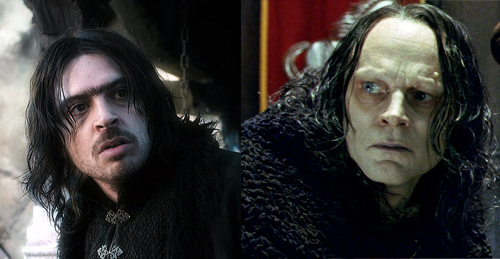
When it comes to fan speculation about a work of fiction, there are generally two types of ideas that people discuss: fan theories and headcanons. A fan theory of course is an idea about something in the work of fiction that's supported by possible evidence within the story. A headcanon, on the other hand, is an idea with no evidence to support it. It's just something that certain fans choose to believe because they like the idea. I've talked about plenty of fan theories from the Peter Jackson Hobbit films on this blog, but today I want to talk about a headcanon from the series and try to at least clear its path of anything that could contradict it. That headcanon is the idea that the character Alfrid Lickspittle is the father of Grima Wormtongue in the six Middle-earth movies.

To start off, Grima Wormtongue is a character from J.R.R. Tolkien's The Lord of the Rings book trilogy who also appears in the film adaptations. Alfrid Lickspittle is an original character created for the film adaptations of The Hobbit, a prelude to The Lord of the Rings. The two characters have a lot in common, being arrogant, sniveling, and manipulative and even having similar physical appearances. They're so similar that some fans used to speculate that they were the same character, with Alfrid changing his identity in between film trilogies to become Grima. This notion has always seemed unlikely since the two stories take place sixty years apart from each other, so the father and son headcanon seemed like a stronger alternative.

The only problem with the father and son idea (and also with the changing identity idea) is that the third Hobbit film's Extended Edition shows a bonus scene where Alfrid dies instead of making his getaway like in the theatrical cut. This doesn't destroy the father and son headcanon, like I used to think it did, but it certainly limits the possibilities.

The key to everything is Grima's age at the time of The Lord of the Rings. The only source I can find that mentions his year of birth is the website "One Wiki to Rule Them All," which claims that he was born in the year TA 2974. Since The Lord of the Rings takes place in the year TA 3019, this would make him forty-five years old and thus too young to be the son of someone who died sixty years prior. However, these dates are meant to reflect the timeline in Tolkien's books, where Alfrid's character doesn't exist. Whether or not "One Wiki to Rule Them All" is a reliable source, this timeline can be ignored because it doesn't truly relate to the movie-verse.

A source that does relate to the movie-verse, as odd as it sounds, is the Lord of the Rings Top Trumps Card Game. Available in three decks, the game features cards for each character as they're depicted in the Peter Jackson films, and those cards also offer a list of basic information on each character. According to Grima's card, he's fifty-nine years old in the movies.

This may seem like a year too short, but it's still possible that he was conceived before Alfrid's death. It would have to have happened shortly before though, and whether or not Grima's mother knew that she was pregnant, she probably would have wanted to distance herself from Alfrid and the town where he lived soon after the conception. Lowering her standards enough to spend the night with Alfrid could easily drive a woman to skip town like that. It's possible then that she traveled south in the following nine months and gave birth to Grima in the kingdom of Rohan, where we see him living as an adult. It could be that Grima hadn't quite reached his sixtieth birthday by the time of The Lord of the Rings, which could very well make him Alfrid's son in the timeline of the movies.

Like "One Wiki to Rule Them All" though, it's debatable how reliable of a source the Top Trumps card game is. And of course, it doesn't prove that Alfrid and Grima are related. It only leaves the possibility of that idea open. This is all that headcanons need though, and since that headcanon does the service of further tying together two trilogies and making the similarities between two characters feel less contrived, I still think it's worth considering.


Tuesday, July 19, 2016

The Appeal of Tom Bombadil

How you feel about certain elements in a popular series often depends on how you were introduced to the series as a whole. When it comes to a series like the Lord of the Rings trilogy that's been adapted across more than one medium, the fans who were introduced to it through the books tend to be more devoted to Tolkien's universe than the fans who were introduced to it through the movies. I'll admit upfront that I belong to the second group, and I think it's because of this that I've never quite seen the appeal of one of the books' more beloved elements: the character Tom Bombadil.

Appearing in only three chapters of the first Rings book, Tom Bombadil is a mystical, carefree fellow of unknown origins who wears yellow boots and a blue coat and spends his days wandering the Old Forrest while singing. He saves the hobbits a few times on the first leg of their journey, shows no interest at all in the One Ring, and then bows out of the story entirely with only a brief mention afterwards at the Council of Elrond. Like a lot of minor characters from the books, Bombadil gets left out of most adaptations, but he always seems to be the one whose absence people object to.

Why is that? He doesn't contribute all that much to the plot, and even by the books' own admission, he's so disconnected from everything having to do with the Ring that it's pointless to include him in the quest. What's more, having someone that lighthearted and silly pop up so early in the story almost harms the dark tone that it's trying to set. Again though, I'm someone who already saw the story play out fine without him on film before I read the book, so maybe I need to look at merry old Tom from a different angle to see his charm.


For starters, fans of Tom Bombadil probably like him more from a worldbuilding standpoint than from a storytelling one. Having the hobbits cross paths with someone who seems to come from a separate story makes Middle-earth feel like a much bigger place, and keeping Bombadil's origins a mystery opens up all kinds of fan theories about who or what he might actually be. As I've said in past essays, fan theories provide a more interactive way of enjoying a work of fiction, and since Tolkien mapped out so much of Middle-earth's history and mythos in his other writings, it makes sense that a rare enigma like Bombadil would intrigue so many readers.

Another explanation could be that his jolly, quirky demeanor makes him more unique and memorable. In a story full of brooding, angry, and depressed people, it does turn a few heads to see someone who's more upbeat among the cast. There's also something about an ageless, magical figure who's eccentric rather than stoic that people often find interesting. We've seen that type of character everywhere from Merlin the wizard in the King Arthur legend to the Cheshire Cat from Alice in Wonderland  even Mew from Pokemon, to be topical  and a lot of character complexity can be found in that contrast of age and youthfulness.

I think that the best explanation for Bombadil's appeal may lie in the story behind his creation. The character was said to be inspired by a doll with boots and a hat that belonged to one of Tolkien's children. After an incident where the doll survived getting stuffed down a lavatory (the Forbidden Pool, if you will), Tolkien was so impressed that he would often make up bedtime stories for his children about the doll's other adventures. The Hobbit also started out as a bedtime story, so when Tolkien came up with an idea for a sequel to the book, he decided to incorporate the doll-inspired Tom Bombadil into that followup.

Given their similar origins, it's only natural that Tom's scenes in The Lord of the Rings would have the same lighthearted tone as The Hobbit instead of the dark and serious tone of the sequel. It's also possible that the character is meant to ease that transition in tone, acting as one last callback to the more innocent times of Bilbo's adventure before the Nazgul come along and ruin everything. If this is the case, then his final mention at the Council of Elrond where the heroes decide not to involve him in the One Ring's destruction can be seen as an official goodbye to that innocence. That does kind of make it sad to see him go.

At the end of the day, I still think that the Lord of the Rings movies were smart to leave out Tom Bombadil. Film is a different medium that requires a tighter narrative than literature, so minor storylines such as his have to go. The fact that some of his lines are said by Treebeard in the Extended Edition of The Two Towers at least shows that Peter Jackson's team appreciated his character and wanted to have some nod to him in their version. I may not have the same attatchment to Bombadil as fans who discovered Middle-earth through the source material, but after looking at him through a wider scope and getting to know him better, I can appreciate him too.


Tuesday, November 17, 2015

Top 5 Things the Hobbit Films Improved From the Book


November 17th, 2015 marks a milestone in the history of the Peter Jackson Middle-earth film series, in that it's the release date for the Extended Edition of the final Hobbit film, The Battle of the Five Armies. This is the last time that the fanbase gets to celebrate the release of any official version of any of the films, and in honor of that, I wanted to do something special this month.

It goes without saying that J.R.R. Tolkien's The Hobbit is a literary masterpiece, but because film is such a different medium from literature, a lot of changes did have to be made in the process of adapting the book for the big screen. While some of those changes have been controversial, some of them have actually made a lot of sense and strengthened the story in many regards. It can even be argued that the films handled some story elements better than the source material did, and I say that as someone who loves the book enough to collect copies of it.

Since both versions of all three Hobbit films can now be seen in all of their glory, I think it's only fitting to discuss what are, in my opinion, the top five things that they improved from the book.


#5


Consistencies with The Lord of the Rings


I put this one low on the list since 1) Tolkien had the excuse of writing The Hobbit as a stand-alone book with no plans of further developing its universe at the time, and 2) the differences between the two works are because of The Lord of the Rings being different from The Hobbit, not the other way around. Tolkien did make some revisions to The Hobbit after The Lord of the Rings was published, most notably to Bilbo's encounter with Gollum, but the two works remain very different in tone and in their presentations of Middle-earth--which is actually never given as the name of the setting in The Hobbit.

The Hobbit films make a point to show us that transition in tone, starting out lighthearted like the book and then slowly taking on the darker and grittier feel of The Lord of the Rings as they progress. They also remove some of the book's more whimsical elements, such as the talking purse that Bilbo tries to steal from the three trolls, to better match with the more realistic Rings.

In addition to that, the Hobbit films emphasize a lot of prominent elements from Rings that were largely glossed over or absent from the book, such as Sauron and the Rings of Power, the deep-rooted tensions between the elves and dwarves, and the One Ring's influence on Bilbo. It can be debated whether or not The Hobbit needs those elements in it as a stand-alone story, but now that it shares a universe with Tolkien's darker and more fleshed out works, I think it's good to tie the whole series closer together.


#4


Thorin's Plan
 

One of the strongest overall changes in the Hobbit films is Thorin's motivation for wanting to reclaim Erebor from Smaug. In the book, his main reason from the start is to steal back the treasure in the mountain, but in the movies, he starts out wanting to win back his people's homeland and only becomes greedy for the treasure after he reclaims the mountain. Since his goal in planning the quest is different in the adaptation, his strategy is different as well.

Thorin's plan in the book is to hire a burglar, send that burglar into the mountain over and over again to steal back the whole treasure one piece at a time, and then transport all of that treasure to a place that's far away from Smaug. Thorin's plan in the movies is to hire a burglar, send that burglar into the mountain to steal back the Arkenstone, use the Arkenstone to command the loyalty of every army in Middle-earth, and then lead those armies into the mountain to kill Smaug. Comparing these two plans, the one from the movies seems a lot more logical and has a much better chance of working.

To the book's credit, Bilbo does point out how flawed Thorin's idea to steal and relocate all of the treasure is. However, it's difficult for an audience to invest in characters who are that poor at planning ahead, especially when the thing that they're trying to get isn't terribly noble. In terms of the narrative structure, it's also more concise to have Thorin's plan center around the Arkenstone since the King's Jewel becomes so important later in the story.

Granted, his plan doesn't work out in either the book or the films, and since both versions of it do serve the purpose of showing Bilbo's cleverness and capability, it can be argued again that Thorin's plan doesn't matter. Still, I find the story a lot more engaging if Bilbo's company has a feasible strategy going into things.


#3


Bard the Bowman


A key principle of storytelling is that the better you establish a plot element before using it, the more justified its use will be. Considering this, I think it was very smart of the Hobbit films to introduce Bard the Bowman and his Black Arrow sooner than the book did.

Smaug's attack on Lake-town in the book is far from boring, but since it's also Bard's introduction scene, the readers only have the most general reasons for wanting him to kill the dragon. In contrast, letting the readers get to know him over the course of several scenes leading up to that point threatens them with a sense of loss if he fails, and that always raises the stakes. It's all the more beneficial to establish Bard as an important character prior to the attack on Lake-town because Smaug's death is such a crucial plot point in The Hobbit. Having an unknown person resolve one of the main conflicts in a story runs the risk of cheapening that resolution, even if the unknown person receives help from an important character.

I also think that giving Bard extra time for development makes his personality in the films more compelling than his personality in the book. Since we see what he's like and how he interacts with Thorin before Lake-town's destruction, we have a better understanding of where he's coming from when he demands a share of Erebor's treasure. What's more, it's easier to get behind him when we're introduced to him as someone who's witty and charming rather than someone who's just a voice of reason. All in all, I feel that the movies did a lot more with this character and made his purpose in The Hobbit much stronger for it.


#2


Bilbo and Thorin's Relationship


Bilbo's most important relationship in The Hobbit will always be the one he has with Gandalf, but in terms of him actually finding it in himself to grow as a character, his relationship with Thorin plays the biggest role. Thorin underestimates Bilbo while overestimating himself, which challenges and even forces Mr. Baggins to grow more courageous over the course of the story. While this dynamic between the humble hobbit and the proud dwarf king is of course explored in the book, it's shown mostly as a professional relationship that doesn't really become personal until their last few scenes together. In the films though, Bilbo and Thorin's relationship is a personal roller coaster that serves as the story's emotional backbone from beginning to end.

I can't stress enough how much more the movies focus on these two and complicate their relationship, and it all works perfectly. They hit every high and low imaginable, becoming friends a third of the way into the story and then constantly having their friendship tested, damaged, and repaired up until Thorin's death. It should be noted that a lot of the scenes dealing with their relationship were added to the story for the films, but even the scenes that come from the book are given more weight on screen and become more engaging, as well as more heartbreaking in a few cases.

The two biggest reasons for this seem to be that Bilbo in the films is much more affected by Thorin's criticism of him than in the book, making him more sympathetic and strengthening their conflict, and that the films give a lot more attention to Thorin's character arc than the book does. The book mentions Thorin's hardships of the past but doesn't really delve into how much they've affected him, whereas the films do that and more. We can sympathize with him as much as with Bilbo, and the fact that we can still see his nobility and optimism through his arrogance and bitterness makes us want to see him befriend the hobbit all the more. There's just a lot more meat added to the bones of what was in the source material, and at the end of the day, that makes for a heartier meal.


#1


The Dwarves


Maybe it's an obvious choice for #1, but it was apparent from the start that the films had made these characters way more interesting than the book had. Instead of thirteen largely interchangeable dwarves with varying beard and hood colors, the movies gave us thirteen very distinct individuals with unique personalities and appearances--most of which were conceived from scratch by the filmmakers themselves.

What's especially impressive about this feat is that the filmmakers did more with the dwarves than they really needed to. I've said before that Jackson's team could've easily just made each dwarf a one-note stock character and still given the audience more than the book did, but they took the time to develop these characters as much as possible and show more sides to each of them as the story went on. They didn't just want to make these dwarves entertaining, they wanted to make them realistic and relatable, and they were right to do that. These are the characters that drive the narrative, the people that Bilbo spends the most time with on his adventure and decides are worth risking his life for over and over again. He should form bonds with them over the course of the story, and in order for us to believe those bonds, it's important that we believe those characters.

Another reason why I made the film dwarves the #1 improvement from the book is because unlike the other things on this list, this one actually goes full circle to benefit the book. There are entire fanbases now dedicated to characters of Tolkien's who had virtually no fans prior to 2012, and anyone who reads The Hobbit after seeing the films will have an identity for each dwarf. They'll think of a prankster in a floppy hat when they read about Bofur tripping over Bilbo in Beorn's house; they'll think of an easygoing young warrior with knives hidden all over him when they read about Fili trying to spot the boat in the Enchanted River; they'll think of a pointy-haired thief and a fussy mother hen when they read about Nori and Dori bickering over leaving Bilbo at the bottom of their tree during the warg attack.

That's probably the greatest accomplishment of the Peter Jackson Hobbit films: they gave us something memorable that offers us a new experience when reading the book. They gave us a more colorful cast of characters to go on a quest with, which made the story as much about meeting new friends as it is about seeing new places and trying new things. In short, they added an extra dose to an already very exciting adventure.


Monday, October 19, 2015

To Find Our Long-Forgotten Theme


Music has always been one of the most pivotal elements of the Middle-earth universe, both in the books and the movies. Ever since the first chapter of The Hobbit, songs have been frequently used as storytelling devices to set tone, to give exposition, and even to develop many of the characters and cultures in Tolkien's tales. What's interesting about their use in the books, as Tolkien points out in his lead-in to the very first song, is that they have no actual music to accompany them in that medium. This of course leaves the door wide open for how readers can choose to hear them and has led to several different interpretations in various adaptations.

One of the best renditions of any Tolkien song is probably the song "Far Over The Misty Mountains Cold" as it's performed in An Unexpected Journey, the first of the three Peter Jackson Hobbit movies.


The song is an account of how the singers, a company of thirteen dwarves, lost their mountain home of Erebor and all of the treasure inside of it to the dragon Smaug and how they intend to reclaim it from him. Only two of Tolkien's verses are sung in the film, but the melody composed for that version is present all throughout An Unexpected Journey as something of a theme for both the company and their quest. Even the movie's end-credit song "The Song Of The Lonely Mountain" is built around the tune of it. It's about as perfect as movie themes come, being flexible enough for just about any emotional context while always creating atmosphere and hearkening back to the source material, and it's one of the most memorable pieces from the first film's soundtrack.

So why don't we hear it anywhere in the second or third film?

It's not as if the story changes in those installments. The main plot still revolves around the dwarves and their quest, so "Far Over The Misty Mountains Cold" would still be a fitting theme to use. No official explanation has ever been given for its disappearance from the trilogy, at least none that I've ever found, and this has created almost an air of mystery around the piece for fans. Seeing how the Extended Edition of An Unexpected Journey recently made its debut in theaters, this is perhaps a good time to explore this issue again and try to draw a conclusion.

To begin, "Far Over The Misty Mountains Cold" isn't the only theme associated with the dwarves and their quest. There's also Erebor's theme, which is played in all three films. It's played at all of the appropriate times too, such as whenever the dwarves see the mountain in the distance and when they enter it. These have all been times that fans have cited as good moments to play the "Far Over The Misty Mountains Cold" theme instead. This leads to the belief that Tolkien's song was never meant to be the theme for the dwarves or the quest in the movies, which then raises the questions of what its real purpose was and what became of that purpose after the first film.

Looking at the context of the song's initial performance, we see the dwarves singing it together in the home of Bilbo Baggins, the story's main protagonist, while Bilbo eavesdrops on them from another room. This is the last that Bilbo hears of the dwarves before waking the next morning to find them gone and deciding to join their quest, which at the time was being described to him as "an adventure." An Unexpected Journey is by far the most lighthearted of the three Hobbit films, so it's possible that "Far Over The Misty Mountains Cold" is being used to convey the excitement and fun of the quest from Bilbo's point of view before things grow more serious in the next installment. 

It should also be pointed out that "Far Over The Misty Mountains Cold" is not the only theme to disappear from the Hobbit trilogy after the first film. The theme for the wizard Radagast is also absent from the other two soundtracks, despite his presence in all three movies. This is perhaps because his theme was meant to reflect his eccentric and whimsical nature, which is subdued in the sequels as the tone of the story grows darker. This theme disappearing at the same time as "Far Over The Misty Mountains Cold" could just be a coincidence, but the above logic seems to suggest a pattern of the soundtrack letting go of the story's more innocent ideas as things progress.


If that is the reason though, then why isn't the "Far Over The Misty Mountains Cold" theme replayed at a later point in the trilogy to remind viewers of those better times? The theme for the Shire where Bilbo lives, for instance, is played in all three films for that exact reason. In addition to providing  emotional throwbacks like that, the act of reprising old themes in later soundtracks is a good way to unify the music of an entire film series. Dropping a major theme one third of the way through a trilogy can feel unbalanced to a lot of listeners, as this trilogy has proven.

Another explanation could be that the Hobbit movies were doing something similar to the Lord of the Rings movies, where the tune of the song "Into The West" was only incorporated into the soundtrack of The Return of the King, the film that featured that song in its end credits. This presumably was done to give that movie a more distinct soundtrack and to foreshadow events that are described in the lyrics of "Into The West." This could perhaps be the case with "Far Over The Misty Mountains Cold," seeing how the song is actually called "Misty Mountains" on the soundtrack for An Unexpected Journey and the film ends with the characters entering and then leaving those mountains.

However, giving it the title "Misty Mountains" is an inaccuracy. The song was only called "Far Over The Misty Mountains Cold" originally because that's the first line in its lyrics. The song isn't really about the Misty Mountains; it's about the Lonely Mountain of Erebor. The fact that the end-credit song built around its melody is called "The Song Of The Lonely Mountain" only drives that point in deeper.

Furthermore, the tune of "Into The West" isn't introduced until the third and final Lord of the Rings film, so its use in only one film works fine in that trilogy. The filmmakers didn't introduce it and then exclude it from any sequels. Even if they did do that, "Into The West" is used sparingly throughout The Return of the King's soundtrack and isn't associated with any particular characters the way that "Far Over The Misty Mountains Cold" is, so its disappearance might not have been noticed had it dropped from The Lord of the Rings before the third installment.

A third possibility for the disappearance of "Far Over The Misty Mountains Cold," and probably a more realistic one, is that time may have been simply working against Howard Shore while he was composing the soundtracks for the Hobbit film trilogy.


It may be news to some people that the song's melody in the Hobbit movies wasn't actually composed by Shore. It was composed by Plan 9, a company in New Zealand that creates music for film and TV. Having helped with the soundtracks for many of Peter Jackson's other films, including The Lord of the Rings, Plan 9 was approached to write a tune for the song that the dwarves sing in Bilbo's house. Long story short, Howard Shore loved what they came up with so much that he worked its melody into the score that he had written.

What isn't news to people is that the Hobbit trilogy had a very problematic production from the start. The temporary change in director, constant pressure from the new studio, and the evolution from two movies to three partway through shooting made things so difficult for the filmmakers that it really is a miracle that the films turned out as good as they did. Is it possible that in the midst of all of these setbacks, demands, and deadlines, Shore simply didn't have time to work the "Far Over The Misty Mountains Cold" theme into the later soundtracks?


The Desolation of Smaug and The Battle of the Five Armies would have been far more affected than An Unexpected Journey by the change from two films to three, and sources say that Shore wasn't even available to conduct the orchestra himself for the recording of Desolation's soundtrack. It could be that in the rush to finish the music that was absolutely needed for those later films, he had to sacrifice the luxury of later additions and revisions.

Looking at all of the above mentioned reasons, it's likely that every one of them played some part in the disappearance of "Far Over The Misty Mountains Cold." Maybe when his workload suddenly increased from two to three soundtracks, Shore decided to limit the theme to the first movie for the other discussed reasons and it just never occurred to him that people might miss it later.

Things may have turned out very differently had the production of the trilogy gone smoother, but that's not at all to say that the music replacing that theme in the later installments is bad. Howard Shore, Peter Jackson, and everyone involved in the Hobbit movies did the best job that they could with a much less favorable situation than they had with The Lord of the Rings, and they should be admired for that. The fact that Shore put "Far Over The Misty Mountains Cold" in his score at all when he didn't have to shows that his heart was in the right place.

Perhaps in hindsight, we can look on that theme's use just in An Unexpected Journey not as a loss, but as a musical equivalent of the Arkenstone in Erebor's treasure hoard; as a rare gem that should be remembered fondly but not obsessed over.


Wednesday, October 14, 2015

"The Battle of the Five Armies" Extended Edition - Early Review


I've finally seen it.

After ten months of blogging theories and a few days of trying to find a construction-free route to the one theater in town that was showing it, I've finally seen the Extended Edition of The Hobbit: The Battle of the Five Armies.


I should backtrack a little though to talk about this event as a whole. Just as they did with the Lord of the Rings trilogy in June of 2011, the company Fathom Events recently hosted a one-time-only, three-night screening of the Extended Editions of the Hobbit film trilogy in select theaters across the country. Fans like myself naturally flocked to cinemas to see the Extended Editions of the first two films last week, and both were highly entertaining experiences. However, this week's screening of the never-before-seen third Extended Edition was the star attraction of this event.

This was apparent not only from the much larger turnout in the audience, but also from the much more visual presentation of Peter Jackson's pre-movie introduction. Instead of showing one simple shot of the director talking to the camera like the first two Extended Editions did, the third one's intro featured music and clips from all three movies along with a full-screen graphic at the end. This extra bravado for the third Extended Edition makes sense, seeing how underwhelmed so many people were by the theatrical cut, and I for one was very excited for the movie to start after Mr. Jackson was done giving his thank-you's.

With that said, and with the promise not to give away much, what did I think of the Extended Edition of The Battle of the Five Armies?


To begin, there's only about 20 minutes of bonus footage added, not 30 minutes as was originally planned, and the bulk of it is more battle scenes. There are some scenes added before the battle, including a simple but poignant one that fans have been hoping to see since almost last December, but expect a first half that's very similar to the theatrical cut. There's also a bit more wrap-up after the fighting is over, though most of the minor storylines still don't get the closure that a lot of people probably wanted for them.

On a more praising note, there's actually quite a lot of humor throughout the bonus footage. Some of it is just goofy slapstick and sight gags, but the jokes involving the main characters give this version of the film something that was sorely missing from the other: a sense of fun.

Bilbo may be the heart of this story, but in the movies, the dwarves are the soul of it. They're the key to what made Bilbo and the audience come to enjoy this whole adventure in the first place, and having their presence diminished so much in the theatrical cut of The Battle of the Five Armies sapped nearly all of the enthusiasm out of it and left us with a terribly bleak final act of the Hobbit trilogy. Thankfully, the dwarves get way more screentime during the battle and we get more of their action antics like those in the first two films. Fans of Bifur, Bofur, and Bombur are especially going to walk away happy from this movie.

For anyone concerned about the Extended Edition's R rating, don't worry. I can point the finger for that at exactly two shots, and what happens in them is mostly aimed to draw cheers and laughter from the audience. What that says about our modern-day senses of humor is probably more disturbing than the actual onscreen content.

There's really only one deleted scene that I lamented not making it into the Extended Edition, since it likely would have been a major character development moment and was sort of a centerpiece of the film's original trailer, but ultimately, I do understand why it was cut. There's also a scene added in that I've thoroughly spoken against in a previous blog entry, although the way that it unfolds is just so ludicrous and yet poetically fitting that another part of me couldn't help liking it.

And since it's been almost a year since I wrote my "There's Something About Ori" essay, I might as well mention that the little dwarf scribe photobombs Bilbo twice in one bonus scene. It's not the journal scene that I was hoping to get, but I'll still call it a victory.


In short, the Extended Edition of The Hobbit: The Battle of the Five Armies is worth the wait. I wish we had gotten this version in theaters instead last year, and given its 164-minute run time, it feels more like a theatrical cut anyway. Like I said back in December, hardcore fans are probably going to look back on this movie and all five of its predecessors as films that were preceded by condensed editions rather than followed by Extended Editions.

But in the end, I'm grateful that the filmmakers of the six Middle-earth movies cared enough about their fans to give us two versions of each to choose from. We're a very lucky bunch, if you do believe in luck.


Thursday, September 17, 2015

Talking Animals in the Middle-earth Movies


Keeping with something of a theme that’s come up in my past couple of essays, I want to discuss the subject of talking animals in the Middle-earth books and explore why this aspect of Tolkien’s universe has been mostly left out of the Peter Jackson film adaptations. It’s understandable that not everything on the page can make it onto the screen, but in the case of certain animals, this change in depiction is a bit more noticeable and raises a few questions about why it was made. This is especially the case for the talking animals in The Hobbit, who play much larger roles in that story than in The Lord of the Rings.

To start off, not every animal in Tolkien's source material talks. The majority of them don't, in fact. The only ones who do, at least in The Hobbit and The Lord of the Rings, are Shelob and the spiders in Mirkwood, the ravens of Erebor, and the eagles. Sometimes a character will be able to speak the language of an animal in order to gain information from it, and the reader is occasionally treated to the thoughts of an animal that crosses paths with the heroes, but those individuals never voice their thoughts out loud.

In the six movies, the only animals who speak are the spiders in Mirkwood, and even the circumstances of that are changed so that their voices can only be heard after the hero puts on the One Ring of Power. It's implied that the dwarves might be able to communicate with the ravens of Erebor, but no conversations between them are ever shown on screen. Shelob says nothing, now arguably because no one ever wears the One Ring in her presence, and of course, the eagles never speak with anyone to explain why they won't just fly the characters all the way to their destinations. Jackson's team didn't even modify that in the Hobbit films after a decade of hearing fans complain about it from the Lord of the Rings films.

The question then is why these changes were made to the adaptations. Why were the filmmakers so opposed to including this particular aspect of Tolkien’s stories?

The first possible reason is the change in depiction from the books to the movies. The Middle-earth that we see on the screen is a less magical and more reality-based world than the one we read about on the page. This helps to make the setting a bit more familiar and relatable to movie audiences and thus makes the world in the movies easier to step into in a shorter amount of time, as well as to give it a bit more credibility to viewers who aren’t familiar with the source material. Talking animals are obviously not a realistic concept, so their inclusion would detract from what the movies are trying to do.

Another possible reason is the change in tone from the books to the movies. It’s not to say that the books were geared entirely for children, particularly not The Lord of the Rings, but the films are much more graphic than what Tolkien wrote. Case in point, the upcoming Extended Edition of the third Hobbit movie is going to be rated R for “extended sequences of intense fantasy action violence, and frightening images.” Talking animals in this day and age carry a more Disney-esque kid-friendly connotation that most teens and adults probably wouldn’t take seriously, so they don’t fit so nicely into a more mature adaptation.

And that’s the third possible reason for taking away most of the animals’ voices in the movies: the change in times from the books to the movies. The Hobbit was originally published in the 1930’s, a time when epic fantasy was still blossoming as a genre, and The Lord of the Rings trilogy was published in the 1950’s, a time when popular entertainment was just starting to become a little grittier. I would dare say that both of those works played a major role in revolutionizing the genre and the grit, but to stay on point, talking animals in fiction were not considered so childish back in those decades. Times have changed so much since then that even modern-day Disney films like Enchanted and Frozen not only steer away from using talking animals, but also poke fun at the idea.

To put things into perspective, compare the Lord of the Rings and Hobbit films to another recent big screen adaptation of a popular fantasy series, The Chronicles of Narnia. Written by C.S. Lewis and also published in the 1950’s, the Narnia books were very much intended for children and are filled with talking animals who play major roles in each story. While a few funny lines are added to the films to properly convey the humans’ surprise at these animals, not much of that aspect is changed and the series remains very much geared to a younger audience.

The three Narnia films that have come out to date made a total of roughly $1.5 billion worldwide at the box office—about half of what the Lord of the Rings film trilogy and the Hobbit film trilogy made apiece.

I’m not saying that talking animals were to blame for the Narnia movies not being more successful. I’m saying that they were just one element of an overall tone that doesn’t appeal to fans of fantasy movies so much anymore. Granted, the Lord of the Rings films probably gave a lot of viewers certain expectations for future fantasies that the Narnia films didn’t live up to, but the fact remains that more realism and less whimsy seems to be a bigger draw for the genre nowadays.

So why then did the Hobbit movies give us talking spiders in Mirkwood? Why not stick to the rule of silence and let them go on making disgusting little noises like Shelob instead of inventing a way for Bilbo to decipher their language? My best guess is that the filmmakers wanted to give a nod to the very vocal spiders from the source material and to perhaps lighten the mood of the scene a little.

The intention of the Hobbit trilogy was to start out lighthearted and fun like the book and then gradually take on the darker tone of The Lord of the Rings, which is understandable since those books are extremely different in tone. Since the spiders show up early in the second Hobbit film and the scene where Bilbo saves the dwarves from them is supposed to be an enjoyable moment, it’s still fitting to make them silly, and a good way to do that is by making them complain and comment on their still-living food just like they do in the book. They can be seen as sort of a less cartoony version of the three trolls from the first film, and then Smaug can be seen as an even further transition from that.

In short, I think that talking animals were largely left out of the Peter Jackson Middle-earth movies because they’re seen as something too innocent for what Middle-earth has become since the 1930’s. Tolkien’s books themselves offer some hint of that, as the only talking animals in the more adult Lord of the Rings books are carry-overs from the more child-friendly Hobbit. The lessening presence of talking animals in that world, as well as in our world’s popular culture, seems to reflect an overall transition towards maturity that has occurred over nearly the past eight decades. Whether this is good or bad is debatable, but in the case of Middle-earth, it is perhaps a sign of Tolkien's universe simply growing up alongside its readers.