Showing posts with label books. Show all posts

Monday, April 29, 2024

Book Fair Success


The Local Authors Book Fair at the Norwin Public Library went great this weekend! Thank you to everyone who came, and thank you to everyone for all of your help and support for the event.

Sold some books, donated one to the library, and met a lot of cool authors, including one I've actually crossed paths with multiple times before at the Pittsburgh Renaissance Festival. Events like these are a great way to network and share ideas for possible venues and ways to market your books.

...And since the event happened to take place on International Hyena Day, I gave away a lot of hyena fact pamphlets as an educational tie-in to my novel Crocuta!


Tuesday, May 4, 2021

"The Last Good Man Part 3" Now Available!

The final novel in my "Last Good Man" trilogy is finally here. Check it out on Kindle today and in Amazon paperback on May 18th:


www.amazon.com/The-Last-Good-Man-Part-3


Owen Bronson and his companions are in a fight for their lives. Driven from their compound by the deadly Patrol agents and unable to survive in a virus-plagued world, their only hope is an army base in Ivydale, WV. The soldiers who live there seem helpful at first, but it isn't long before Owen starts questioning the motives of his strange new hosts—and what they could mean for his team's goal of curing the virus.

Meanwhile, Jodi Sullivan is in an even bigger mess. Captured and forced to join the Patrol alongside many other survivors, she's now surrounded by enemies who could discover her connection to Owen at any minute. Things get worse when she learns what the agents are planning: a full-scale assault on Ivydale to steal back the cure and eliminate Owen's team.

Time is running out as the Patrol close in. Can Jodi, Owen, and the soldiers of Ivydale band together to save themselves? More importantly, can they trust one another enough to finally save the human race?

Also be sure to check out the entire trilogy at this link: www.amazon.com/The-Last-Good-Man-Series


Tuesday, September 10, 2019

Rereading "Remnants"


I want to start this review by adding to an idea from my Everworld review. I speculated that the Scholastic Corporation had been afraid to promote a young adult book series from the late 90's called Everworld, due to it being written by the same co-authors as Animorphs but possibly being too mature for the same audience. This seems all the more evident now that I've reacquainted myself with Remnants, a third book series that K.A. Applegate and Michael Grant also co-wrote together. The beginning of every Remnants book features a list of the pair's other Scholastic titles, and while that list includes Animorphs, it doesn't include Everworld.

This could be forgivable, since Remnants was also geared towards a younger audience than Everworld, but the final Everworld book actually promoted Remnants. The finales of both Animorphs and Everworld presented a full-page ad and a chapter-long excerpt from the first Remnants book, and yet only one of them got a shoutout in return when Remnants came out. I still can't say anything for certain, but this one-way "cross promotion" really suggests that Scholastic wanted readers to forget Everworld and embrace Remnants as "the other K.A. Applegate series" instead.

This is ironic for two reasons. The first is that despite its lack of adult content like swearing, sexuality, and alcoholism, Remnants is actually way darker than Everworld in tone. Multiple gruesome character deaths occur in almost every book, and most of the proceedings have a bleak, humorless, mean-spirited vibe to them. The second reason is that despite all of this favorable treatment from its publisher, Remnants really didn't fare much better than Everworld. It only ran for about two years with fourteen books, fell into obscurity afterwards, and has very little information about it available today.

And as someone who tried reading it once before as a teen but didn't get halfway through the series, I have a pretty good idea why.


Remnants tells the story of eighty humans who escape from Earth right before an asteroid destroys the planet. After five hundred years in hibernation, they wake to find they've landed aboard Mother, a deserted alien spaceship that can simulate any environment. The catch is that Mother currently has no operator, and three hostile alien species are fighting the humans to seize control of it. Totally unarmed, the humans have to dodge perils at every turn as they wander the ship's patchwork of environments in search of the command bridge.

At least that's what the first half of Remnants is about. The second half centers around the humans, now more or less in control of Mother, rediscovering what's left of Earth and trying to return to it so they can rebuild the world they lost — all while three mutants in the ship's basement try to overthrow them and use Mother to conquer the universe.

Notice that I didn't mention any character names in that summary. That's because when you get right down to it, Remnants isn't really about its characters. Unlike Animorphs, which was almost entirely character-driven, and Everworld, which was more setting-driven but still had an interesting main cast, Remnants is mostly plot-driven. It's about weird things happening and other weird things being done to resolve them. The characters' emotions are largely glossed over, and while some of them do grow and change throughout the series (at least the ones who survive), their primary role is just to witness and carry out all these bizarre happenings until the main conflict changes again.

To be fair though, here are some of the core characters. The main one is Jobs, a fourteen-year-old computer wiz and romantic idealist who just wants the group to have a home again. There's also his best friend Mo'Steel, a fun-loving adrenaline junkie with an easy-going, can-do attitude; 2Face, a girl with a half-burned face who wants to be a strong leader but is too aggressive, manipulative, and paranoid for her own good; Violet, a sophisticated, no-nonsense art expert who always does her best to help; Yago, a selfish, entitled bully who constantly tries to divide the others so he can control them more easily; Billy, a quiet Chechnyan orphan who goes mad during his hibernation and is the only human able to control Mother; and Tamara, a Marine soldier who gave birth to a creepy, possibly alien baby in hibernation that is now mind-controlling her to do its bidding. Like I said, bizarre happenings.

I should point out that unlike Animorphs and Everworld, which were written in First-Person with a different narrator for each book, Remnants is written in Third-Person with numerous shifts in perspective throughout each book. It could be that this different writing style just makes the Remnants characters seem less personal since it's not what I'm used to from these authors, but I also think that having a lot fewer characters would have done this series a world of good. Most of the characters that I didn't list above are either red-shirts who are just there to get killed or seat-fillers who have nothing to do half the time. Some characters die offscreen in between chapters or even in between books, and one who manages to live through the whole series doesn't get mentioned in the final book's epilogue. The story just seems to forget about him.

The most engaging characters are probably 2Face and Yago. We never quite get the full details of how 2Face got burned, but she sees her disfigurement as sort of a scarlet letter for the "ugly" side of her persona. Eventually, that inner ugliness alienates her from the group, and she becomes so desperate to redeem herself in their eyes that she'll stoop to any low towards the end of the series. She's tragic and despicable all at once, much like her supervillain namesake.

Yago, in contrast, is so over-the-top slimy and egotistical that it kind of gets funny after a while. You can actually love to hate this guy at times, especially in Book 6 when he makes Mother simulate a world where he's the president of the United States. Surprisingly though, the series manages to give him an arc towards the end that leads to some of its few legitimately poignant moments.

But since the plot is the real focus of Remnants, how does that hold up? Well, it holds up fairly well for the first half of the series. The mystery surrounding Mother, Tamara's baby, and the various alien species is all kind of intriguing, and we get just enough answers in each book to keep it that way. Other developments, such as Billy learning to harness Mother and some of the other humans learning that they've gained mutant superpowers, can also make us curious about where the story is going. The climaxes of Books 5-7 are imaginative and exciting, and while the characters don't quite resonate enough to give us an emotional connection to anything, the end of Book 7 still feels like a satisfying achievement.

The second half of the series is where the real trouble starts.

Again, I can't say anything for certain due to the lack of info, but I get the sense that sales for Remnants really started to drop halfway through its run. Books 1-8 have fancy, embossed, metallic lettering for their titles on the front covers, but Books 9-14 have flat, standard printing for theirs. The cover art also starts to look more slapped together after Book 8, and the books themselves start to get shorter on average. It feels like Scholastic saw the writing on the wall and started doing whatever it could to cut corners and wrap up the series as quickly as possible.

But getting back to the plotting, Books 8 and 9 are about the same in quality as the previous ones, even though Book 8 starts with a three-month time jump from the end of Book 7. Book 10, however, is hands down the worst book in the series.

See, Book 9 ends with a mid-battle cliffhanger, and instead of picking up from there, Book 10 jumps ahead another three months and just gives us a summary of how the battle ended. We find out that two somewhat important characters died in the fight, and then a third, more important one also dies pretty much offscreen with little fuss during the events of Book 10. We get two more massive time jumps over the course of the book as the humans sail Mother back to Earth, and then shortly after they land there, a fourth character who was finally starting to get interesting also abruptly dies. And then the book pulls a surprise twist that effectively throws everything the series was about into the garbage. I don't blame K.A. Applegate or Michael Grant for this, since I suspect Scholastic was starting to tighten the vice and I'm fairly sure Book 10 was ghost-written, but reading it made me furious.

Books 11 and 12 have the opposite problem; they try to slow things back down to establish the new characters, setting, and conflict, but they go too far and just drag. I was pretty much ready to pan the entire rest of the series after this point...but then Book 13 came along.

I've heard that this one was also ghost-written, but out of all the Remnants installments, Book 13 feels the most like Applegate and Grant's usual writing style. It's told almost entirely from the perspective of a girl named Tate who got separated from the other humans in Book 10, and it deals with her fighting for survival against the new villain trio in Mother's basement. Survival also happens to be the book's official subtitle, by the way.

This is a character piece first and foremost. It still has a lot of the weird, otherworldly elements you expect from the series, but we're allowed to single in on just one protagonist's view of them and see how she gradually comes to grips with them. The focus is on how those things impact her character, not on the mere fact that they exist and that they're weird. We also get to explore the protagonist's backstory in an open, honest, and meaningful way, and the things that we learn about her from her memories actually factor into her decision making throughout the book. Best of all, the ending throws more of those mind-bending Remnants twists at us, and while they could stand to be better explained, they have a genuine emotional resonance because the book let us properly get to know the character that experiences them. One of Tate's big discoveries at the end of the book even lends emotional weight to the entire scope of the series and makes us understand why it's so important for the characters to try and start a new life on Earth.

Book 13: Survival has Animorphs Chronicles levels of pathos. It's easily the crown jewel of the whole Remnants series, and I wish the rest of the series had been more like it. So it's only fitting that this wonderful exception to every complaint I've ever had about Remnants...is entirely skippable.

I'm not kidding. Everything that Tate accomplishes and discovers in Book 13 gets reexplained to the other characters in Book 14, so you don't even need to read Book 13. Good news for the superstitious readers, I guess.

Book 14, the finale, has the same problem as Books 11 and 12, plus it barely ties up any of the loose ends from all the mysteries that the series built up. One character gets a thought-provoking ending to their arc, another major one dies offscreen, and everyone else gets an ending that's earned, I guess, but the tone of it doesn't feel consistent with the overall series. In fact, I question if it was even Applegate or Grant's idea.

Despite this, I am glad that I finally went back and read all of Remnants. There was a gem or two in there, and when the series was imaginative, it was extremely imaginative. However, I think it's more interesting as a case study in how constant corporate deadlines and pressure can wear down a project. At least that's what I have to deduce it's a case study in. I'll always have the utmost respect for K.A. Applegate and Michael Grant, and while I do believe that Remnants could have been better under more ideal circumstances, I'm willing to view the series itself as the ultimate testament to its thesis: that no matter how disastrous things get, there's always a chance of something good surviving.


But seriously, Everworld is better.


Wednesday, October 31, 2018

5 Tips for NaNoWriMo


Well, tomorrow marks the start of the 2018 NaNoWriMo challenge. For anyone unfamiliar with NaNoWriMo (short for National Novel Writing Month), it's an annual online competition where participants are given the entire month of November to write a novel from beginning to end. The goal is to either finish the book or write 50,000 words, whichever you do first.

It's an exciting challenge for writers of all experience levels, but it can also seem daunting to people who haven't tried it before. I felt the same way about it for years, since I tend to be a slow writer, but when I did it for the first time last year, I actually managed to finish my novel The Last Good Man before the end of November. That hardly makes me an expert, but since more and more people are taking an interest in NaNoWriMo every year, I figured I ought to offer the advice I have to any first-timers out there.


1. Use The Website

Maybe it goes without saying, but it helps your writing pace tremendously if you register on the official NaNoWriMo website and log your progress every day. Check your word count for the day on whatever word processing program you use, enter it into the site, and NaNoWriMo will give you a full breakdown of your daily average. It also compares your overall word count to what it should be by that point in the month, then it uses that information to calculate the date when you'll reach 50,000 words.

If that isn't motivation enough, you can also find other writers on the NaNoWriMo site and add them to your "Writing Buddies" list to compare each other's progress. Lastly, the site offers prizes, usually subscriptions for writing or formatting software, to the first few people who upload a 50,000-word manuscript. It might be better for first-timers to just focus on meeting their own writing goals for the month instead of competing, but if winning a prize helps you to keep going, then by all means go for it. Besides, the prize might help you on your next NaNoWriMo.

Here's a link to the website for anyone interested: https://nanowrimo.org


2. Outline Your Book

The only rule of NaNoWriMo is that you're not allowed to start writing the actual novel until November 1st. You're allowed to outline it as much as you want before that, though. Mapping out your story ahead of time is usually the best approach to writing a book under any circumstances, but it's especially handy when you only have thirty days to write one. That way, you can avoid writing yourself into a corner, getting hung up on plot holes, or stalling out because you don't know where you want the story to go.

Granted, outlines aren't always perfect. You might discover while writing your book that something in your outline doesn't make sense, or that you forgot a crucial detail in the planning stage that needs to be addressed in the story. Maybe you'll even think up a new plot point that's better than what you had in your outline and it will end up altering the rest of the plot. My best advice for things like that is to go with your gut feeling and maybe make notes for possible changes at the end of each chapter. The book might need work after NaNoWriMo, but having an outline will at least give it the foundation it needs.


3. Write, Don't Edit

What matters for NaNoWriMo is the pace of your writing, not the quality. No first draft of anything is flawless, so it's best not to stew over your word choices or punctuation when you're writing on such a strict time budget. Picture what's supposed to happen in the scene that you're working on, write down what you see in your mind, and then move on. This might sound alarming to more methodical writers, but eventually you will get comfortable with it. Personally, I found it more than a little therapeutic to to stop thinking about how the book might sound to readers and just focus on writing it.

This might just be a matter of preference, but based on my own experience, I recommend writing your first NaNoWriMo book from the First Person point of view. I typically write in Third Person, which tends to come out too wordy and poetic since the story is basically being told by some all-knowing, James Earl Jones-like narrator in the sky. It's from the point of view of someone above the characters, whereas stories in the First Person are from the point of view one of the characters themselves. This allows you to take a much less formal approach to the writing style, since you're writing it the way a normal person would tell the story, and I think that helps the writing to go faster. Your book will still need editing afterwards, but since you're writing it in a more naturalistic way, you might not think about that nearly as much in the meantime.


4. Keep It Simple

There's a part of every writer that dreams of becoming the next J.K. Rowling, but even the first Harry Potter book was pretty basic compared to its sequels. Writing 50,000 words in thirty days is challenging enough for first-timers, so it's probably not a good idea to tackle the most complicated story you can think of for your first NaNoWriMo. A simple, to-the-point story makes for quicker writing, and quicker writing makes for a more motivated, enthusiastic writer.

That's not to say that every NaNoWriMo book you ever write has to be simplistic. I just think it's good to get comfortable with a faster work pace first and then move your way up to telling more complex stories. Think of it like weight training; if you try to lift an eighty-pound barbell on your first gym visit, you'll probably hurt yourself, but if you start by lifting smaller weights, you'll eventually build yourself up to the point where you'll be able to handle a heavy load.


5. Make It Fun

Listen to your favorite music while writing your NaNoWriMo book. Let yourself go to the movies as a reward when you reach a big milestone on your word count. Drink a shot of something (responsibly) to celebrate every time you finish a chapter. NaNoWriMo is supposed to be a fun challenge, so do whatever keeps you in a positive mindset while you're writing.

If I have one piece of wisdom to give about writing, it's that if you like a story enough, it will write itself for you. In other words, if you write your book with enthusiasm, you'll be more immersed in it and more likely to keep coming up with fresh and creative ideas for it as you go along. An author's energy can really show in their writing, and that energy can rub off on readers and make reading your books all the more enjoyable to them in turn. And that's the goal of NaNoWriMo: to make writing a source of entertainment rather than stress. If you can accomplish that, then half the battle will already be won.


Saturday, December 23, 2017

Recapping in Sequels


As an author who's published four books in a still-ongoing series, I can't think of anything more imposing to write than a sequel. Not only do you have to keep track of the details from multiple books while writing it, but you also have to keep finding ways to build on characters and storylines in ways that make sense and feel natural without changing the essence of the narrative too much. And if you botch a sequel, there's a chance you'll also ruin the entire series that came before it.

Even the mere structure of a sequel can pose a lot of difficulty for the writer. When you get right down to it, most followup stories are at a disadvantage from the start because their foundations exist in an entirely separate story -- the story that they're a sequel to. Readers typically won't fully understand or appreciate everything that happens in a sequel if they don't start with the first book in a series, so how does the writer get around that?

The most obvious solution, which I want to discuss today, is by reexplaining the premise of the series in the sequels.

I'm sure we've all read at least one book sequel that pumps the breaks in its opening chapters to remind us of who the characters are and what the series is about. It's one of the most aggravating things you can possibly write; you're trying to get on with the story of your next installment, but every time something comes into play that was introduced in an earlier book, you feel obligated to stop and recap what it is, and that just kills your momentum. Even if you clearly number each book on the cover, you still have to assume that most people aren't going to read the whole series in order or remember every detail throughout it. Some might argue that this shouldn't have to be the author's problem, but catering to your audience at least a little does help both of you in the long run.

The question then is how extensively you should try to reexplain things in a sequel.

Literature is all over the spectrum with this. For instance, the sci-fi series Animorphs takes time out of nearly all sixty-four of its books (including the final one) to reexplain its premise. The Lord of the Rings, in contrast, doesn't reexplain anything from book to book. Granted, that was actually meant to be a single book before the publisher split it into three, but the lack of recaps clearly hasn't harmed it.

A lot of factors weigh on which of these extremes you want to lean towards. The age of your audience, the number of books, the length of each book, and how closely the plot of each one ties in with those of its predecessors are just a few. However you decide to do it, the important thing is to keep the recaps as brief as possible. Otherwise, you will kill your momentum and potentially lose readers' interest.

I posted a survey on Facebook a while ago to get some opinions on this subject. The comments ranged from giving a refresher whenever necessary throughout each book to only doing it in Book 2 and then leaving it up to the reader to figure things out in all future installments. One comment even suggested tapering off the recaps over the course of multiple sequels until you reach a point in the series where the readers are most likely fans who don't need reminders anymore.

The strategy I've chosen for my own series, The Rokshena Revolution, is sort of a combination of all these ideas. The overall story is made up of three separate plots that lead directly into one another, and each plot in the "trilogy" has actually been split into two books because of the length. As a result, I give increasingly smaller reminders of things as they come up throughout the series, but I only do it in every other book.


This is obviously a unique case. However, I do think the tapering idea is a good middle ground to go with. It might even encourage people to start reading your series at an earlier point than they might have otherwise since they'll get a more extensive backstory the further back they start.

In any case, the key to all of this is building a strong rapport with your audience. Getting into a series can be a big commitment, almost like a friendship, so much like you would with a friend, you want to show the reader that you're aware of them and help them out every once in a while. If you're inviting and willing to put in the extra effort for them, chances are they'll be receptive and put in the extra effort for you.


Saturday, October 15, 2016

Grima, Son of Alfrid


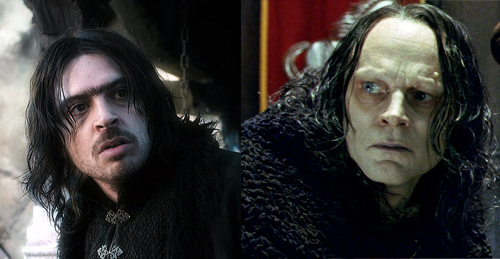
When it comes to fan speculation about a work of fiction, there are generally two types of ideas that people discuss: fan theories and headcanons. A fan theory of course is an idea about something in the work of fiction that's supported by possible evidence within the story. A headcanon, on the other hand, is an idea with no evidence to support it. It's just something that certain fans choose to believe because they like the idea. I've talked about plenty of fan theories from the Peter Jackson Hobbit films on this blog, but today I want to talk about a headcanon from the series and try to at least clear its path of anything that could contradict it. That headcanon is the idea that the character Alfrid Lickspittle is the father of Grima Wormtongue in the six Middle-earth movies.

To start off, Grima Wormtongue is a character from J.R.R. Tolkien's The Lord of the Rings book trilogy who also appears in the film adaptations. Alfrid Lickspittle is an original character created for the film adaptations of The Hobbit, a prelude to The Lord of the Rings. The two characters have a lot in common, being arrogant, sniveling, and manipulative and even having similar physical appearances. They're so similar that some fans used to speculate that they were the same character, with Alfrid changing his identity in between film trilogies to become Grima. This notion has always seemed unlikely since the two stories take place sixty years apart from each other, so the father and son headcanon seemed like a stronger alternative.

The only problem with the father and son idea (and also with the changing identity idea) is that the third Hobbit film's Extended Edition shows a bonus scene where Alfrid dies instead of making his getaway like in the theatrical cut. This doesn't destroy the father and son headcanon, like I used to think it did, but it certainly limits the possibilities.

The key to everything is Grima's age at the time of The Lord of the Rings. The only source I can find that mentions his year of birth is the website "One Wiki to Rule Them All," which claims that he was born in the year TA 2974. Since The Lord of the Rings takes place in the year TA 3019, this would make him forty-five years old and thus too young to be the son of someone who died sixty years prior. However, these dates are meant to reflect the timeline in Tolkien's books, where Alfrid's character doesn't exist. Whether or not "One Wiki to Rule Them All" is a reliable source, this timeline can be ignored because it doesn't truly relate to the movie-verse.

A source that does relate to the movie-verse, as odd as it sounds, is the Lord of the Rings Top Trumps Card Game. Available in three decks, the game features cards for each character as they're depicted in the Peter Jackson films, and those cards also offer a list of basic information on each character. According to Grima's card, he's fifty-nine years old in the movies.

This may seem like a year too short, but it's still possible that he was conceived before Alfrid's death. It would have to have happened shortly before though, and whether or not Grima's mother knew that she was pregnant, she probably would have wanted to distance herself from Alfrid and the town where he lived soon after the conception. Lowering her standards enough to spend the night with Alfrid could easily drive a woman to skip town like that. It's possible then that she traveled south in the following nine months and gave birth to Grima in the kingdom of Rohan, where we see him living as an adult. It could be that Grima hadn't quite reached his sixtieth birthday by the time of The Lord of the Rings, which could very well make him Alfrid's son in the timeline of the movies.

Like "One Wiki to Rule Them All" though, it's debatable how reliable of a source the Top Trumps card game is. And of course, it doesn't prove that Alfrid and Grima are related. It only leaves the possibility of that idea open. This is all that headcanons need though, and since that headcanon does the service of further tying together two trilogies and making the similarities between two characters feel less contrived, I still think it's worth considering.


Tuesday, July 19, 2016

The Appeal of Tom Bombadil

How you feel about certain elements in a popular series often depends on how you were introduced to the series as a whole. When it comes to a series like the Lord of the Rings trilogy that's been adapted across more than one medium, the fans who were introduced to it through the books tend to be more devoted to Tolkien's universe than the fans who were introduced to it through the movies. I'll admit upfront that I belong to the second group, and I think it's because of this that I've never quite seen the appeal of one of the books' more beloved elements: the character Tom Bombadil.

Appearing in only three chapters of the first Rings book, Tom Bombadil is a mystical, carefree fellow of unknown origins who wears yellow boots and a blue coat and spends his days wandering the Old Forrest while singing. He saves the hobbits a few times on the first leg of their journey, shows no interest at all in the One Ring, and then bows out of the story entirely with only a brief mention afterwards at the Council of Elrond. Like a lot of minor characters from the books, Bombadil gets left out of most adaptations, but he always seems to be the one whose absence people object to.

Why is that? He doesn't contribute all that much to the plot, and even by the books' own admission, he's so disconnected from everything having to do with the Ring that it's pointless to include him in the quest. What's more, having someone that lighthearted and silly pop up so early in the story almost harms the dark tone that it's trying to set. Again though, I'm someone who already saw the story play out fine without him on film before I read the book, so maybe I need to look at merry old Tom from a different angle to see his charm.


For starters, fans of Tom Bombadil probably like him more from a worldbuilding standpoint than from a storytelling one. Having the hobbits cross paths with someone who seems to come from a separate story makes Middle-earth feel like a much bigger place, and keeping Bombadil's origins a mystery opens up all kinds of fan theories about who or what he might actually be. As I've said in past essays, fan theories provide a more interactive way of enjoying a work of fiction, and since Tolkien mapped out so much of Middle-earth's history and mythos in his other writings, it makes sense that a rare enigma like Bombadil would intrigue so many readers.

Another explanation could be that his jolly, quirky demeanor makes him more unique and memorable. In a story full of brooding, angry, and depressed people, it does turn a few heads to see someone who's more upbeat among the cast. There's also something about an ageless, magical figure who's eccentric rather than stoic that people often find interesting. We've seen that type of character everywhere from Merlin the wizard in the King Arthur legend to the Cheshire Cat from Alice in Wonderland — even Mew from Pokemon, to be topical — and a lot of character complexity can be found in that contrast of age and youthfulness.

I think that the best explanation for Bombadil's appeal may lie in the story behind his creation. The character was said to be inspired by a doll with boots and a hat that belonged to one of Tolkien's children. After an incident where the doll survived getting stuffed down a lavatory (the Forbidden Pool, if you will), Tolkien was so impressed that he would often make up bedtime stories for his children about the doll's other adventures. The Hobbit also started out as a bedtime story, so when Tolkien came up with an idea for a sequel to the book, he decided to incorporate the doll-inspired Tom Bombadil into that followup.

Given their similar origins, it's only natural that Tom's scenes in The Lord of the Rings would have the same lighthearted tone as The Hobbit instead of the dark and serious tone of the sequel. It's also possible that the character is meant to ease that transition in tone, acting as one last callback to the more innocent times of Bilbo's adventure before the Nazgul come along and ruin everything. If this is the case, then his final mention at the Council of Elrond where the heroes decide not to involve him in the One Ring's destruction can be seen as an official goodbye to that innocence. That does kind of make it sad to see him go.

At the end of the day, I still think that the Lord of the Rings movies were smart to leave out Tom Bombadil. Film is a different medium that requires a tighter narrative than literature, so minor storylines such as his have to go. The fact that some of his lines are said by Treebeard in the Extended Edition of The Two Towers at least shows that Peter Jackson's team appreciated his character and wanted to have some nod to him in their version. I may not have the same attatchment to Bombadil as fans who discovered Middle-earth through the source material, but after looking at him through a wider scope and getting to know him better, I can appreciate him too.


Saturday, February 8, 2014

Are Borrowed Ideas Bad Ideas?

If you're a writer, you've probably been in this situation at least once: you come up with an original idea for a story, you get really enthused about it and start building on it, and then you discover that the idea isn't so original after all. It can be pretty disappointing for some of us to reach that realization, and looking at how much flack movies like Avatar and books like The Hunger Games have gotten for supposedly "borrowing" ideas from other works, it can also be pretty discouraging. Granted, both of those examples have been insanely huge successes, but not many aspiring authors have that kind of confidence in ideas they've barely begun to develop.

So what do you do in this situation? Should you abandon your idea altogether, should you alter it beyond recognition, or should you leave it as is and see how things turn out? And actually, is it even so bad to have a story that isn't 100% original?

One defense that people often make for alleged ripoffs is that there are only so many story ideas out there, so of course every book, movie, or TV show is going to remind us of something else. While I personally don't agree with the idea of there only being "so many story ideas" in existence, I will consent that we haven't come up with many new ones in a while. That being said, I do agree that stories shouldn't be condemned right off the bat for having familiar elements. What it comes down to, at least for me, is just how many familiar elements a story has and how well it presents them.

On the surface, The Hunger Games does have a similar premise to the 1999 novel Battle Royale; it centers around an annual tournament in which a group of children are thrown together in an isolated place and forced to fight to the death while being heavily monitored by the government, and (spoilers) two competitors end up defying the rule that there can only be one victor and walk away from the tournament together. Where The Hunger Games differs is that its tournament is constantly juxtaposed with a social commentary on the shallow glamor of celebrity life and how morally blind the public can be to things that are trendy. Also, the rules, setting, and reasons for the tournaments in each story are not the same, just the intended outcome.


Lastly, whereas Battle Royale is a single book, The Hunger Games is a trilogy of books that pretty much stops focusing on the tournament and becomes an entirely different entity by Part 3. What happens to the boy and girl who survive the tournament in Battle Royale? We don't know, because the story ends there. The Hunger Games sequels, however, go into great detail about Katniss and Peeta's lives after they defy the rules and how they eventually overthrow the dictator responsible for the tournament. Suzanne Collins had an idea that wasn't entirely new -- unbeknownst to her at the time, by the way -- but she gave it a unique spin and developed it into something that was able to find life and a storyline beyond its initial premise. The first Hunger Games book only sounds like a ripoff if you describe it as generally as I did at the beginning of the previous paragraph.

And then there's the film Eragon. I can't speak for the book series by Christopher Paolini since I haven't read it, and I'll give the screenwriter the benefit of a doubt too, but I find it very hard to sit through the movie without recognizing story elements from the original Star Wars film. It's one thing to have the same premise as another work; it's another thing to have the same plot. I know the idea of a lowly peasant getting thrown together with a princess, a wise old man, and a rogue scoundrel to battle an evil empire wasn't new even when Star Wars used it, but the specific storyline in that film was unique. The movie Eragon's storyline, in contrast, is practically note by note identical to Star Wars. Replacing the lightsabers with swords and the spaceships with dragons and horses doesn't make the narrative different.

What makes this worse is that Eragon doesn't even retell that story well. A lot of its scenes just putter out and give up at the end, and you never feel like you know anything about the characters or their personalities. It doesn't even feel like you really saw a film by the time it's over. Believe it or not, I might have actually excused the movie if it had told that story better than Star Wars. At least then it could have argued a case for its derivative-seeming nature.

This is the way I feel about Avatar. I never really minded how unoriginal the story in that film was because honestly, I don't think the movies it supposedly ripped off were that good to begin with. Condemning Avatar for borrowing from movies like Pocahontas and FernGully: The Last Rainforest is kind of like condemning The Hangover for borrowing from Dude, Where's My Car? It's not exactly tainting the good names of any masterpieces. Avatar may be corny and as subtle as a brick to the face, but it's one of the better versions of the "ignorant-person-destroying-the-forest-until-he-bonds-with-the-natives-and-saves-it" story.

Getting back on topic, what should an aspiring writer do if they realize their story idea isn't so original? Before deciding to pull the plug on your idea, you should take some time to really examine what you've got. How much does your story remind you of that other one that already used your premise? Does your story offer something unique from that other one? Most importantly, do you as the writer see potential in your story? If you have enough confidence in your idea and if you can even devise a way to make it more distinct from other similar works, you should proceed with it. If it seems like a weaker retread of something else, I would suggest setting it aside for later and going back to the drawing board in the meantime.

And if by chance you don't discover those similar works until after your story's been published, then hopefully you made your story as good as you possibly could.

Tuesday, July 23, 2013

"Well, in the book it says..."

Blowing off the dust after my longest hiatus to date...

I want to begin today's entry by talking about the movie The Hobbit. No surprise there, but I promise I have a point this time.

You see, there's a scene roughly 2/3 of the way through the film where Bilbo decides that he wants to turn back and go home. He tries to sneak away from the dwarves while they're sleeping, but one of them, a character named Bofur, catches him in the act and tries to talk him out of leaving. Bofur says that Bilbo is just homesick and that he understands that feeling, to which Bilbo snaps that none of the dwarves understand because they're used to "not belonging anywhere." Bilbo immediately apologizes for this insult, but Bofur sadly admits that it's true; "We don't belong anywhere." He then wishes the hobbit well and allows him to leave -- only for them and the rest of the group to be captured by goblins a second later. It's a well done scene and a very nice moment for both characters, and it's one of my favorite parts in the whole film. However, there is one little issue that I may or may not have with it. I say "may or may not" because there's actually another, bigger issue with the film that kind of cancels out the first issue.

I'll explain.

According to all of the movie guides, visual companion books, and online character profiles for The Hobbit, Bofur and his relatives Bifur and Bombur aren't from Erebor, the dwarf kingdom that was taken over by the dragon in the story. They're actually from the Blue Mountains, which is also where the dwarves from Erebor ended up settling. In short, I can literally draw a map of what's wrong with the above mentioned scene:


So yeah, the "We don't belong anywhere" line kind of falls apart coming from Bofur. He's one of the only dwarves in the whole group that it doesn't work for, in fact. If the screenwriters had put just about anyone else in that scene with Bilbo, there would be no issue.

With that said, here's the other, bigger issue that kind of cancels it out: we never learn Bofur's personal backstory in the movie. The dialogue never explains where he's from, why he joined the quest, or what sort of relationship he has with any of the other dwarves. This is the case for most of the dwarves in the movie, minus their leader Thorin, and since their backstories don't exist in any of Tolkien's works, the supplementary guide books for the film are the only places where you can read up on that information. So if you don't bother with any of those extra materials and just watch the film by itself, that scene will play out just fine.

This finally leads me to today's topic: required reading for movies. There are entire websites and bookstore shelves filled with literature about characters, locations, chronologies, and so on from popular film franchises. Their purpose is to enrich the films by giving juicy inside information about what's happening onscreen. In some cases, they also divulge a few very important tidbits of information that pertain to the plot, which for some reason aren't spelled out nearly as well in the movies themselves. As a result, many of these "enriching" materials become necessary ones that you won't be able to follow the movies without.

Take the Star Wars prequels for instance -- the worst offenders of this, in my opinion. Virtually no one has ever been able to make sense of the villains' plans in any of those films without first consulting the billions of outside materials that Lucasfilm is happy to sell. I'm not condemning anyone for reading or buying those materials, seeing how I own several myself, but I've come to realize from them just how poorly and lazily written those movies are. You should never have to do research in order to understand a film. If the filmmakers do their jobs well, you won't have any questions by the time the end credits roll, at least not about the plot or the characters' motivations.

The same goes for movies that have been adapted from novels or comic books. Just because the audience for an adapted movie has most likely read the source material beforehand doesn't mean the screenwriters have an excuse to phone in their script and skimp on the exposition. Movies are meant to be accessible to everyone, not just to one group of people, but you can tell that a lot of popular movie adaptations out there are mainly written for people who've already read the source material. Try going into these movies cold, and you will be very confused by what you're watching. I know as an aspiring author that I should be encouraging people to read the books in addition to seeing the films, but as an aspiring filmmaker, I 'm saying that it shouldn't be necessary to do so. Movies like The Godfather, Jurassic Park, and even 2013's The Great Gatsby prove that a discernible stand-alone adaptation can be made.

So my question after all this ranting is, what makes the supplementary/source material for a movie required reading? At what point does it cross that line and start to do the screenwriters' jobs for them? Ultimately, I think it comes down to how essential to the story the information in question is. You don't need to know every aspect of how the Galactic Republic operates, but you do need to know why it's having trouble operating and why the Separatists are declaring war on it. You don't need to know how or why Sirius Black and Remus Lupin created the Marauder's Map in Harry Potter, but you do need to know that they created it so you won't be puzzled when they randomly start explaining how it works.

And then there's The Hobbit. As much as some of us may enjoy reading about Bofur the dwarf's personal background, he's a peripheral character, and thus we don't need to know anything about him in order to follow the plot. However, we do need to know a lot about Thorin, the dwarves' leader who sets the whole plot in motion. We need to learn that two of the other dwarves in the group are his nephews so we'll understand [something that happens near the end of the story]. We need to know how Gandalf managed to get the key to Erebor from Thorin's presumably dead father so we won't be questioning the logic of it the entire time. Those things haven't been made clear yet in the Hobbit trilogy, and if they never are, then we'll have issues. If they're made clear by the end of the second film, then smooth sailing. And who knows? Maybe the second film will even reveal Bofur's background after all and it'll turn out that his "We don't belong anywhere" line was just a big sad act to put Bilbo on a guilt trip. The possibilities are still endless.

So that's my two cents about extra reading materials. They're still a ton of fun to dive into, but they should remain in the shadows of the movies that they're about. Keep collecting them if you like them, and if you don't like them, then hopefully you'll never need to.

And if it's not too much to ask, Peter Jackson, could you please explain why the characters in The Hobbit can't just fly those giant eagles to their destination? I know it says in the book, but I think you finally have the opportunity you need to state it on film and put that issue to rest.