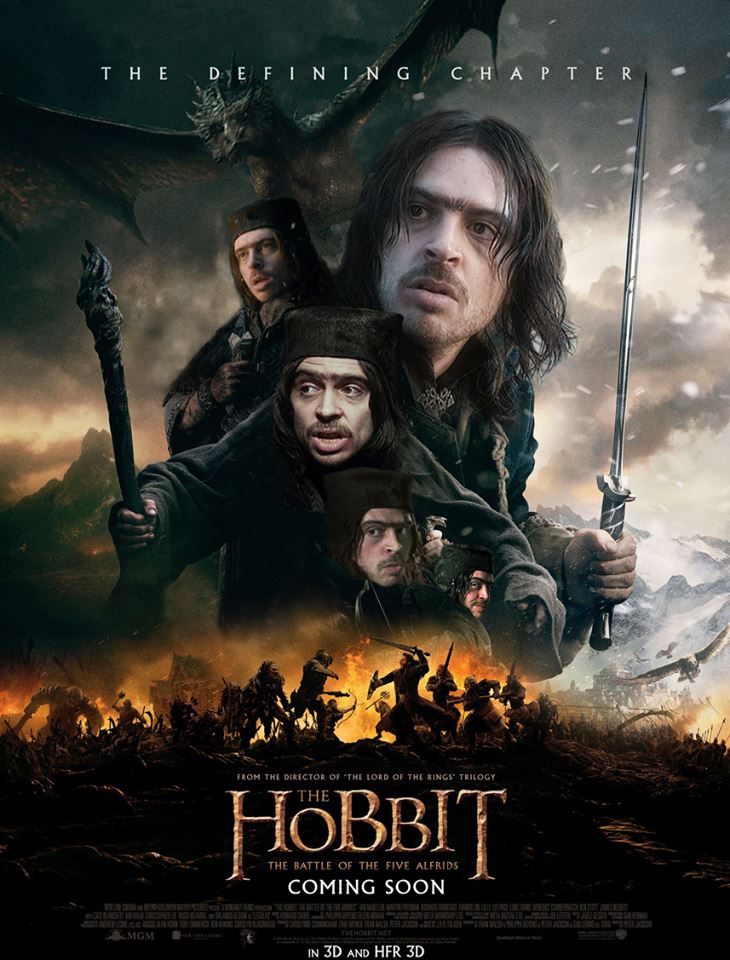
Showing posts with label alfrid. Show all posts

Saturday, October 15, 2016

Grima, Son of Alfrid


When it comes to fan speculation about a work of fiction, there are generally two types of ideas that people discuss: fan theories and headcanons. A fan theory of course is an idea about something in the work of fiction that's supported by possible evidence within the story. A headcanon, on the other hand, is an idea with no evidence to support it. It's just something that certain fans choose to believe because they like the idea. I've talked about plenty of fan theories from the Peter Jackson Hobbit films on this blog, but today I want to talk about a headcanon from the series and try to at least clear its path of anything that could contradict it. That headcanon is the idea that the character Alfrid Lickspittle is the father of Grima Wormtongue in the six Middle-earth movies.

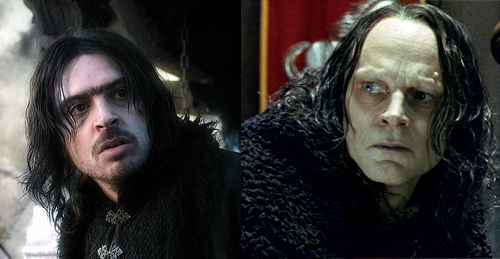
To start off, Grima Wormtongue is a character from J.R.R. Tolkien's The Lord of the Rings book trilogy who also appears in the film adaptations. Alfrid Lickspittle is an original character created for the film adaptations of The Hobbit, a prelude to The Lord of the Rings. The two characters have a lot in common, being arrogant, sniveling, and manipulative and even having similar physical appearances. They're so similar that some fans used to speculate that they were the same character, with Alfrid changing his identity in between film trilogies to become Grima. This notion has always seemed unlikely since the two stories take place sixty years apart from each other, so the father and son headcanon seemed like a stronger alternative.

The only problem with the father and son idea (and also with the changing identity idea) is that the third Hobbit film's Extended Edition shows a bonus scene where Alfrid dies instead of making his getaway like in the theatrical cut. This doesn't destroy the father and son headcanon, like I used to think it did, but it certainly limits the possibilities.

The key to everything is Grima's age at the time of The Lord of the Rings. The only source I can find that mentions his year of birth is the website "One Wiki to Rule Them All," which claims that he was born in the year TA 2974. Since The Lord of the Rings takes place in the year TA 3019, this would make him forty-five years old and thus too young to be the son of someone who died sixty years prior. However, these dates are meant to reflect the timeline in Tolkien's books, where Alfrid's character doesn't exist. Whether or not "One Wiki to Rule Them All" is a reliable source, this timeline can be ignored because it doesn't truly relate to the movie-verse.

A source that does relate to the movie-verse, as odd as it sounds, is the Lord of the Rings Top Trumps Card Game. Available in three decks, the game features cards for each character as they're depicted in the Peter Jackson films, and those cards also offer a list of basic information on each character. According to Grima's card, he's fifty-nine years old in the movies.

This may seem like a year too short, but it's still possible that he was conceived before Alfrid's death. It would have to have happened shortly before though, and whether or not Grima's mother knew that she was pregnant, she probably would have wanted to distance herself from Alfrid and the town where he lived soon after the conception. Lowering her standards enough to spend the night with Alfrid could easily drive a woman to skip town like that. It's possible then that she traveled south in the following nine months and gave birth to Grima in the kingdom of Rohan, where we see him living as an adult. It could be that Grima hadn't quite reached his sixtieth birthday by the time of The Lord of the Rings, which could very well make him Alfrid's son in the timeline of the movies.

Like "One Wiki to Rule Them All" though, it's debatable how reliable of a source the Top Trumps card game is. And of course, it doesn't prove that Alfrid and Grima are related. It only leaves the possibility of that idea open. This is all that headcanons need though, and since that headcanon does the service of further tying together two trilogies and making the similarities between two characters feel less contrived, I still think it's worth considering.


Friday, June 19, 2015

To Kill an Alfrid


Well, it's finally happened. After months of theorizing and speculating, fans of The Hobbit have finally received a list of bonus scenes to expect in the Extended Edition of The Battle of the Five Armies. I don't recall a list like this coming out for any of the previous five Extended Editions, at least not this early. If I'm correct to think that it hasn't been done before, this could serve as further evidence that Peter Jackson was forced to trim down this film far beyond his liking for the theaters.

In any case, here's the list:
  • More scenes of Bard attempting to kill Smaug
  • More scenes of Smaug destroying Lake-town
  • An extended scene of Azog's invasion forces
  • Elf archers firing at Orcs, Wargs, and Trolls
  • Dwarves with Ballistas firing at Orcs and Trolls
  • Dwarven Goat Riders and Rams join the battle to attack Orcs and Wargs
  • Funeral of Thorin, Fili, and Kili
  • Coronation of Dain II Ironfoot, Now King Dain II Ironfoot
  • Bard becoming the new king of New Dale
  • Gifts of treasures given to Bilbo, Bard, Thranduil, and the People of Lake-town
  • Bilbo and Gandalf revisit the Trollshaws
  • An Exchange between Thranduil and Gloin during the battle
  • Beorn tortured in Dol Guldor
  • Sauron interrogates Gandalf in Dol Guldor
  • The death of Alfrid Lickspittle
  • More fighting in the city of Dale
  • More battle scenes
  • The war beasts Azog sends just after the battle begins
  • Axe blade removed from Bifur's forehead
  • Conversation between Bilbo and Bofur before Bilbo hands over the Arkenstone
  • Smaug destroys the Dwarven Wind lance
  • Galadriel unveils true the power of her Elven ring, Nenya
  • Thorin and Company start counting and assessing their treasure hoard
  • Bilbo buries his acorn in Dale
  • Beorn brings a dead Thorin II Oakenshield back to the Lonely Mountain
  • More graphic and brutal Orc kills 
Most of these scenes seem like promising additions, particularly the ones involving the dwarves from Thorin's Company. The only extra footage of Smaug's attack on Lake-town that I think we need is him destroying the Wind lance to explain why Bard doesn't use it, but if more destruction and attempts to kill him better illustrate the horror of that attack, then I'll take it. Scenes like Beorn being tortured and Bilbo planting his acorn should also be interesting, and it looks like a lot more very welcome closure is in store for the end of this version.

The only scene on this list that I have reservations about, strangely enough, is Alfrid's death.

I've been all over the spectrum with this character since the release of The Battle of the Five Armies. In the span of a few months, I've gone from saying that he shouldn't be disposed of so quickly and that he should get more screentime to saying that his only screentime at all should consist of Bilbo kicking him in the shin. The whole "Alfrid Problem" is just so befuddling because he had so much potential in the second Hobbit film that went utterly wasted in the third, and it leaves many of us scratching our heads about why he was even written into this trilogy.

The question then is why I would take issue with seeing him die if that's pretty much the only gratifying thing he can do at this point. Well, there may be a few answers for that.

First of all, there is a legitimate reason for adding Alfrid's character to the films. Giving the Master of Lake-town an accomplice makes sense from a screenwriting standpoint because it's easier to convey his plans to the audience when he has someone to discuss them with out loud. The puzzlement is why the Master becomes the one to die in the third film's opening while his accomplice gets to stick around afterwards for the majority of the plot. It would be a lot truer to the book if the opposite happened, with Alfrid the watchful manipulator dying in Lake-town and the Master being reduced to a powerless weasel without his aide around to manage things.


The screenwriters wouldn't even have to change all that much; Alfrid could get killed by Smaug right after the Master pushes him off their boat, then Bard's lasso could pull the Master overboard and Smaug could fall on the boat before the Master can return to it to save his gold. The Master could spend the rest of the movie doing the exact same things that Alfrid does, discovering how ineffectual he really is on his own, then decide to skirt off—so to speak—after finding the gold hoard in Dale because wealth was all he ever cared about.

It doesn't make as much sense for Alfrid to have that story arc in the third film because he was never established as being so materialistic before Smaug's attack. He actually suggests dumping some of the Master's gold overboard to lighten the boat during their escape attempt, so it seems somewhat out of character for him to become obsessed with getting his hands on Erebor's gold later. I guess the argument can be made that he starts falling into the same greedy vices as the Master once he comes into his own, much like Thorin does after succeeding Thror, but the movie never indicates that this sort of character development is going on. It almost feels like the roles were the other way around originally and then Alfrid was dumped into the Master's place at the last minute without any other changes being made to those scenes.

That brings me to my first issue with Alfrid's death. In my opinion, if this adaptation is going to give him the Master's story arc, then the least it can do is be true to the Master's arc in the book. Killing Alfrid robs that arc of one of the few things it had in common with the source material. Granted, we don't know what "The Death of Alfrid Lickspittle" entails, if we'll see him get killed during the battle or starve to death in the wilderness like the Master eventually does in Tolkien's writings, but knowing these movies, it's likely that he'll meet a more theatrical demise.

My second issue with Alfrid’s death, which I admit is my own problem, is that I had been very on board with the headcanon that he was actually Grima Wormtongue’s father in the movies. One of the biggest grievances that people have always had with Alfrid is that he’s a knockoff of Wormtongue, so what better solution is there for that resemblance than to make them relatives? It would have explained a few things about Wormtongue too, such as why he has a drastically different appearance from the other Rohan natives, and it would have given fans something neat to further tie the two trilogies together.


Any chance of that being canon dies with Alfrid in the Extended Edition of the third Hobbit movie though, which means we have to go right back to accepting that he looks, sounds, and acts exactly like another Middle-earth character by complete coincidence. In that sense, his storyline is one that the filmmakers might have been better off leaving open-ended.

My third issue comes from looking at the Hobbit films in a wider scope with the Lord of the Rings films. For as much as The Lord of the Rings gets dubbed the darker of the two stories, it leaves surprisingly few casualties on the good guys' side. The only significant, permanent, onscreen deaths that I can think of are Boromir's, King Theoden's, and Haldir's. On the bad guys' side, however, virtually everyone dies. Sure, Shelob lives and some of the orcs escape from that earthquake outside Mordor at the end of The Return of the King, but none of them were really characters that we grew to personally know or hate.

That makes Alfrid's apparent survival in the theatrical cut of The Battle of the Five Armies rather unique. Instead of dying like every other notable antagonist, his comeuppance is running away alone and disgraced with nothing wholesome or meaningful in his future. That's arguably an even worse fate. It's also a much more mature and thought-provoking one when compared to the deaths of the heroes Thorin, Fili, and Kili.

It all hearkens back to Gandalf's line in The Fellowship of the Ring about how "many that live deserve death" while "some that die deserve life." I think that this line resonates a lot more if we've seen examples of both play out in a previous film. Keeping Alfrid alive adds an extra dose of reality to the whole six-film series, however unfair that reality is, and it creates something of another legacy from The Hobbit that didn't exist so clearly in the first Lord of the Rings movie prior to last December. Having him turn out to die after all, in my mind, undoes the one substantial thing that he contributed to The Battle of the Five Armies.

I'm not sure how any of the decisions on Alfrid's role in the trilogy were made. My theory is that the filmmakers really liked actor Ryan Gage and decided to do a lot of tinkering with the script after realizing that they had to scrap the character he was originally cast for, but that's mostly just a hunch. In the end, Alfrid is what he is, and no amount of complaining is going to change that. It's possible that the upcoming Extended Edition could give some depth to his character like the last one did, but if not, I can look on the bright side. If his death is the only bonus scene that I have reservations about on a list of twenty-six, then I’ve got it pretty good.


Tuesday, February 17, 2015

Was Bilbo a Failure?

I was recently thinking about the third Hobbit movie, The Battle of the Five Armies, when I realized what my biggest issue with it is. It's not that it strays from the book or that the elves get more screentime than the dwarves, or even that Alfrid gets any screentime.

It's that the main protagonist, Bilbo Baggins, doesn't clearly accomplish anything by the end of it.


That's not to say that Bilbo doesn't do anything in the movie. He actually does quite a lot. It's just that for as much as he does, none of it really seems to pay off.

His main goal for about the first half of the plot is to save his thirteen dwarf friends by preventing the battle over the treasure that Thorin refuses to share with the Laketown survivors. Bilbo tries to accomplish this by giving the survivors Thorin's prized Arkenstone, which they can use as leverage to get their promised share of treasure from the corrupt dwarf king. It's an ingenious plan (despite Thorin trying to kill him over it), but then a bunch of other armies show up and make it all for nothing. Bilbo's new objective after that becomes to save Thorin and company from an ambush by Azog on Ravenhill during the battle. He does a good job of defying Gandalf's authority and reaching Thorin in time to warn him, but by then it's too late for them to escape from that ambush, so Thorin, Fili, and Kili end up dying anyway.

And then there's Bilbo's overall goal throughout the whole film: to save Thorin from his corruption. He does succeed at that, but Thorin's death soon afterwards makes it kind of a short life lesson, and since the other dwarves already disapproved of his greedy behavior, they don't really learn anything from the hobbit by the end either. What's more, instead of feeling uplifted by Thorin's noble redemption, Bilbo spends the rest of the movie and possibly the rest of his life so traumatized that he can barely even admit Thorin was his friend.

Man, and we say The Lord of the Rings is the darker story.

It's possible, like many issues with The Battle of the Five Armies, that this will be ironed out in the Extended Edition later this year. You can also make the argument that Bilbo's real goal throughout the entire trilogy was to help the dwarves of Erebor reclaim their homeland, which he did, and therefore he wasn't a failure. I heartily agree with that argument, but the third installment doesn't take the time to properly reflect on that and remind us of Bilbo's successes when all is said and done.

...And that's why I think The Battle of the Five Armies needed to establish Ori's journal.

If you read my essay "There's Something About Ori" back in November, you knew I was going to revisit that topic sooner or later after the third movie came out. Not only doesn't the mitten-wearing scribe get the payoff I was hoping to see for him in Battle, but he doesn't even photobomb Bilbo all that much. He does get to stand with Bofur at the front and center of the group when Bilbo says good-bye to the dwarves though, and I'm fairly certain there was a shot of him killing orcs during the company's charge onto the battlefield. It's also been brought to my attention that Ori did in fact draw the sketch of young Bilbo seen in An Unexpected Journey, so at least one speculation in my essay was right.

But I digress. In regards to Bilbo's successes, I think establishing Ori's journal would have done a world of good because it would have reintroduced a very important element of the story: legacy. That's the idea behind Bilbo's book, as well as all of the tales and songs presented in Middle-Earth. They're the means by which their writers pass along lessons and experiences so that future generations can learn from them as well. By informing Bilbo and the audience that one of the dwarves was documenting the quest the whole time, the third movie would have assured that the hobbit's part in that quest would become a major part of Erebor's history. Also, since Ori wrote that tale, we could assume that it would present Bilbo in a positive light and as a good role model.

Just think back to the company's prison-break from Mirkwood in The Desolation of Smaug. Right before Bilbo shows up with the keys, we see Ori very gloomily ask his brother, "We're never gonna reach the mountain, are we?" After Bilbo arrives and starts freeing the dwarves from their cells, we see Ori again, looking completely awestruck by him.


Wouldn't it be a great payoff to have Ori approach Bilbo, perhaps after Thorin's funeral in the Extended Edition, and tell him that every dwarf in Erebor who reads about its reclamation will know it was all thanks to a humble but decent hobbit? It might also be a nice touch if he mentions his notes including how that humble, decent hobbit made the fallen King Under the Mountain noble again. And just for continuity's sake, I would have Ori first break the ice by awkwardly giving Bilbo that portrait sketch.

Alas, like most of my recent Hobbit ramblings, whether or not something like this will happen remains to be seen. I don't know how much hype there's been for the last two Extended Editions, but I suspect the third one is going to stir up a heck of a lot more buzz. It might even stir up enough to rival the third film's theatrical release, at least among fans. And who can blame us? To me, the issue of Bilbo's undermined accomplishments at the end of The Battle of the Five Armies is the ultimate proof that we didn't get a whole movie last December.

And if by change the Extended Edition features a scene of Bilbo kicking Alfrid in the shin, I'll count that as another success.

Monday, December 22, 2014

Thoughts on Alfrid

Now that we've had time to absorb The Hobbit: The Battle of the Five Armies, I'd like to discuss one particular element of the film today. The character Alfrid (played by Ryan Gage) has had a largely negative reception from viewers, being seen by many as an irritating and pointless addition to the story. Being invented solely for the movies and having a strong resemblance to the character Grima Wormtongue from The Lord of the Rings have never helped his case. It's tough to disagree with the complaints about him in the latest Hobbit movie, but perhaps fans, like the survivors of Laketown, shouldn't be too quick to dispose of him.

I actually found Alfrid really interesting in The Desolation of Smaug. Even in the theatrical cut where a lot of his scenes are omitted, you can tell he has his own agenda. There's something about the way he speaks to the Master of Laketown, watches the other man's reactions, and behaves when the Master isn't looking that suggests he hates the disgusting windbag and is just using him as a puppet to control the town. It's a real testament to Gage's subtlety as an actor.

You would think then that the Master's death at the start of The Battle of the Five Armies would allow Alfrid to step out of the shadows and shine as a character. Instead, the film reduces him to a string of punchlines until he scurries off. He doesn't learn anything, he doesn't oppose the heroes, he just reminds us that he's a jerk and runs off in a dress. Why make a point to spare him from Smaug and the other townspeople if the plot isn't going to make use of his survival?

Granted, this might be smoothed out in the Extended Edition next November. That's a long time from now though, and since I've got this cemented in my head, here's my personal take on what the movie could have done with the character:

After falling out of favor with the townspeople, Alfrid starts contemplating how to win back their approval while grudgingly following Bard's orders in the meantime. He eavesdrops on the meeting where Bilbo gives the Arkenstone to Bard and Thranduil, then just like in the movie, Gandalf forces him to look after the hobbit. This of course ends with Bilbo promptly escaping from Alfrid, which makes the man look even worse and gives him a personal reason to resent Mr. Baggins.

Later, when Bard reveals to Thorin that he has the Arkenstone and Bilbo prepares to explain his role in it, Alfrid steps forward from the crowd. He informs Thorin of Bilbo's actions and describes them in the most dastardly way possible. This feeds Thorin's paranoia to the point that when Bilbo explains himself truthfully, the dwarf king refuses to believe him. Bard angrily asks Alfrid what he's up to, and Alfrid explains that exposing a traitor among Oakenshield's company will make the dwarves violently turn on each other, thus removing the need for a battle.

That's Alfrid's plan to win back the townspeople's approval -- to be the one who got them the gold and prevented war. His triumph is short-lived though, as Gandalf intervenes to save Bilbo and then the orc army arrives gung-ho for a fight anyway. No longer seeing a future for himself among the survivors of Laketown, Alfrid lies low during the battle and flees with his stolen gold at the first opportunity.

It's possible that something along those lines could happen in the Extended Edition. Philippa Boyens said in the commentary for The Desolation of Smaug that Alfrid's character is supposed to "blossom" in the third film, which doesn't seem to have happened yet. Some may cringe at the thought of him getting even more screentime, but as we saw with Beorn's introduction in the last film, sometimes material in a theatrical cut gets removed from the Extended Edition to make way for a better alternative.

And just for the heck of it, here's a crazy fan theory to walk away with: maybe in the movies, Alfrid is Grima Wormtongue's father.


They look, sound, and act a lot alike, right? Wormtongue has a vastly different appearance from the other Rohan natives, and sixty years do pass between the two film trilogies. Perhaps after slipping away from the battle, Alfrid found his way to Rohan, changed his name to Galmod for good measure, and found a woman stupid enough to marry him. Having a ton of cash on him probably helped in that department. The end result was Grima, who apparently followed his father's example and attached himself to two powerful figures.

And as for Grima's creepy habits with women...well, he probably overheard a few arguments between his parents about whose dress from Laketown that was in the closet.