Showing posts with label beorn. Show all posts

Friday, June 19, 2015

To Kill an Alfrid


Well, it's finally happened. After months of theorizing and speculating, fans of The Hobbit have finally received a list of bonus scenes to expect in the Extended Edition of The Battle of the Five Armies. I don't recall a list like this coming out for any of the previous five Extended Editions, at least not this early. If I'm correct to think that it hasn't been done before, this could serve as further evidence that Peter Jackson was forced to trim down this film far beyond his liking for the theaters.

In any case, here's the list:
  • More scenes of Bard attempting to kill Smaug
  • More scenes of Smaug destroying Lake-town
  • An extended scene of Azog's invasion forces
  • Elf archers firing at Orcs, Wargs, and Trolls
  • Dwarves with Ballistas firing at Orcs and Trolls
  • Dwarven Goat Riders and Rams join the battle to attack Orcs and Wargs
  • Funeral of Thorin, Fili, and Kili
  • Coronation of Dain II Ironfoot, Now King Dain II Ironfoot
  • Bard becoming the new king of New Dale
  • Gifts of treasures given to Bilbo, Bard, Thranduil, and the People of Lake-town
  • Bilbo and Gandalf revisit the Trollshaws
  • An Exchange between Thranduil and Gloin during the battle
  • Beorn tortured in Dol Guldor
  • Sauron interrogates Gandalf in Dol Guldor
  • The death of Alfrid Lickspittle
  • More fighting in the city of Dale
  • More battle scenes
  • The war beasts Azog sends just after the battle begins
  • Axe blade removed from Bifur's forehead
  • Conversation between Bilbo and Bofur before Bilbo hands over the Arkenstone
  • Smaug destroys the Dwarven Wind lance
  • Galadriel unveils true the power of her Elven ring, Nenya
  • Thorin and Company start counting and assessing their treasure hoard
  • Bilbo buries his acorn in Dale
  • Beorn brings a dead Thorin II Oakenshield back to the Lonely Mountain
  • More graphic and brutal Orc kills 
Most of these scenes seem like promising additions, particularly the ones involving the dwarves from Thorin's Company. The only extra footage of Smaug's attack on Lake-town that I think we need is him destroying the Wind lance to explain why Bard doesn't use it, but if more destruction and attempts to kill him better illustrate the horror of that attack, then I'll take it. Scenes like Beorn being tortured and Bilbo planting his acorn should also be interesting, and it looks like a lot more very welcome closure is in store for the end of this version.

The only scene on this list that I have reservations about, strangely enough, is Alfrid's death.
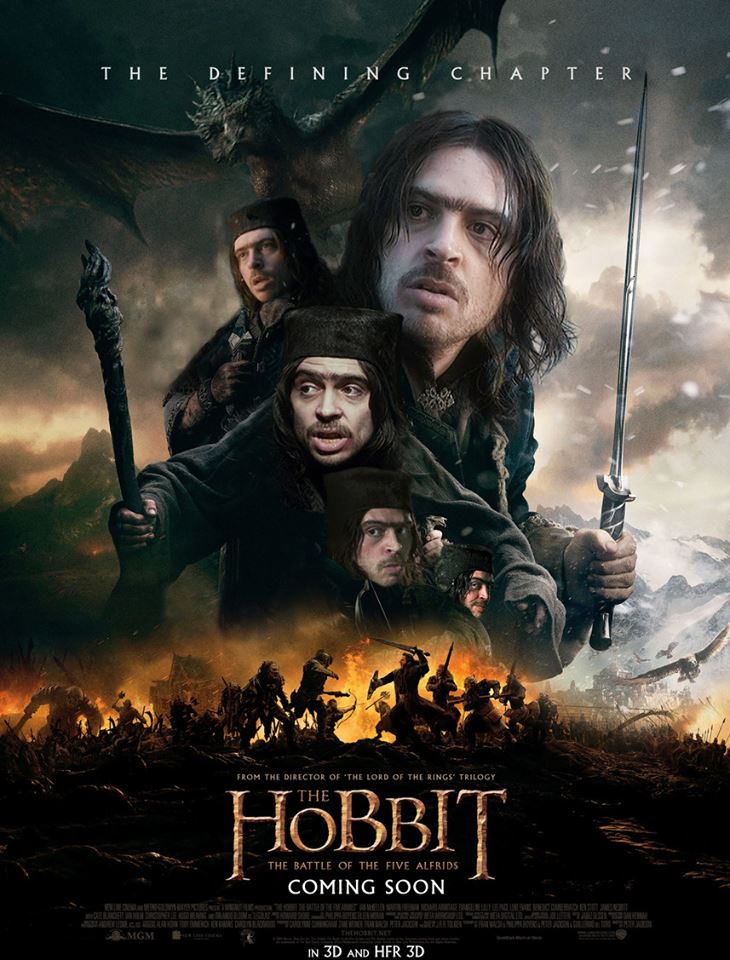
I've been all over the spectrum with this character since the release of The Battle of the Five Armies. In the span of a few months, I've gone from saying that he shouldn't be disposed of so quickly and that he should get more screentime to saying that his only screentime at all should consist of Bilbo kicking him in the shin. The whole "Alfrid Problem" is just so befuddling because he had so much potential in the second Hobbit film that went utterly wasted in the third, and it leaves many of us scratching our heads about why he was even written into this trilogy.

The question then is why I would take issue with seeing him die if that's pretty much the only gratifying thing he can do at this point. Well, there may be a few answers for that.

First of all, there is a legitimate reason for adding Alfrid's character to the films. Giving the Master of Lake-town an accomplice makes sense from a screenwriting standpoint because it's easier to convey his plans to the audience when he has someone to discuss them with out loud. The puzzlement is why the Master becomes the one to die in the third film's opening while his accomplice gets to stick around afterwards for the majority of the plot. It would be a lot truer to the book if the opposite happened, with Alfrid the watchful manipulator dying in Lake-town and the Master being reduced to a powerless weasel without his aide around to manage things.


The screenwriters wouldn't even have to change all that much; Alfrid could get killed by Smaug right after the Master pushes him off their boat, then Bard's lasso could pull the Master overboard and Smaug could fall on the boat before the Master can return to it to save his gold. The Master could spend the rest of the movie doing the exact same things that Alfrid does, discovering how ineffectual he really is on his own, then decide to skirt offso to speakafter finding the gold hoard in Dale because wealth was all he ever cared about.

It doesn't make as much sense for Alfrid to have that story arc in the third film because he was never established as being so materialistic before Smaug's attack. He actually suggests dumping some of the Master's gold overboard to lighten the boat during their escape attempt, so it seems somewhat out of character for him to become obsessed with getting his hands on Erebor's gold later. I guess the argument can be made that he starts falling into the same greedy vices as the Master once he comes into his own, much like Thorin does after succeeding Thror, but the movie never indicates that this sort of character development is going on. It almost feels like the roles were the other way around originally and then Alfrid was dumped into the Master's place at the last minute without any other changes being made to those scenes.

That brings me to my first issue with Alfrid's death. In my opinion, if this adaptation is going to give him the Master's story arc, then the least it can do is be true to the Master's arc in the book. Killing Alfrid robs that arc of one of the few things it had in common with the source material. Granted, we don't know what "The Death of Alfrid Lickspittle" entails, if we'll see him get killed during the battle or starve to death in the wilderness like the Master eventually does in Tolkien's writings, but knowing these movies, it's likely that he'll meet a more theatrical demise.

My second issue with Alfrid’s death, which I admit is my own problem, is that I had been very on board with the headcanon that he was actually Grima Wormtongue’s father in the movies. One of the biggest grievances that people have always had with Alfrid is that he’s a knockoff of Wormtongue, so what better solution is there for that resemblance than to make them relatives? It would have explained a few things about Wormtongue too, such as why he has a drastically different appearance from the other Rohan natives, and it would have given fans something neat to further tie the two trilogies together.


Any chance of that being canon dies with Alfrid in the Extended Edition of the third Hobbit movie though, which means we have to go right back to accepting that he looks, sounds, and acts exactly like another Middle-earth character by complete coincidence. In that sense, his storyline is one that the filmmakers might have been better off leaving open-ended.

My third issue comes from looking at the Hobbit films in a wider scope with the Lord of the Rings films. For as much as The Lord of the Rings gets dubbed the darker of the two stories, it leaves surprisingly few casualties on the good guys' side. The only significant, permanent, onscreen deaths that I can think of are Boromir's, King Theoden's, and Haldir's. On the bad guys' side, however, virtually everyone dies. Sure, Shelob lives and some of the orcs escape from that earthquake outside Mordor at the end of The Return of the King, but none of them were really characters that we grew to personally know or hate.

That makes Alfrid's apparent survival in the theatrical cut of The Battle of the Five Armies rather unique. Instead of dying like every other notable antagonist, his comeuppance is running away alone and disgraced with nothing wholesome or meaningful in his future. That's arguably an even worse fate. It's also a much more mature and thought-provoking one when compared to the deaths of the heroes Thorin, Fili, and Kili.

It all hearkens back to Gandalf's line in The Fellowship of the Ring about how "many that live deserve death" while "some that die deserve life." I think that this line resonates a lot more if we've seen examples of both play out in a previous film. Keeping Alfrid alive adds an extra dose of reality to the whole six-film series, however unfair that reality is, and it creates something of another legacy from The Hobbit that didn't exist so clearly in the first Lord of the Rings movie prior to last December. Having him turn out to die after all, in my mind, undoes the one substantial thing that he contributed to The Battle of the Five Armies.

I'm not sure how any of the decisions on Alfrid's role in the trilogy were made. My theory is that the filmmakers really liked actor Ryan Gage and decided to do a lot of tinkering with the script after realizing that they had to scrap the character he was originally cast for, but that's mostly just a hunch. In the end, Alfrid is what he is, and no amount of complaining is going to change that. It's possible that the upcoming Extended Edition could give some depth to his character like the last one did, but if not, I can look on the bright side. If his death is the only bonus scene that I have reservations about on a list of twenty-six, then I’ve got it pretty good.


Saturday, May 16, 2015

The Road to Bilbo's Oak Tree


One of the more talked about scenes in The Hobbit: The Battle of the Five Armies is the scene where Bilbo shows Thorin the acorn from Beorn's garden. It's not a long scene, and like many in that film, it wasn't in the book, but there's always been a bit of buzz surrounding it. Some people like it for being one of the happier and more tender moments in Battle, and others like it for the metaphor comparing Bilbo's character to an acorn, which had been very subtly hinted at up until that point. This is especially clever when contrasted with Thorin, who is often associated with an oak tree because of his oakenshield.

I think one of the biggest reasons why people talk about the scene is because we don't really get a payoff for it. Thorin tells Bilbo to go home and plant his tree, but we never see the hobbit do that. We want to know what became of the acorn since it tugged at our heartstrings so much.

Popular belief for a little while was that the oak tree on top of Bag End was the tree that Bilbo planted from it. However, the few exterior shots that we see of his house in the beginning of An Unexpected Journey and the end of The Battle of the Five Armies seem to show that the tree was already there prior to his adventure.


I tried comparing those shots with shots of Bag End from The Fellowship of the Ring to see if any other trees had appeared there since the Hobbit movies. There's one lighter colored tree on the side of the hill in Fellowship that looks small enough to have been planted fairly recently, but it's hard to tell from the angle in Battle if it's already there or not. In any case, it doesn't look like an oak tree.


This left me in a bit of a quandary. Was I overlooking something? Was the acorn scene such a last-minute idea for the Hobbit movies that the filmmakers didn't have time to go back and remove one of the trees from Bag End's exterior shots? Was there a deleted scene showing where Bilbo planted the acorn? These questions were nagging me so much one day that I decided to research the matter using one of the greatest sources of information known to modern man.

Tumblr.

And sure enough, I found an answer. Apparently, there is going to be a bonus scene in the Battle of the Five Armies Extended Edition that shows Bilbo planting his acorn—in Dale.

This of course raises all sorts of new questions. Why would Bilbo do that when Thorin told him to plant the tree at his home? Did Bilbo not want to remember his journey after all? Did he do it to leave a reminder of himself in the closest place to Erebor where a tree could grow?

My personal theory is that Bilbo knew by then that Bag End was never really going to be his home anymore, so he didn't want to plant his tree there. Maybe a part of him always knew that he was going to leave the Shire again one day and try to return to Erebor, so he saw the East as his home instead. It would certainly lend a more poignant subtext to his decision to leave in Lord of the Rings; one of his motivations could have been that he wanted to see his oak tree once before he died.

As most of my essays these days end though, no conclusions can really be drawn until the Extended Edition comes out. If there is a scene of Bilbo planting his acorn in Dale, it could contain dialogue or something else that conveys his reasoning. It's also entirely possible that it won't, and that the reasoning will be left up to the viewer's imagination. Either way, I suspect that Bilbo's acorn and the tree that grew from it will remain a popular topic of discussion among Hobbit fans after this November.