Showing posts with label unexpected. Show all posts

Saturday, May 16, 2015

The Road to Bilbo's Oak Tree


One of the more talked about scenes in The Hobbit: The Battle of the Five Armies is the scene where Bilbo shows Thorin the acorn from Beorn's garden. It's not a long scene, and like many in that film, it wasn't in the book, but there's always been a bit of buzz surrounding it. Some people like it for being one of the happier and more tender moments in Battle, and others like it for the metaphor comparing Bilbo's character to an acorn, which had been very subtly hinted at up until that point. This is especially clever when contrasted with Thorin, who is often associated with an oak tree because of his oakenshield.

I think one of the biggest reasons why people talk about the scene is because we don't really get a payoff for it. Thorin tells Bilbo to go home and plant his tree, but we never see the hobbit do that. We want to know what became of the acorn since it tugged at our heartstrings so much.

Popular belief for a little while was that the oak tree on top of Bag End was the tree that Bilbo planted from it. However, the few exterior shots that we see of his house in the beginning of An Unexpected Journey and the end of The Battle of the Five Armies seem to show that the tree was already there prior to his adventure.


I tried comparing those shots with shots of Bag End from The Fellowship of the Ring to see if any other trees had appeared there since the Hobbit movies. There's one lighter colored tree on the side of the hill in Fellowship that looks small enough to have been planted fairly recently, but it's hard to tell from the angle in Battle if it's already there or not. In any case, it doesn't look like an oak tree.


This left me in a bit of a quandary. Was I overlooking something? Was the acorn scene such a last-minute idea for the Hobbit movies that the filmmakers didn't have time to go back and remove one of the trees from Bag End's exterior shots? Was there a deleted scene showing where Bilbo planted the acorn? These questions were nagging me so much one day that I decided to research the matter using one of the greatest sources of information known to modern man.

Tumblr.

And sure enough, I found an answer. Apparently, there is going to be a bonus scene in the Battle of the Five Armies Extended Edition that shows Bilbo planting his acorn—in Dale.

This of course raises all sorts of new questions. Why would Bilbo do that when Thorin told him to plant the tree at his home? Did Bilbo not want to remember his journey after all? Did he do it to leave a reminder of himself in the closest place to Erebor where a tree could grow?

My personal theory is that Bilbo knew by then that Bag End was never really going to be his home anymore, so he didn't want to plant his tree there. Maybe a part of him always knew that he was going to leave the Shire again one day and try to return to Erebor, so he saw the East as his home instead. It would certainly lend a more poignant subtext to his decision to leave in Lord of the Rings; one of his motivations could have been that he wanted to see his oak tree once before he died.

As most of my essays these days end though, no conclusions can really be drawn until the Extended Edition comes out. If there is a scene of Bilbo planting his acorn in Dale, it could contain dialogue or something else that conveys his reasoning. It's also entirely possible that it won't, and that the reasoning will be left up to the viewer's imagination. Either way, I suspect that Bilbo's acorn and the tree that grew from it will remain a popular topic of discussion among Hobbit fans after this November.


Saturday, March 7, 2015

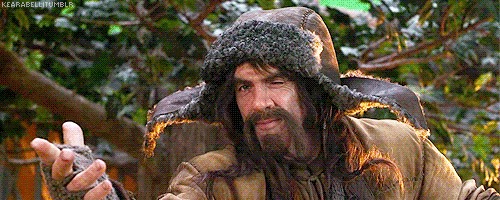
The Genius of Bofur

Whether they’re casual filmgoers, fantasy film lovers, or devout Tolkienites, most people seem to agree that Peter Jackson’s Hobbit movie trilogy is of a lesser quality than his Lord of the Rings trilogy. Reasons for this vary, though one of the most prevalent complaints is that the Hobbit films focus heavily on characters who had minor roles in the novel, weren’t in the novel at all, or weren’t in any work of Tolkien’s whatsoever. While this complaint is understandable, I do want to discuss one such character that has been well received by viewers: Bofur the dwarf.

Bofur obviously falls into the first of the above three categories. A dwarf with his name and same colored clothing is present in the book, but his characterization—that of a witty, fun-loving prankster who’s protective of Bilbo despite constantly teasing him—is not. Although hints of that persona can be read into the original text, particularly in a scene where he trips over a sleeping Bilbo and finds a reason to scold the hobbit for it, the Bofur that we see onscreen is largely a creation of the filmmakers.
 

You would think that being so embellished from his book counterpart would turn fans off to him, but he’s had the opposite effect. The Internet has been swarming with fanart, fanfiction, fanvideos, memes, and cosplay photos proclaiming our love for the dwarf in the silly hat ever since December 2012. We love Bofur so much that we were even disappointed when he didn’t get his seemingly promised character arc in the third film. Really think about that. Fans of The Hobbit, including fans of the novel, were disappointed that a character made almost from scratch for the movies didn’t get more screentime.

So why do we love him so much?

Well, he gets points for technically being a major character who’s supposed to be in the story. Bofur is one of Bilbo’s thirteen main traveling companions from the book, so it makes sense that the movies would want to give him a better-defined personality and more development. He also gets points for being a nice guy, as well as for being funny and optimistic to a degree that isn’t annoying or forced. And yes, being played by a charismatic actor like James Nesbitt also helps. These qualities certainly make Bofur likeable, but I think what really made his character stand out was the way the movies unveiled him.

We probably weren’t expecting the supporting dwarves to be very complex when we first saw An Unexpected Journey. They were barely more than names on a list in the book, and since we had a much bigger main cast and a shorter running time than the Lord of the Rings films, we may have figured that those dwarves would each fall into a standard “token” role. The tough-looking dwarf with the tattoos would be the token muscle, the little dwarf with the slingshot would be the token kid, and that dwarf with the floppy hat and the jaunty accent would be the token comic relief.

There’s nothing inherently wrong with keeping film characters simple when you’ve got so many of them, especially in an adaptation. Leaving any of the dwarves out of the Hobbit films would have likely angered the fanbase, and since Peter Jackson’s team didn’t have much to go off of from the book in terms of their personalities, depicting the less important dwarves as one-note tropes would have been forgivable. The fact stood though that being an oblivious walking punchline didn’t make Bofur terribly engaging in the first two thirds of the film.

And then the cave scene happened.


To this day, I think that the conversation where Bilbo accidentally says the dwarves don’t belong anywhere and Bofur wishes him “all the luck in the world” is one of the most moving and ingenious moments in the whole Hobbit film trilogy, and it wasn’t even written by Tolkien. Not only did it reveal that Bofur actually had feelings to hurt underneath his wisecracks, but it also changed our perspective on a lot of his previous actions towards Bilbo. He wasn’t an insensitive idiot; he was a well-intentioned friend who just liked to poke fun at the hobbit for being so uptight.

That’s why I think we came to love Bofur so much. He caught us by surprise in a really good way, and we were excited to see what he would do next. The Desolation of Smaug and The Battle of the Five Armies may not have given us anything quite as impressive, at least not yet in the latter’s case, but after Bofur got our attention, he stayed interesting enough to keep it.

As superior as the Lord of the Rings movies are considered to be, I do think that the filmmakers learned a lesson from their slapstick portrayal of Gimli. They may have learned that lesson so well, in fact, that they decided to play to our expectations by introducing Bofur as another clown before revealing more of his layers. Granted, there are still a few comedic misfires among the cast of The Hobbit, and the cave scene with Bilbo was actually a later idea shot in pickups, but it’s clear that movie Bofur was always meant to be something new to Peter Jackson’s Middle-Earth. He was meant to be (and is) self-aware comic relief.

How often in movies like this are the funny characters in on their own jokes? Most of the time, it seems like the audience is meant to laugh at them rather than with them. Even with previous three-dimensional comic relief characters like Merry and Pippin, the humor usually came from how foolish or awkward they were, not from how witty they were.

Bofur is a different breed. While he does have a few comical misfortunes, such as hitting his head on the bottom of a table and saying that things “could have been worse” right before the Great Goblin falls on him, the majority of his humor comes from him mocking or making light of serious situations. The character himself has a sense of humor, and he deliberately uses it throughout the films to try and boost his company's moral.

Case in point, the scene in The Desolation of Smaug where he leaves to find Athelas for Kili's poisonous arrow wound. Just before Bofur runs out the door to begin his search, he stops in front of the younger dwarf and orders him not to move, earning a few stares from his other companions. This line might seem obtuse at first, but a moment's thought makes us realize the true spirit behind it. 

Bofur knows full well how dire the situation is. He was the one who told Bard in the first place that Kili was "very sick," after all. He's aware that a dying, violently convulsing person isn't going to wander off while he's gone, but he's making a joke anyway to try and cheer up Kili.

Another case is the scene in An Unexpected Journey where he describes to Bilbo what it’s like to be incinerated by dragon fire. Bofur obviously has no idea what that’s really like, but since Bilbo is taking the threat of it so seriously, the dwarf is trying to play it down and make it sound ridiculous. Some might see this as him trying to scare Bilbo more, since it ends with the hobbit passing out, but remember that it comes after Bofur’s thoughtful reaction to Gandalf saying that there’s more to the hobbit “than appearances suggest.” He’s putting on a goofy act to try and make Bilbo laugh off the danger. 


That’s what makes Bofur’s movie persona so ingenious, in my opinion. He’s a person first and an archetype second, and he knows it in a way. Because of that, he’s versatile enough to carry a completely serious moment just as naturally as a completely funny one, just like a real person who has a sense of humor.

The fact that he carries out those funny moments on purpose makes him all the more endearing, because he’s putting forth a conscious effort to make the events we see onscreen more enjoyable. We almost feel like Bofur, not just the actor and film crew behind his character, is trying to entertain us and get us through things as much as he’s trying to do that for Bilbo and the other dwarves. That makes us feel more like we’re part of the company, rather than a bunch of spectators watching them from a theater. The experience of viewing the Hobbit movies is more immersive because his character is so genuine.

No official word has been given so far on Bofur’s role in the Extended Edition of The Battle of the Five Armies. The only guesses we can make are from hints by screenwriter Philippa Boyens and a couple castmembers about what was meant for him prior to the film’s theatrical release. Whether or not we’ll see him come more into his own or have another conversation with Bilbo this November is unclear, but given his history with the Extended Editions and that thirty minutes will be added to this coming one—and that the filmmakers seem to like him as much as we do—it’s a safe bet that he’ll get his chance to shine one last time.


Thursday, November 27, 2014

There's Something About Ori

It's no news to Hobbit fans that the Extended Edition of The Desolation of Smaug came out a few weeks ago with 25 minutes of bonus scenes added to the film. I enjoyed those scenes as much as the next fan, but watching that version brought a rather amusing and puzzling trend to my attention. What makes that trend puzzling is that it centers around the character Ori.

For anyone not familiar with The Hobbit, Ori is one of thirteen dwarves that the hero Bilbo Baggins joins on a quest to reclaim their kingdom from a dragon. Even though Ori appears all throughout the book, he has no real personality to speak of and never gets a single line of dialogue. He's basically just there to be the thirteenth dwarf. His character is much more fleshed out and talkative in the movies, yet he still remains something of a featured extra.

But have you ever noticed how often he's right next to Bilbo?

I'm not talking about scenes where the two of them actually interact, either. I'm talking about scenes where Bilbo and the dwarves are just standing around, running around, wandering around, or doing anything else around; scenes where the placement of the characters is meant to be random. There are so many times where Ori is either directly beside, behind, or in front of Bilbo. Even in a lot of shots where Bilbo is the main focus, Ori will be the most prominently visible other character.


Okay, that last one doesn't count. I just think it's a funny picture.

But why does this keep happening? Why does this seemingly unimportant character keep popping up so close to the main protagonist? Is it just a coincidence? Are the filmmakers doing it on purpose, or aren't they even aware of it?

If they aren't aware of it, I have two theories:

         1. It really is just a coincidence.

         2. They're doing it subconsciously.

A bit of background for Theory #2 -- The actor who plays Ori is named Adam Brown, and when he first auditioned for The Hobbit, he actually tried out for the role of Bilbo. He wasn't quite what they were looking for, but the screenwriters loved his audition so much that they wrote Ori's characteristics based on Brown's personality for him specifically to play. Since Brown had a lot of Bilbo-like qualities to begin with, it's no surprise that the film version of Ori wound up with a lot of those qualities too.

Is it possible that in the backs of their minds, the filmmakers still saw Adam Brown and Martin Freeman as the same character, and thus kept seeing Ori as the most natural choice for someone to frame with Bilbo?

If the filmmakers are aware of the trend, I have a few other theories:


         3. They're doing it as an in-joke to the fact that Adam Brown auditioned for Bilbo.

         4. They're doing it because Ori is the smallest and least distracting-looking dwarf.

         5. They're doing it to hint at how protective the other dwarves are.

See, most of the dwarves are well aware of how dangerous their quest is -- except for Ori. He's the kid who signed up with no clue of what he was getting into, much like Bilbo did. Since the two of them are the weakest and least experienced members of the group, it would make sense for the others to lump them together. That would make keeping tabs on both of them easier.


It's also possible that as the journey goes on and becomes more dangerous, this would start happening more often. That could be why Ori and Bilbo are seen together far more in The Desolation of Smaug than in An Unexpected Journey.

And then there's the crazy theory:

         6. The filmmakers are trying to subliminally convey that Bilbo and Ori have a lot in common.

Think about it. The movies could be gradually conditioning us to associate Ori with Bilbo and we don't even know it! If in some bizarre universe this really is the case, then why do it? Did the filmmakers feel bad that they couldn't give Adam Brown a bigger subplot so they decided to showcase his character more covertly? Or better yet, maybe it could be some very subtle foreshadowing of things to come in the next movie, The Battle of the Five Armies.

Probably the most notable aspect of Ori in the films is that he's a scribe. His job on the quest is to document everything in a journal so that future generations can someday read about his group's accomplishments. The only problem is that the films still have yet to clearly introduce his journal. The most we've seen of it so far are a few shots of him handling it in Bilbo's house, and one of those shots features him (of course) in the background behind Bilbo.


That instance really lends to the idea that the filmmakers are trying to subtly draw a connection between the two characters. It happens when the wizard Gandalf tells Bilbo, "All good stories deserve embellishment. You'll have a tale or two to tell of your own when you come back." Look quickly, and you can spy Ori behind the hobbit, writing in his journal; he's in the process of telling his own "tale or two."

It's also worth noting that Ori tends to play second fiddle to another dwarf, Bofur, in scenes where the latter interacts with Bilbo. In An Unexpected Journey, Bilbo's rant to Gandalf about what the dwarves have done to his house is book-ended by an exchange with Bofur and an exchange with Ori. Later, when Bilbo nearly falls off of a cliff, Ori assists Bofur in a rescue attempt.


In The Desolation of Smaug, Bofur, Bilbo, and Ori are the first three to approach the enchanted river in Mirkwood. When it becomes apparent that Bilbo will have to cross the river first, he looks to Bofur and Ori for confirmation.

In the scene where Bilbo frees the dwarves from an elf prison, Bofur and Ori are the only two characters who speak before the hobbit arrives. Lastly, when the group reaches their destination without Bofur and sends Bilbo in to face the dragon alone, Ori is the first to voice concern for the hobbit -- a job that Bofur usually has covered.


So what's my point in bringing this up? Well, Bofur has one of the closer relationships with Bilbo among the dwarves, and having Ori as the third wheel in that relationship seems to suggest that the little scribe has a similar fondness for Mr. Baggins. Since Bofur is currently not among the group and it's allegedly been hinted that Ori and Bilbo have a lot in common, perhaps the two will have a moment to bond with each other in the next movie. And perhaps it will be over Ori's journal.

We see in the very beginning of An Unexpected Journey that Bilbo eventually decides to write his own book about the quest. We also see him dig up an old sketch of his younger self while preparing to write his book. I can easily imagine a scene in the third film where Ori shows Bilbo his journal and unknowingly plants the seed of inspiration for our hero to become a writer too. Given how dark and dire The Battle of the Five Armies seems to be from the trailers, a warmer and more innocent scene like that might be greatly welcome.

As for the old sketch of Bilbo, I'm not the first person to speculate that Ori drew it for him.


But at the end of the day, that's all any of this is: speculation. Come December 17th, I might look back on this essay and think, "Wow. I was an insane person three weeks ago." That's the fun of watching a story play out over multiple installments, though. It gets the creative wheels in your head turning.

In all likelihood, regardless of why he's there, Ori will probably remain off to the side and in the background throughout The Battle of the Five Armies. I see potential for his character and an opportunity to show it, but that doesn't change the fact that his character is a peripheral one that the film might not have time for. Who knows? Maybe he stands a better chance of getting the spotlight in the next Extended Edition. I have hope, even if it is, as they say, just a fool's hope.