Showing posts with label laketown. Show all posts

Friday, June 19, 2015

To Kill an Alfrid


Well, it's finally happened. After months of theorizing and speculating, fans of The Hobbit have finally received a list of bonus scenes to expect in the Extended Edition of The Battle of the Five Armies. I don't recall a list like this coming out for any of the previous five Extended Editions, at least not this early. If I'm correct to think that it hasn't been done before, this could serve as further evidence that Peter Jackson was forced to trim down this film far beyond his liking for the theaters.

In any case, here's the list:
  • More scenes of Bard attempting to kill Smaug
  • More scenes of Smaug destroying Lake-town
  • An extended scene of Azog's invasion forces
  • Elf archers firing at Orcs, Wargs, and Trolls
  • Dwarves with Ballistas firing at Orcs and Trolls
  • Dwarven Goat Riders and Rams join the battle to attack Orcs and Wargs
  • Funeral of Thorin, Fili, and Kili
  • Coronation of Dain II Ironfoot, Now King Dain II Ironfoot
  • Bard becoming the new king of New Dale
  • Gifts of treasures given to Bilbo, Bard, Thranduil, and the People of Lake-town
  • Bilbo and Gandalf revisit the Trollshaws
  • An Exchange between Thranduil and Gloin during the battle
  • Beorn tortured in Dol Guldor
  • Sauron interrogates Gandalf in Dol Guldor
  • The death of Alfrid Lickspittle
  • More fighting in the city of Dale
  • More battle scenes
  • The war beasts Azog sends just after the battle begins
  • Axe blade removed from Bifur's forehead
  • Conversation between Bilbo and Bofur before Bilbo hands over the Arkenstone
  • Smaug destroys the Dwarven Wind lance
  • Galadriel unveils true the power of her Elven ring, Nenya
  • Thorin and Company start counting and assessing their treasure hoard
  • Bilbo buries his acorn in Dale
  • Beorn brings a dead Thorin II Oakenshield back to the Lonely Mountain
  • More graphic and brutal Orc kills 
Most of these scenes seem like promising additions, particularly the ones involving the dwarves from Thorin's Company. The only extra footage of Smaug's attack on Lake-town that I think we need is him destroying the Wind lance to explain why Bard doesn't use it, but if more destruction and attempts to kill him better illustrate the horror of that attack, then I'll take it. Scenes like Beorn being tortured and Bilbo planting his acorn should also be interesting, and it looks like a lot more very welcome closure is in store for the end of this version.

The only scene on this list that I have reservations about, strangely enough, is Alfrid's death.
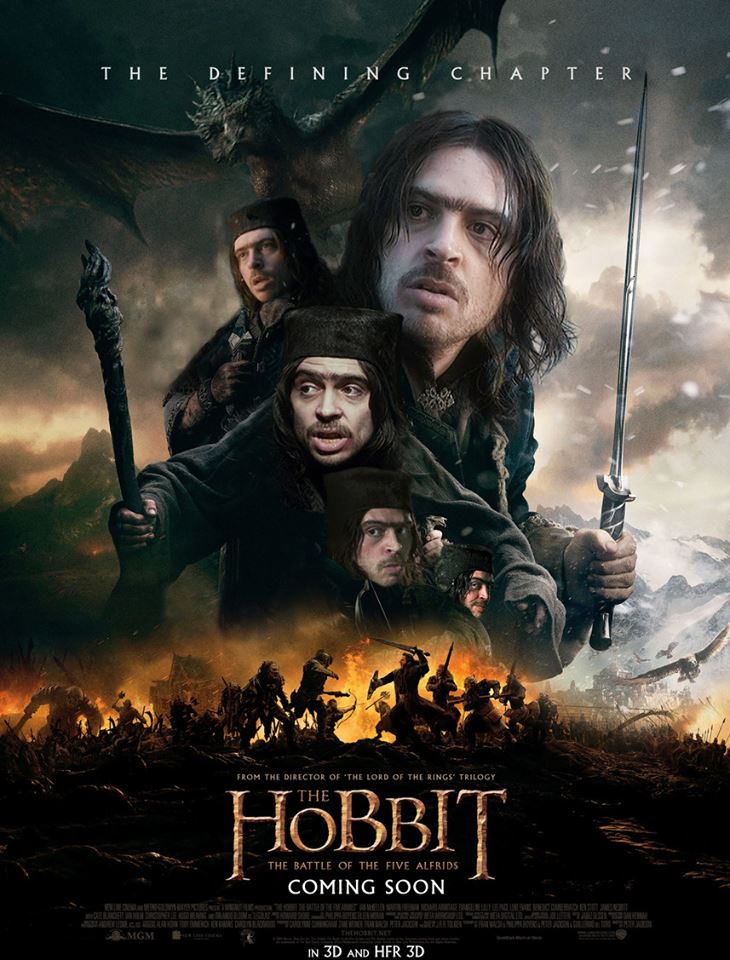
I've been all over the spectrum with this character since the release of The Battle of the Five Armies. In the span of a few months, I've gone from saying that he shouldn't be disposed of so quickly and that he should get more screentime to saying that his only screentime at all should consist of Bilbo kicking him in the shin. The whole "Alfrid Problem" is just so befuddling because he had so much potential in the second Hobbit film that went utterly wasted in the third, and it leaves many of us scratching our heads about why he was even written into this trilogy.

The question then is why I would take issue with seeing him die if that's pretty much the only gratifying thing he can do at this point. Well, there may be a few answers for that.

First of all, there is a legitimate reason for adding Alfrid's character to the films. Giving the Master of Lake-town an accomplice makes sense from a screenwriting standpoint because it's easier to convey his plans to the audience when he has someone to discuss them with out loud. The puzzlement is why the Master becomes the one to die in the third film's opening while his accomplice gets to stick around afterwards for the majority of the plot. It would be a lot truer to the book if the opposite happened, with Alfrid the watchful manipulator dying in Lake-town and the Master being reduced to a powerless weasel without his aide around to manage things.


The screenwriters wouldn't even have to change all that much; Alfrid could get killed by Smaug right after the Master pushes him off their boat, then Bard's lasso could pull the Master overboard and Smaug could fall on the boat before the Master can return to it to save his gold. The Master could spend the rest of the movie doing the exact same things that Alfrid does, discovering how ineffectual he really is on his own, then decide to skirt offso to speakafter finding the gold hoard in Dale because wealth was all he ever cared about.

It doesn't make as much sense for Alfrid to have that story arc in the third film because he was never established as being so materialistic before Smaug's attack. He actually suggests dumping some of the Master's gold overboard to lighten the boat during their escape attempt, so it seems somewhat out of character for him to become obsessed with getting his hands on Erebor's gold later. I guess the argument can be made that he starts falling into the same greedy vices as the Master once he comes into his own, much like Thorin does after succeeding Thror, but the movie never indicates that this sort of character development is going on. It almost feels like the roles were the other way around originally and then Alfrid was dumped into the Master's place at the last minute without any other changes being made to those scenes.

That brings me to my first issue with Alfrid's death. In my opinion, if this adaptation is going to give him the Master's story arc, then the least it can do is be true to the Master's arc in the book. Killing Alfrid robs that arc of one of the few things it had in common with the source material. Granted, we don't know what "The Death of Alfrid Lickspittle" entails, if we'll see him get killed during the battle or starve to death in the wilderness like the Master eventually does in Tolkien's writings, but knowing these movies, it's likely that he'll meet a more theatrical demise.

My second issue with Alfrid’s death, which I admit is my own problem, is that I had been very on board with the headcanon that he was actually Grima Wormtongue’s father in the movies. One of the biggest grievances that people have always had with Alfrid is that he’s a knockoff of Wormtongue, so what better solution is there for that resemblance than to make them relatives? It would have explained a few things about Wormtongue too, such as why he has a drastically different appearance from the other Rohan natives, and it would have given fans something neat to further tie the two trilogies together.


Any chance of that being canon dies with Alfrid in the Extended Edition of the third Hobbit movie though, which means we have to go right back to accepting that he looks, sounds, and acts exactly like another Middle-earth character by complete coincidence. In that sense, his storyline is one that the filmmakers might have been better off leaving open-ended.

My third issue comes from looking at the Hobbit films in a wider scope with the Lord of the Rings films. For as much as The Lord of the Rings gets dubbed the darker of the two stories, it leaves surprisingly few casualties on the good guys' side. The only significant, permanent, onscreen deaths that I can think of are Boromir's, King Theoden's, and Haldir's. On the bad guys' side, however, virtually everyone dies. Sure, Shelob lives and some of the orcs escape from that earthquake outside Mordor at the end of The Return of the King, but none of them were really characters that we grew to personally know or hate.

That makes Alfrid's apparent survival in the theatrical cut of The Battle of the Five Armies rather unique. Instead of dying like every other notable antagonist, his comeuppance is running away alone and disgraced with nothing wholesome or meaningful in his future. That's arguably an even worse fate. It's also a much more mature and thought-provoking one when compared to the deaths of the heroes Thorin, Fili, and Kili.

It all hearkens back to Gandalf's line in The Fellowship of the Ring about how "many that live deserve death" while "some that die deserve life." I think that this line resonates a lot more if we've seen examples of both play out in a previous film. Keeping Alfrid alive adds an extra dose of reality to the whole six-film series, however unfair that reality is, and it creates something of another legacy from The Hobbit that didn't exist so clearly in the first Lord of the Rings movie prior to last December. Having him turn out to die after all, in my mind, undoes the one substantial thing that he contributed to The Battle of the Five Armies.

I'm not sure how any of the decisions on Alfrid's role in the trilogy were made. My theory is that the filmmakers really liked actor Ryan Gage and decided to do a lot of tinkering with the script after realizing that they had to scrap the character he was originally cast for, but that's mostly just a hunch. In the end, Alfrid is what he is, and no amount of complaining is going to change that. It's possible that the upcoming Extended Edition could give some depth to his character like the last one did, but if not, I can look on the bright side. If his death is the only bonus scene that I have reservations about on a list of twenty-six, then I’ve got it pretty good.


Friday, April 17, 2015

Was Bofur Left in Laketown On Purpose?

I've said before on this blog that the fun of watching a story play out over multiple installments is that it gets the creative wheels in your head turning. You would think that a film series like The Hobbit, which is based on one of the most thoroughly mapped out legendariums in literary history, wouldn't allow much room for fan theories, but through the power of book-to-screen adaptation, a lot of things have changed in the tale and a lot of questions have been raised about them. One such change is the screenwriters' decision to have four of the dwarves from Thorin Oakenshield's company stay behind in Laketown in the trilogy's second film, The Desolation of Smaug.


For the sake of this essay, here's a quick run-down of how that scene unfolds. Thorin is in a hurry to leave Laketown so his party can reach the secret door into Erebor by sundown, a deadline that their entire quest hinges on them meeting. Having learned that his nephew Kili is injured, Thorin orders him to stay behind for the time being since he will likely slow their progress. Outraged by this, Kili's brother Fili decides to stay behind with him, and the group's medic Oin decides to stay as well so he can tend to Kili's wound. In the midst of all of this, a fourth dwarf named Bofur wakes up late to discover that the group is leaving without him and he just misses the boat out of Laketown.

The controversy of this change aside, the only leaving-behind of the four that ever felt contrived to me was Bofur's. The reasons for the other three dwarves are fairly well set up and tie in naturally with each other, but in Bofur's case, it just sort of happens. No one has much to say about it, and it seems almost random that it even happens to him at all. We know from a storytelling standpoint why it does; he's one of the more likeable dwarves, and if he's in Laketown when the dragon Smaug attacks it, we'll be more invested. In the context of the movie though, it's a little hard to buy that twelve other dwarves (including his own brother and cousin) would fail to notice his absence from the group.

This leads me to my own personal fan theory about The Desolation of Smaug: that Bofur being left behind in Laketown is supposed to feel contrived because in the context of the movie, it was contrived. My theory is that the other dwarves left him there on purpose.

Why would they do that? The answer, I believe, lies with the person who most likely would have orchestrated the whole plan—Thorin.

Looking at his interactions with Bofur before that, it's easy to come up with a motive for the King Under the Mountain. For starters, Bofur doesn't seem to take Thorin all that seriously as a leader. He follows orders most of the time, even if he's not always thrilled with them, but when there's danger afoot, he makes his own judgement calls without waiting to hear what Thorin thinks.

Take for instance the warg chase from An Unexpected Journey. After the company takes cover from their pursuers in a cave, they discover a tunnel, which Bofur immediately declares they should venture into. The rest of the company obeys this direction without so much as consulting Thorin.


The end result of this is their arrival in Rivendell, where the elves and the White Council try to put a stop to their quest. This is a situation that Thorin's been trying to avoid from the very beginning of the journey, and Bofur more or less led their group into it.

There's another instance of Bofur overstepping his bounds at the beginning of The Desolation of Smaug. Upon learning that their company is in the vicinity of a giant, man-eating bear, he suggests to everyone that they turn around and go back the way they came. This time, however, Thorin dismisses the idea before it's considered.


This seems to show development on Thorin's part. He's aware by now that Bofur has a habit of going over his head and leading the group into troublesome situations, so he's ready to keep it in check. As we see though, Thorin becomes more desperate and obsessed with reaching Erebor the closer their deadline grows, and he becomes quicker to cast aside problematic group members than he is to deal with them. If he's willing to exclude his injured nephew from the home stretch of their journey, he's probably more than willing to exclude an apparent loose canon like Bofur.

Thorin's motive could also pertain to his plan for after he finds the entrance to Erebor. His intention is to send Bilbo into Smaug's lair alone to steal back one key piece of treasure while the dragon is sleeping. The other company members, being dwarves whose smell Smaug will recognize, are supposed to wait outside of the mountain the entire time. If something should go wrong with this plan, there's a very good chance that the hobbit and possibly the dwarves will be killed.

It's no secret to Thorin by the time they reach Laketown that Bofur is attached to Bilbo. He's there when Bofur tries to save their burglar from the cliff on the Misty Mountains, and we see him eavesdropping on the conversation in the cave where Bofur wishes Bilbo "all the luck in the world." Furthermore, he's the person that Bofur asks about Bilbo's whereabouts when the dwarves are captured by elves in Mirkwood.

Thorin has probably also noticed that the insolent dwarf tends to lose his head whenever Mr. Baggins is in danger. Bofur has to be pulled to safety himself at one point during the stone giants' battle while trying to keep Bilbo secured, and when the hobbit almost falls from the cliff, Bofur doesn't just throw himself over the edge to try and grab him. He also commands Ori, the youngest dwarf in the group, to do the same.

Given all of this, it's conceivable that Bofur might charge into Smaug's lair to rescue Bilbo at the first sign of trouble, which could have a disastrous outcome for everyone present. Thorin would never take a chance on something like that happening. It's doubtful that Bofur would obey an order to stay in Laketown, and since having him detained there might make him even less cooperative in the future, Thorin's best option would be to make his leaving-behind appear accidental.

If that is the case, then why would the other dwarves go along with that plan? They all seem to like Bofur, and while they may be anxious to reach the mountain and take back Erebor too, I don't think they're as keen as their leader is to accomplish their goal through deception. The most likely explanation is that Thorin told them it would be for Bofur's own good, for all of the previously mentioned reasons. It may have helped his argument that Bofur appeared to be hungover on the morning that they left Laketown. The other dwarves didn't want their reckless friend/brother/cousin to get hurt or killed, so they agreed not to wake him as they were preparing to leave.

Bilbo seems to have been left out of that conspiracy though, as he's the only person to ask where Bofur is on their way to the boats. It's possible that since he's so close to the dwarf and the others don't know him well enough to predict how he'd feel about such an idea, they decided it was best to just keep the hobbit out of the loop. Either that, or they figured Bilbo had enough to worry about that day as it was.


This leads me to wonder then what the screenwriters' other purpose was for keeping Bofur in Laketown, besides raising the stakes during Smaug's attack. Philippa Boyens has said on numerous occasions that they wanted his character to see that attack so he could come more into his own in The Battle of the Five Armies. That arc didn't make it into the film's final cut, but if it's restored in the Extended Edition, could the above theory play a part in it?

It would be easy enough to work into the plot. Perhaps in the excitement of their reunion, one of the other dwarves (the usually silent Bombur, perhaps?) could let it slip to Bofur that Thorin told them to leave him behind. This combined with their leader's refusal to help the Laketown survivors could cause Bofur to lose what little respect he did have for Thorin, prompting him to actively oppose the new dwarf king. Perhaps then Bofur would become the person that Thorin originally suspects of stealing the Arkenstone, and this mounting tension could lead to the alleged cut scene where Bofur sends Bilbo away from Erebor at night to ensure the hobbit's safety.

Once again though, this is just a fan theory. There's no way to determine whether or not any of this was the filmmakers' intent, but a lack of definitive proof rarely snuffs out speculations like these. Some Tolkien readers have believed ever since the 1970's that Gollum killed Frodo's parents, after all. Not knowing the truth is part of what makes fan theories so enjoyable; it inspires that same spark of imaginative storytelling that can sometimes lead to gems like The Hobbit.

All the same, I still hope very much that when the final Extended Edition comes out, Bofur's secret purpose does get included in the final leg of that journey.


Friday, January 16, 2015

The Line of Thorin Would Not Be So Easily Cut

Ever since Peter Jackson announced last month that the Extended Edition of The Hobbit: The Battle of the Five Armies was set to be thirty minutes longer, the Internet has been buzzing with predictions. We've all heard tidbits from the writers and cast about things we might expect to see, such as Radagast giving his staff to Gandalf and Bilbo having a talk with Bofur before sneaking out of Erebor, but a lot of hints at other bonus scenes can be found right in the film's promos. Even the two main trailers feature a considerable chunk of material that didn't make it into the final cut.


Looking at some of that material, fans can gather evidence and piece together a few potential scenes.

The scene I want to piece together today centers around Thorin Oakenshield. For as much as the King Under the Mountain gets rebuked in the official trailer, he does get one thing to say for himself: "Everything I did, I did for them." Since he's most likely referring to his nephews Fili and Kili, I think I know exactly what the context of that line is.


First of all, Thorin isn't wearing any of his kingly attire in the shot where he says it. This means that the scene either takes place before Fili, Kili, Bofur, and Oin arrive at Erebor or after Thorin overcomes his "Dragon Sickness" and decides to join the battle for the climax. He doesn't seem to be wearing any armor, so the first theory is probably the case.

Second of all, the trailer shows a shot right before that where Thorin appears to be standing among Erebor's treasure hoard without his crown on. If memory serves me correctly, I don't think that's a scenario we ever saw in the theatrical cut. Since he doubtfully would have gone back to the treasure after casting away his crown, that shot most likely takes place before the four dwarves in Laketown arrive at the mountain. Therefore, the shot where Thorin says his line probably occurs around that same time.


I found it a bit jarring in the theatrical cut when Fili, Kili, Bofur, and Oin arrive at Erebor and Bilbo just runs up to them saying, "FYI, Thorin's a totally different person now." It's understandable that this is how those characters would be informed of Thorin's transformation, but it's also how the audience is informed of it. No more gradually watching his character spiral downward -- he's just completely corrupt now. Since Bilbo mentions that Thorin has been counting the treasure in the mountain for days, we can assume that a scene of that downfall was originally included in the film and might return in the Extended Edition.

So how will it occur?

Well, let's look at Thorin's introduction in The Battle of the Five Armies. As Bilbo and the dwarves watch Smaug attack Laketown in the prologue, we see Nori trying to console his brother Ori. After that, we see Gloin looking dreadful and Bombur looking horrified. I always interpreted that as Gloin and Bombur realizing that their brothers, Oin and Bofur, are still in Laketown and caught in the middle of the carnage. Given that, I see Thorin's reaction, standing away from the group with his back to Laketown, as him realizing that Fili and Kili are also caught in the attack and not being able to watch.

It's likely that the Company's next scene in the Extended Edition will be a new one where they discuss their concern for the dwarves left in Laketown. Since Thorin isn't the most optimistic dwarf, he'll probably be convinced that Fili and Kili didn't survive Smaug's attack. That will prompt him to dismally say his line, "Everything I did, I did for them."

You can imagine what a horrible state of mind that would leave him in. He thinks his nephews are dead. The whole reason he set out to reclaim Erebor was to build a better future for them, and now the whole quest has been for nothing and he no longer has a purpose. And it's pretty much all his fault that Fili and Kili were left behind in Laketown to begin with. Adding the fact that all of his loyal followers are now mourning over two other dwarves that he left behind, it's a wonder Thorin didn't jump right off that cliff he was standing on at the start of the film.

It's pretty easy to guess where things might go from there. Thorin will probably wander away from the others in his depression, come across the treasure hoard, and literally lose himself in it. As we see in the theatrical cut, he gets so lost in it that when Fili, Kili, Bofur, and Oin turn up alive in Erebor, he barely even cares. The only thing he wants to do is show off all of his new treasure to them.


Let me just state for the record how much I hate the concept of "Dragon Sickness." It seems to be presented, at least in the movies, as a mental disorder caused by something in Erebor's gold that descendants of the dwarf king Durin are especially susceptible to. Being corrupted by greed has nothing to do with who those descendants are as people; they have a certain genotype, so they're going to catch that disorder from the contaminated gold. It's the same problem people have with the Midi-chlorians from Star Wars -- it reduces what should be a character trait to a condition.

Having Thorin succumb to "Dragon Sickness" because of his grief over his nephews, however, would fix that. He wouldn't have fallen to temptation because of his bloodline. He would have fallen to it because he lost hope and momentarily lost the will to resist it. That would have everything to do with who he is as a person. It would even make us wonder if he might have endured had Fili and Kili been with him the whole time.

That's about the only extra screentime I see Thorin needing in the Extended Edition (aside from his funeral). I'm very much in the camp that the bulk of that bonus footage should go to the supporting dwarves and characters like Beorn who got seriously shortchanged in this adaptation. We'll probably get more news about the Extended Edition closer to its release, but in the meantime, we'll just have to keep wandering the glorious halls of Tumblr and Twitter while counting the piles of rumors sparkling around us...


Monday, December 22, 2014

Thoughts on Alfrid

Now that we've had time to absorb The Hobbit: The Battle of the Five Armies, I'd like to discuss one particular element of the film today. The character Alfrid (played by Ryan Gage) has had a largely negative reception from viewers, being seen by many as an irritating and pointless addition to the story. Being invented solely for the movies and having a strong resemblance to the character Grima Wormtongue from The Lord of the Rings have never helped his case. It's tough to disagree with the complaints about him in the latest Hobbit movie, but perhaps fans, like the survivors of Laketown, shouldn't be too quick to dispose of him.

I actually found Alfrid really interesting in The Desolation of Smaug. Even in the theatrical cut where a lot of his scenes are omitted, you can tell he has his own agenda. There's something about the way he speaks to the Master of Laketown, watches the other man's reactions, and behaves when the Master isn't looking that suggests he hates the disgusting windbag and is just using him as a puppet to control the town. It's a real testament to Gage's subtlety as an actor.

You would think then that the Master's death at the start of The Battle of the Five Armies would allow Alfrid to step out of the shadows and shine as a character. Instead, the film reduces him to a string of punchlines until he scurries off. He doesn't learn anything, he doesn't oppose the heroes, he just reminds us that he's a jerk and runs off in a dress. Why make a point to spare him from Smaug and the other townspeople if the plot isn't going to make use of his survival?

Granted, this might be smoothed out in the Extended Edition next November. That's a long time from now though, and since I've got this cemented in my head, here's my personal take on what the movie could have done with the character:

After falling out of favor with the townspeople, Alfrid starts contemplating how to win back their approval while grudgingly following Bard's orders in the meantime. He eavesdrops on the meeting where Bilbo gives the Arkenstone to Bard and Thranduil, then just like in the movie, Gandalf forces him to look after the hobbit. This of course ends with Bilbo promptly escaping from Alfrid, which makes the man look even worse and gives him a personal reason to resent Mr. Baggins.

Later, when Bard reveals to Thorin that he has the Arkenstone and Bilbo prepares to explain his role in it, Alfrid steps forward from the crowd. He informs Thorin of Bilbo's actions and describes them in the most dastardly way possible. This feeds Thorin's paranoia to the point that when Bilbo explains himself truthfully, the dwarf king refuses to believe him. Bard angrily asks Alfrid what he's up to, and Alfrid explains that exposing a traitor among Oakenshield's company will make the dwarves violently turn on each other, thus removing the need for a battle.

That's Alfrid's plan to win back the townspeople's approval -- to be the one who got them the gold and prevented war. His triumph is short-lived though, as Gandalf intervenes to save Bilbo and then the orc army arrives gung-ho for a fight anyway. No longer seeing a future for himself among the survivors of Laketown, Alfrid lies low during the battle and flees with his stolen gold at the first opportunity.

It's possible that something along those lines could happen in the Extended Edition. Philippa Boyens said in the commentary for The Desolation of Smaug that Alfrid's character is supposed to "blossom" in the third film, which doesn't seem to have happened yet. Some may cringe at the thought of him getting even more screentime, but as we saw with Beorn's introduction in the last film, sometimes material in a theatrical cut gets removed from the Extended Edition to make way for a better alternative.

And just for the heck of it, here's a crazy fan theory to walk away with: maybe in the movies, Alfrid is Grima Wormtongue's father.


They look, sound, and act a lot alike, right? Wormtongue has a vastly different appearance from the other Rohan natives, and sixty years do pass between the two film trilogies. Perhaps after slipping away from the battle, Alfrid found his way to Rohan, changed his name to Galmod for good measure, and found a woman stupid enough to marry him. Having a ton of cash on him probably helped in that department. The end result was Grima, who apparently followed his father's example and attached himself to two powerful figures.

And as for Grima's creepy habits with women...well, he probably overheard a few arguments between his parents about whose dress from Laketown that was in the closet.