Showing posts with label disney. Show all posts

Sunday, August 11, 2019

"The Lion King" Review


I'll admit up front, I had no desire to see the new Lion King movie at first. I'm as tired from these endless Disney remakes as anyone else these days, and I actually have skipped seeing most of them. However, two major things spontaneously came together this past Tuesday that convinced me to go see The Lion King:
1) I had no plans and remembered that movie theaters give discounts on Tuesdays
2) I'd heard so many scathing reviews for this film  probably more than the last three Disney remakes combined  that I decided I had to see if it was really that bad
Now that I have seen it, I'm willing to say that the Lion King remake didn't quite live down to my expectations. It's not horrible, but it doesn't remotely hold a candle to the 1994 original.

There are some improvements to the story in this new version. Simba's a lot less bratty as a cub, and things like the way Rafiki figures out that Simba's still alive and the way the lionesses figure out that Scar killed Mufasa are handled a lot better this time around. I also like that this version removes that part where Scar knocks out Zazu during the stampede to keep him from going for help. In the remake, Scar tells Zazu to go get help because that will look way less suspicious and he knows that Zazu won't be back with help in time anyway. They're good updates.

At the same time though, the new version makes a lot of changes that hurt the story. It tries to give Scar more backstory than the original by implying that he once fought Mufasa for the right to marry Sarabi, which was how he got his scar. The problem with this is that it now gives Scar a history of having challenged Mufasa in the past. That just makes Mufasa look foolish for keeping him around in this version since he can't give his brother that benefit of a doubt that he had in the original film.


We also get a new scene where Nala escapes from Pride Rock during Scar's reign to find help. This lessens the suspense of the later scene where she attacks Timon and Pumbaa because now we know who that lioness is and we have reason to think that she won't go through with killing them. Scar only introduces himself to the hyenas after Mufasa rescues Simba and Nala from them, which makes his alliance with them less compelling, and there's just a ton of extra dialogue thrown in all over the place that adds nothing and throws off the pacing of a lot of scenes.

As far as the voice-acting goes, there's not a lot to say. It wasn't as bad as a lot of reviews have made it out to be, but it still pales in comparison to the original. This is most evident in James Earl Jones, who for some reason sounds a lot less intense in this version despite reprising his role of Mufasa. Most of the actors sound like they're either going through the motions or (in the case of Billy Eichner and Seth Rogen as Timon and Pumbaa) ad-libbing so much that it sucks all the meaning out of the original dialogue. The only really noteworthy performance is Chiwetel Ejiofor as Scar, who's allowed to give a theatrically villainous line delivery every now and then.

Also, John Oliver probably laughed all the way to the bank when he got cast as Zazu, because he's joked before about how much he looks like the original version of the character.


Music-wise, the movie's all over the place in quality. The orchestral score is pretty good, but the new versions of the songs are hit or miss. I think the only song to really improve is "The Lion Sleeps Tonight," which uses a wide variety of animals with a wide variety of vocal ranges to give a pretty neat doo-wop rendition. The worst song revamp is "Be Prepared," which is only half as long now and has Scar mostly talk-singing new lyrics that fit better with the hyenas' less dim-witted depictions in this version.

And I'm just going to come right out and say this: the hyenas in the remake are a huge downgrade. Shenzi gets the best treatment out of the main three, since she keeps her original name and her role as the leader, but she's all menace and no personality in this version. Banzai and Ed technically aren't even in the remake; instead we get two other recurring hyenas in the clan named Kamari and Azizi who barely interact with Shenzi.

Apparently, the reason for these changes was because director Jon Favreau felt the hyenas in the original film wouldn't mesh with the more realistic feel that he wanted the remake to have. He wanted their characters to be dangerous instead of funny in his version.

First of all, the hyenas in the original weren't just funny. They were also dangerous, and the way they easily switched back and forth between those two gears made them even more intimidating. They were unpredictable because their silly attitudes made it easy to underestimate them, and that was the whole point of Scar's downfall.

Second of all, the hyenas in the remake are still used as comic relief. It's just that instead of having all three of them go back and forth between serious and funny, we get one who's always serious and two who handle all the comedy. But because it isn't realistic for the comic hyenas to make cartoonish gestures or anachronistic jokes, there's not a lot of funny things they can actually do or say. As a result, we get a villain "trio" where two thirds of them fall flat.
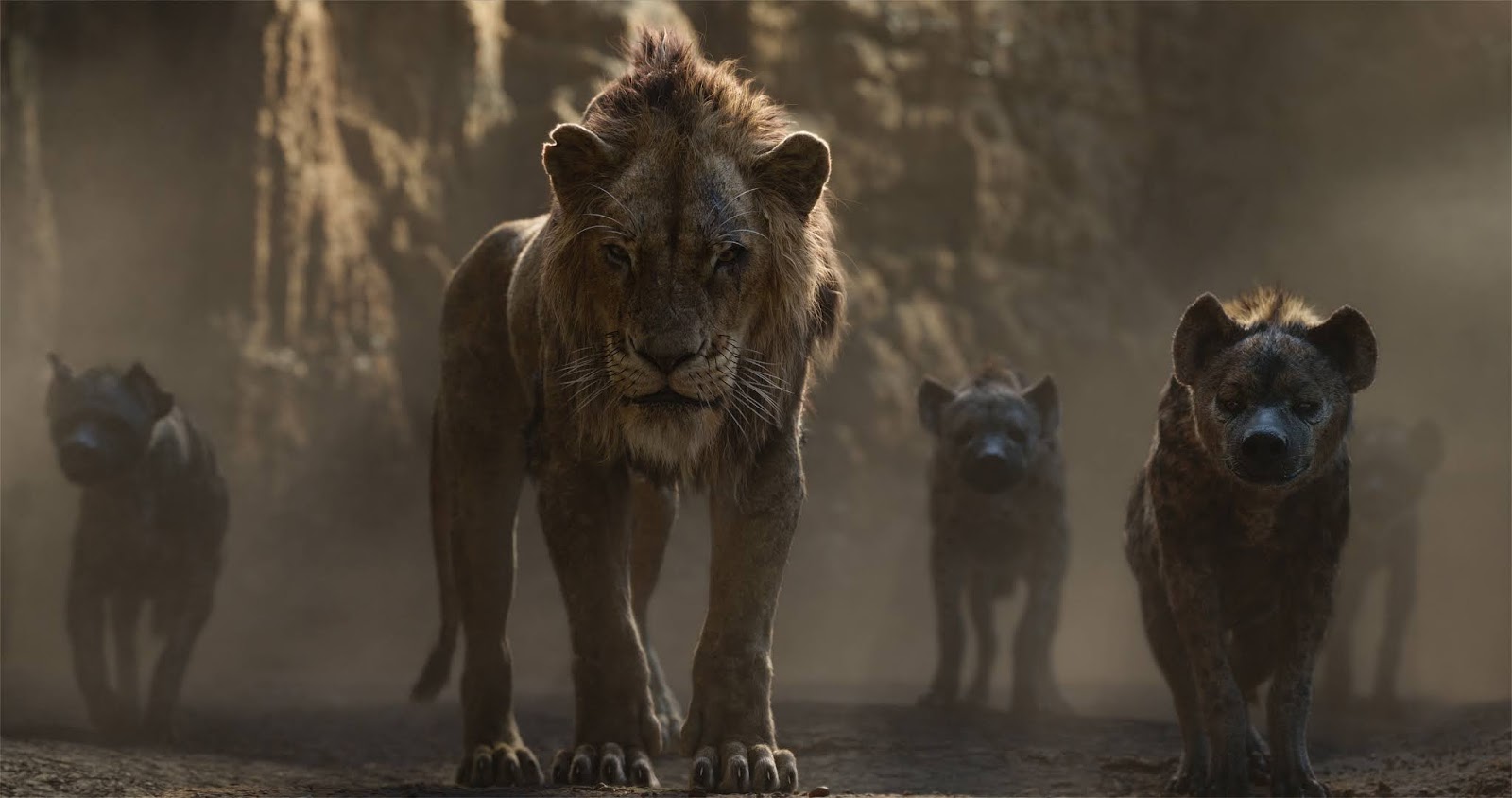

And that's the remake's biggest problem: its super realistic approach to everything. Most reviews have rightly pointed out how the animals' lack of humanlike facial expressions weakens the emotional impact of everything, but there's so much more to it than that. Everything is presented like a nature documentary, so nothing fantastical or cinematic is ever shown onscreen. Instead of a vibrant color and style change when Simba's imagination kicks in during "I Just Can't Wait To Be King," we get a regular looking scene with just more animals in it. Instead of towering skeletons and hellish red and green geysers in the Elephant Graveyard, we just get lots of brown rocks. Instead of seeing Mufasa's face in the clouds when he talks to Simba from the afterlife, we just see normal storm clouds that sometimes look a bit like a lion for a split second when the lightning flashes just right.

Even scenes taken straight from the original film like the "Circle Of Life" opening and the wildebeest stampede look smaller in scope because they're presented in a less visually dramatic way. The crazy thing about all of this is that, just like the original film, this version of The Lion King is also entirely animated. I get that they didn't want it to look 100% identical to the original, but there's just no reason why they had to make it look this much less compelling.


Bottom line, the remake of The Lion King is nothing special. It's gorgeous to look at, it fixes a few problems with the original, and it's entertaining enough for kids, but just like all the other recent Disney remakes I've seen, it clearly expects you to already know the story from the original. You're better off just watching that instead.

Long live the king.


Tuesday, March 26, 2019

Hell, Nick Fury, and a Woman Scorned


I have to admit, I went through kind of a bizarre existential crisis leading up to my viewing of this movie.

YouTube has a way of recommending videos that don't really relate to the ones you normally watch, and then bombarding you with videos that DO relate to those recommendations after you watch them. In my case, this meant crossing paths with one video about Captain Marvel star Brie Larson's snarky comments on the excess of "white dude" film critics and how she wants to use Captain Marvel as her form of activism...and then watching dozens of other videos about that, the audience censorship on Rotten Tomatoes for Captain Marvel, Disney's alleged string-pulling to boost the film's box office numbers and review ratings, and how they're trying to hold this "glass-ceiling-shattering" film so high that feminist activists can't see Aliens, The Terminator, Underworld, Resident EvilThe Hunger GamesWonder Woman, or Alita: Battle Angel in its shadow. And this went on for about a month.

So yeah, I was kind of conflicted about supporting Captain Marvel. I was curious to see the film because of its tie-in to Avengers: Endgame, and I get that Brie Larson just wants equal representation in every aspect of the film industry and only said it in the worst way possible, but all the drama surrounding this movie rubbed me the wrong way. Besides, I've only seen nine of the twenty Marvel Cinematic Universe films that existed before this, and the Avengers crossovers do a pretty good job of recapping things so you don't have to see the other films to understand them. And let's be honest, in today's age of YouTube spoiler reviews and Wikipedia plot summaries, no one has to see any movie anymore to know what happens in it. So really, what need was there to give Captain Marvel a ticket sale -- especially since Disney may or may not be buying enough tickets themselves?
 
Well, in the end, I got invited to a ten-year-old's birthday party to go see the movie, so I caved.

So what do I think of Captain Marvel now that I have seen it?

I don't know if it was intended, but I do think that setting this movie in the 1990's helps to make the whole don't-let-white-dudes-hold-you-down angle feel less ham-fisted. It's a lot more believable, though still debatable, that male air force pilots would be that discriminant against a female pilot back then, as opposed to today. The film doesn't show as many moments of that discrimination as you might think, but there are a few, plus some pretty blatant song choices like No Doubt's "I'm Just A Girl" and one cringeworthy line about how a responsible mother character needs to go along on a potential suicide mission in order to set a better example for her daughter. Although, I don't seem to recall the "I'm kinda done with you telling me what I can't do," line from the teaser trailer being said in the final film.

So yeah, the winks and nods at social justice gender politics throughout the movie can be a bit grating, but I don't think they're so prevalent that they overpower the story.


The story itself is pretty standard. It's an action mystery where Captain Marvel (a.k.a. Carol Danvers) gets stranded on Earth in the 90's and tries to stop aliens from invading it while also trying to remember her past. In Marvel terms, it's like a cross between the first Thor film and Howard the Duck if it starred Wolverine. There's a decent theme of paranoia and not being able to trust people at face value throughout the film, illustrated best by the shape-shifting aliens, and also one big twist that fans of the comics might not expect. Also, I did laugh at the end of the final showdown for basically giving the finger to one really cliched action movie trope. Overall, the story is passable, but it feels more like something you'd see in Phase One of the MCU rather than something you'd see near the end of Phase Three. It just doesn't have the same sharp edge to it that the franchise has evolved since 2008.

And speaking of 2008, it's worth mentioning that Captain Marvel contradicts a few things that were previously established in the MCU. One example is how Fury and Coulson refer to their organization as S.H.I.E.L.D. despite not coming up with that acronym until the end of the first Iron Man a decade later. It's a minor nitpick, but given how good the MCU seemed to be about avoiding those errors until now, I find it telling of how differently the studio approached this film's production.

I also agree with the criticisms that Carol just rising above something that was holding her down without really coming to terms with any of her personal flaws or mistakes is a pretty big narrative misfire. I'm actually curious to see her in Endgame just to see if the Russos course-correct this by making her more reflective.

But much like with Iron Man, the real driving force for Captain Marvel is the cast performances. This has got to be the most likable that Samuel L. Jackson's Nick Fury has ever been in any MCU film. It's almost his origin story, showing how he started out as a lighthearted but levelheaded agent who was quickly forced to become more suspicious and deceptive. It's also pretty funny to see Jackson embrace his dorkier side by baby-talking to a cat and then awkwardly chasing aliens around with it.

Lashana Lynch as Carol's friend Maria Rambeau and Ben Mendelsohn as the villain Talos also do surprisingly good jobs in their roles. Jude Law gives his usual decent performance, and it's nice to see Clark Gregg make his big-screen comeback as Agent Coulson. The only weak link, surprisingly, was Annette Bening as Dr. Mar-Vell. I don't know how, but this movie managed to make a four-time Oscar nominee like her sound like she didn't read the script until an hour before the cameras started rolling.

As for Brie Larson...well...putting aside the way she comes across in real life, I didn't hate her performance, but I didn't like it enough either. She has a lot of good moments, especially in her scenes with Samuel L. Jackson, but I don't think she has enough sincere ones. You can tell Marvel Studios is trying to give her a combination of Tony Stark's humor and Steve Rogers's stoicism, and that makes sense since she's supposed to take their place as the face of the MCU after Endgame. However, Stark and Rogers used those traits largely as fronts, as defense mechanisms to help them cope with their situations. In private moments, we saw that they were more vulnerable, genuine, flawed people. They were fully realized characters, relatable characters, and so were heroines like Black Widow, Gamora, and Scarlet Witch.

What character flaws does Carol Danvers have? The only one I can recall the movie giving is that she's overemotional, but she hardly ever comes across that way. We get a flashback where she discovers that aliens exist when they shoot down her fighter jet, her passenger also turns out to be an alien and then dies from the crash, and she discovers from someone holding her at gunpoint that the fate of an entire race is suddenly in her hands; I don't think her facial expression or tone of voice changes once.

Even in those private moments where the protagonist is supposed to drop their facade, she's still either emotionally distant, snarky, or angry. We never get a satisfactory sense of humanity from her performance because the film seems afraid to make her vulnerable. I don't know if the fault lies with the actor, the director, or just the script again, but it doesn't make me connect with the character enough to really want to see her succeed.

I'm not sure why Marvel Studios is trying so hard to sell us on Captain Marvel. Maybe they're scrambling to outdo Wonder Woman since the DC Extended Universe made a female-led superhero film before they did and that gave DC some competitive traction. Maybe they're also trying to make up for the way they've handled their female characters in the past, such as not bothering to release any Black Widow action figures when Avengers: Age of Ultron came out. That's all just speculation on my part, though. One thing I can say for sure is that Captain Marvel is only groundbreaking in the scope of the MCU itself.

The irony is that looking back on all the drama surrounding this film's marketing, I actually think less may have been more. It's the end of the MCU's Phase Three; the studio doesn't have to work that hard to get viewers into the theaters anymore. There's barely been any advertisement for Endgame, but everyone's rearing to go see that. Heck, the setup for Captain Marvel in Avengers: Infinity War was such a morale booster after that cliffhanger ending that ticket pre-sales for this film were once through the roof. Had Marvel Studios President Kevin Feige and even Brie Larson just taken a step back and let their movie sell itself, I think it would have fared much better. Some people probably still would have complained about the gender politics in the movie afterwards, but most of us would have gone into it more positively.

At the end of the day, I think that Captain Marvel on its own merits is just an average Marvel movie  -- and that's all she wrote.


Saturday, January 27, 2018

When I Get My Force Twisted

Now that we've all had a chance to calm down after seeing Star Wars: The Last Jedi, I think it's a good time to discuss one major aspect of the film's story. I'm not talking about a particular character or subplot, but rather a trend that was present all throughout the movie and has been pretty controversial in film for years. What is that topic?

Why, the utter refusal to bring podracing back into Star Wars, of course! What the heck, Disney? You have a scene set on a gambling racetrack and you give us some cliche animal rights message with puppy-eyed giraffe monsters instead of a podrace? I know you don't want to raise the spectre of the prequels too much, but come on! Just show a quick shot or two of a podrace, then have Finn and Rose hijack a podracer and fly it through the casino as a diversion so the slave children who were being abused can escape.

Actually, the trend I really want to discuss is plot twists that toy with viewer expectations -- which is sort of what my little rant there did, so I'll count it as staying on topic.

Writer/Director Rian Johnson has said in interviews that he wasn't aiming to subvert the fans' expectations in The Last Jedi, stating that doing so "would lead to some contrived places." He claims that everything that happens to Rey, Kylo Ren, Luke, Leia, and Snoke in the story is what felt like the most natural course to take with each character. I'm willing to believe him, especially after reading his explanation on Slashfilm.com for what happens with Kylo and Snoke:


"[...] Kylo’s arc in this movie, besides his relationship with Rey, I saw as the big arc for Kylo breaking down this kind of unstable foundation that he’s on and then building him to where by the end of the film he’s no longer just a Vader wannabe. But he’s stepped into his own as kind of a quote-unquote villain, but a complicated villain that you understand, right?  So with that in mind, the idea that Kylo would get to that place by the end of it led me to think, well, then what is Snoke’s place at the end?  And does that work with him just kneeling before Snoke at the end?  No.  If Kylo’s gotta get to a place of actual power the ultimate expression of that would be him ascending beyond his master.
And that also then gives the opportunity to have a great, dramatic moment that you don’t expect of getting Snoke kind of out of the way.  So that really is where it all stemmed from.  It was thinking about Kylo’s path, thinking about where I wanted him to be at the end of the movie to set him up for the next film.  And thinking okay, that means we’re gonna clear away this slightly more familiar dynamic of the Emperor and the pupil.  Clear the boards from that, and then that’s much more exciting going into [Episode IX], the notion of now we just have Kylo as the one that they have to deal with.  You can no longer take a rational guess at how the Snoke-Kylo thing is gonna play out in the next movie."

Still, after how much The Force Awakens borrowed from the original Star Wars, I doubt very much that Johnson never noticed any of the resemblances to The Empire Strikes Back or Return of the Jedi while writing this film. So many of the setups in The Last Jedi, such as Rey's attempt to sway Kylo to the light side during a showdown in Snoke's throne room, are so familiar that you'd swear Johnson started writing those scenes by copying and pasting the ones from the original trilogy screenplays. 

Maybe the studio pressured him to follow tropes of the series, or maybe he felt compelled to follow the precedent of The Force Awakens (which he didn't write) for consistency. Whatever the case, I'm not sure if it was totally his choice to have such derivative setups throughout his plot. Since those setups are so derivative though, it only stands to reason that their payoffs should be different this time around. That's not toying with viewer expectations so much as being a good screenwriter by avoiding redundancy.

What I find more questionable are the plot twists that Johnson put into the film's secondary storyline, the one that doesn't borrow so heavily from the previous films.

Here's the rundown: After Leia ends up in a coma, the command falls to a female admiral that the character Poe Dameron doesn't trust. Her plan against the villains seems suspicious, so he comes up with his own plan and sends Finn and Rose to find a master hacker who can bug the computer on the villains' main ship. They find the master hacker, but get arrested, then they happen to meet another, better hacker in jail who breaks them out. He hacks the villains' ship like they wanted, then he betrays them because he was actually working for the villains all along. Then Leia wakes up and knocks Poe unconscious when he tries to accuse the admiral of treason. Then he wakes up and learns that the admiral had a better plan all along that she and Leia were hiding to teach him a lesson about trusting authorities.

So basically, that entire subplot was irrelevant.


To be fair, I suspect this storyline was the result of Johnson being saddled with the supporting cast of The Force Awakens and not entirely knowing what to do with them. However, a part of me does still blame it on the trend that we're discussing today.

I'm probably not the first person to say this, but I'm starting to think The Sixth Sense is actually M. Night Shyamalan 's worst contribution to film -- in that its only lasting impact has been the notion that movies must contain big, surprising plot twists in order to be good. I know plot twists were a thing before that (a certain big reveal in a certain other Star Wars movie comes to mind) but The Sixth Sense seems to be the film that really made using them the trend that it is today. I know I'm not the only person who jokingly thought "What a twist!" in an Indian accent after seeing The Last Jedi.

And I mean it, practically every movie contains a twist now, whether it's revealing a surprise villain, revealing a character's secret identity or agenda, revealing a red herring, or most notoriously, revealing that it was all a dream. And you know what? The majority of those plot twists seem to just confuse or annoy audiences.

I think screenwriters need to view plot twists almost like a special effects budget: you only have so much use that you can get out of them, and if you want the quality to be top notch, then use them sparingly and make the story justify each use. Otherwise, you're likely to just cheapen them.

As for The Last Jedi, I still liked the movie overall. The confusing, pointless story arcs are over for now, and I am genuinely curious to see where the core characters go from here. My biggest hope is that since the story is far enough removed from The Force Awakens now, Rian Johnson will have a lot more freedom to write what he wants in the next film. If the second part in a trilogy is supposed the lowest point for everyone involved, then maybe he can truly give us the third part that resolves everything both on the screen and behind the camera.

Wait. He's not writing or directing Episode IX?


Sunday, April 30, 2017

No One Gastons Like Gaston


I know I wrote pretty favorably of the new Beauty and the Beast film in my last entry. I even went so far as to call it superior to the 1991 original in a lot of ways, but now that the hype over this version is calming down and I've seen it again, I think it's only fair to discuss at least one of the ways that it pales in comparison. Changing anything in a remake is a gamble, and when it comes to changing something about a character, the results can be hit or miss. Sadly, I think that the new film's version of Gaston is a miss.

The whole point of Gaston's character is that he's the same way that the Prince/Beast was before meeting Belle. He's shallow, selfish, brutish, boastful, and simple-minded. He's also meant to be the epitome of everything that's wrong with the people in Belle's town, as is shown by how much they admire him for having all of those above mentioned qualities. In short, his character needs to be instantly unlikeable and impossible to take seriously.

Just look at his introduction scene in the original film, where we see him shooting ducks out of the sky in the middle of town. Killing hapless animals by the sack-load paints a lousy enough picture of his character, but the fact that he's doing it in the middle of a crowded village where the birds could fall on anyone illustrates how inconsiderate he is even to the people who admire him. You know right away what kind of a person he is.

In contrast, the new film instantly misses the point of Gaston by making him a war hero who's returning home from battle. I guess the idea was to give the townspeople a more realistic reason for admiring him so much, but Gaston's contribution to the story's theme is supposed to be that he's stupid and selfish. It makes little sense that someone like that could achieve the rank of captain in the military and even less sense that he would risk his life to serve his country in the first place. The film tries to explain that he joined the war effort because he likes fighting, and it can be argued that he also likes bossing around subordinates and receiving medals for his exploits, but as we saw in the original film, there are easier ways for a sociopath to channel his bloodlust.

This sacrifice of character for the sake of realism can be seen all throughout Gaston's screen time in the new version. Two other examples of it are the scenes where he attempts to woo and propose to Belle. In the original film, he goes about it in his usual narcisistic way, bragging about himself and paying no attention to Belle's input because he assumes she adores him. He tosses her favorite book into the mud and casually says that women getting ideas from reading is bad for them, then he assembles an entire wedding outside her house before even proposing to her because he can't imagine why she wouldn't say yes. He's so unabashedly pig-headed that you can't help but be entertained by him.

The new film scales back both of these scenes so much that they actually make Gaston's character inconsistent. He begins his first talk with Belle by offering her flowers and complimenting the book that she's reading, which he admits that he hasn't read himself. Not only does this make him seem sensitive and even humble to some degree, but it contradicts his lines in the song "Belle" where he clearly explains that he only values Belle's beauty and doesn't care about her personality. Gaston shouldn't be making any effort to impress her; he should think that his mere presence is enough to win her over.

The proposal scene takes this even further. In addition to scrapping the whole preemptive wedding setup, the scene has Gaston argue his case to Belle by pointing out that unmarried women in their town become beggars when their fathers die. It's such a compelling argument that Belle can't even offer a good rebuttal. This kind of logic and tact simply doesn't work coming from a character who spends one of his first scenes hitting on his own reflection with all seriousness.

What makes all of this so unfortunate is that these inconsistencies, along with Gaston's more subtle portrayal, make him totally unmemorable in the new film. I either don't know what his character is about or I find him so underwhelming that I tune him out altogether. Heck, he gets out-shined by his sidekick in a song called "Gaston" that's supposed to be all about him and how great he is, and Gaston's own contributions to that song are so low-key that they seem to sap energy out of the scene. That doesn't make a good villain.


I don't blame actor Luke Evans for this portrayal of the character. He gave the performance that he was told to give and the idea behind it simply didn't translate well. That seems to be a flaw with a lot of these recent Disney remakes; story elements, pivotal moments, and characters themselves either get rushed or watered down for some reason and a lot of their emotional resonance gets lost as a result. I still think there are plenty of very good things in the new Beauty and the Beast, but there were three core characters that it had to get right, and at best, it only managed that with two. I don't like to disagree with the beautiful beast that is Meat Loaf, but when this happens in a remake of a beloved classic, two out of three can sometimes be a little bad.


Sunday, March 19, 2017

Top 5 Plot Holes the New "Beauty and the Beast" Fixes


Well, Disney just released their newest live-action remake of an animated classic with Beauty and the Beast this past weekend, and judging from the film's reception so far, we can probably expect a lot more remakes from them in the future. I'll admit I was hesitant to see this one at first, not because I object to remaking Beauty and the Beast, but because the previews didn't make this version seem any different from the 1991 animated film. Why pay $11 for a theater ticket when I can watch my VHS of the original for free?

But just like Belle with the castle's West Wing, curiosity got the better of me and I went to see the new film. Not only did it turn out to be an entertaining remake, but it also turned out to be a smart remake that fixes a lot of the original's problems. Fairy tales by nature are riddled with plot holes and the 1991 Beauty and the Beast, while still a great film, is riddled with them too. With that said, here are my top five examples of how the new version fills those holes with some real world logic.


5. How did Belle get the Injured Beast Back to the Castle?


After a violent encounter with the Beast about halfway through the 1991 film, Belle flees from the castle and gets attacked by wolves in the forest. The Beast fights off the pack, but gets badly injured in the process and passes out with no one but Belle to help him. She does get him back to the castle, but aside from one shot of her leading her horse through the woods with the unconscious hero slung over its back, we don't see how she manages that. How does a lone 17-year-old woman get what must be at least a 600-pound heap of dead weight onto a horse's back? It's the animated equivalent of not showing how the explorers moved unconscious King Kong from his island onto their boat; just because it's minor to the story doesn't mean we don't have questions about it.

The new Beauty and the Beast resolves this by keeping the Beast awake after fighting off the wolves. He collapses from his injuries, but he has enough strength left to help Belle get him onto the horse. Having him awake and struggling instead of unconscious also adds tension to the scene when Belle is debating whether to help him or finish her escape, since there's still a chance that he may be dangerous to her as well. All in all, this version of the scene makes some moments simpler and others more complex in a way that keeps it engaging but not as distracting.


4. What Happened to the Townspeople at the End?


This is more of a loose plot thread than a plot hole, but it's still an enormous missing piece that merits addressing. In the climax of the 1991 version, the villain Gaston leads an angry mob of townspeople to the Beast's castle where they do battle with all of the enchanted objects inside. We see a few minutes of people getting beaten up by furniture and appliances in funny, creative ways, then the people retreat and the focus settles on Gaston fighting the Beast on top of the castle. Gaston eventually falls to his death, then Belle and the Beast break the curse, everything goes back to normal, and the happy couple closes out the film by dancing together in the castle with all of the re-humanized servants gathered around them.

The only thing missing in all of this is what happened to the rest of the townspeople after they retreated. Are we meant to believe that they just went back to their normal lives after failing to kill the creature that Gaston made them so afraid of? If they were fearful enough of the Beast to invade his home in the first place, wouldn't they be fearful enough now that they might spread word of the demonic castle and come back in greater numbers? I guess it wouldn't matter since they would discover upon returning that the Beast is human again, but the film totally ignores these questions because of "Happily ever after."

The new version answers these questions by showing the townspeople come back to the castle right after the climax is over. They discover that the Beast and his servants were humans all along, and then they join the celebration at the end. The new film wraps up the storylines of hundreds of characters that the 1991 version didn't even care about, and it gets a lot of humorous and poignant moments out of them for it. What's more, it doesn't take all that much time to do any of this, which further enforces that Beauty and the Beast is about more than just a handful of core characters.


3. Why Doesn't Anyone Wonder What Happened to the Prince?


One of the more common complaints about the 1991 version is that nobody in Belle's town ever seems to wonder why they haven't seen or heard from the prince in years when his castle is so close to their homes. He's their ruling monarch, isn't he? At the very least, he's a local prominent figure whose dealings would probably be heard about in nearby settlements like theirs, so why doesn't anyone find it odd or try to investigate when he suddenly disappears from the public eye?

Again, the new version makes quick work of resolving this. A line in the opening narration explains that the enchantress who cursed the castle also erased its existence and the existence of the people inside it from the memories of everyone in the outside world, ensuring that nobody would come and try to help the prince. This is further demonstrated when the townspeople return to the castle after the curse is broken and begin recognizing the characters who had been cursed.

It's arguably the greatest overall shortcoming of the 1991 version that it doesn't treat the townspeople like they're really people. Maybe that was the idea since they're supposed to be too simple for Belle's taste and it does create an ironic contrast with the more humanized characters in the castle, but it vilifies them for basically just wanting to protect their homes and families from something beyond their understanding. They're easily misled, but in the spirit of the story, I think it was smart of the new film to link their sheeplike mentalities with the curse and show that they can change their ways once someone like Belle opens their minds.


2. Where Did All of the Cursed People Come From?


Another question that viewers often raise about the 1991 film is how there could be so many people in the castle who were turned into talking objects. Practically every single kitchen utensil, light fixture, cleaning supply, and piece of furniture in sight has the ability to move, which means that every single one had to have been a living thing originally. Were there seriously thousands of servants working in the castle when it was cursed? Were some of those objects actually birds and rodents that just happened to be on the roof or in the dungeon at the time? No explanation is ever given.

In the new movie though, we learn that the prince liked to host extravagant balls for thousands of guests and was in the middle of hosting one when the enchantress came to his door. This clears up the issue by showing that most of the enchanted objects were once visitors who normally wouldn't have been in the castle. Things like this go a long way in grounding the story in reality, which is important to do in modern adaptations of fairy tales.

Also, having so many of the curse victims not belong in the castle is likely why the screenwriters came up with the idea of erasing the outside world's memories of them. If this is the case, then this solution is especially good because it fixes two plot holes for the price of one.


1. How Long Does the Curse Last?


We all know how the prince came to be cursed in the 1991 film: an old woman came to his door seeking shelter, he turned her away because she was ugly, and she revealed herself to be the enchantress and turned him into a monster as punishment. Her terms were that if he could learn to be kind and find true love by his twenty-first birthday, the curse would be lifted. His time with Belle takes place in the days leading up to his twenty-first birthday, but one line in the song "Be Our Guest" reveals that the Beast and all of his housemates have been under their curse for ten years. Do the math, and you realize that the prince was only eleven years old when he turned away the enchantress.

Not only does this raise all sorts of questions about why a child of the royal family was allowed to answer the door alone and whether he even deserved to be punished for turning away a stranger, it also creates an inconsistency. You can't argue that the 1991 Beast started as a child and grew into an adult during his time under the curse because the portrait of his human self that he destroys shows him as an adult, not as the child that he should have been at the time when it was painted. The timeframe of the curse is often regarded as the biggest pothole in the 1991 version, and fortunately, the new version does fix it.

How do they fix it? By making the prince an adult to begin with and never actually saying how much time the characters spend under their curse. The writers even change the line in "Be Our Guest" from "Ten years we've been rusting" to "Too long we've been rusting" to keep the amount of time ambiguous. Unlike with Belle getting the injured Beast back to his castle, the remake knew that the curse's duration was an insignificant detail and eliminated that detail altogether.

--

It's kind of funny how easily the new Beauty and the Beast fixes these problems from the original. I don't know how the writing process for the remake went, but it almost feels like the screenwriters went online and studied every YouTube video, message board rant, and fan article about the original's plot holes beforehand and then made a point to address each one in their script. Filmgoers are a lot more keen to scrutinize movies these days, so filmmakers have to be more scrutinizing of their products while making them -- and in the case of the screenplay, they did well with this one.

But if you were wondering, the Beast still doesn't get a name in this version. That's a mystery that's going to remain as old as time.


Sunday, April 17, 2016

"The Jungle Book" Review

Rudyard Kipling's The Jungle Book is a curious case when it comes to movie adaptations. Several different versions of it have been put to film over the years, but they never seem to want to follow the plot of the source material. They'll often pick one portion of the story to tell (usually the first part where the tiger Shere Kahn is the main villain) or simply borrow elements from Kipling's work while telling a different story altogether. I don't know why Hollywood steers away from faithfully adapting this tale, but nowadays The Jungle Book seems to be more iconic for its characters and their motivations than for what those characters do.

The newest film, produced by Disney and directed by Jon Favreau, also takes liberties with its story. It's a remake of the 1967 animated film first and foremost, so it focuses on the boy Mowgli traveling to the man village to escape from Shere Kahn and only gives a few glimpses of the other humans throughout. Unlike the animated film though, this one actually has quite a few nods to the source material. Not only do the wolves who raised Mowgli play a much bigger role in this version, but we also see some of the book's darker aspects like Shere Kahn trying to corrupt the younger wolves and Mowgli realizing that man is too destructive to be compatible with nature. There's also a scene involving Mowgli, Shere Kahn, and a valley full of water buffalo that feels like an ironic wink at the tiger's comeuppance in the book.

Most notable are this movie's frequent mentions of the Law of the Jungle, the strict rules of nature that the animals teach Mowgli to live by. This concept is what really gave Kipling's tale its identity, and this new movie is one of the few versions I've seen that centers around it so strongly. The story might not be very close, but in terms of tone and feel, Jon Favreau's film is one of the better adaptations of the book.

That's not to say that the tone always redeems its story, however. The beginning is probably its weakest part, and that hurts this film a lot. We don't learn how Mowgli came to live in the jungle until about the story's halfway point, which makes it difficult to form an emotional connection to him and most of the other characters. It's like the film decides to skim over its setup because it assumes that audiences already know its characters and conflict, and that doesn't work. There's also a major plot point that more than one character somehow learns about offscreen, which makes for a lot of confusion when they break the news of it to Mowgli. The film's final scene might also make a few people scratch their heads, especially if they are familiar with The Jungle Book's story, but it's harmless.

Another element that can make or break a film's story is how well the actors perform it. I wouldn't say that the cast of Favreau's film is as strong as the 1967 lineup, but it helps that some of the characters in this version have very different personalities than their cartoon counterparts. Bill Murray as Baloo the bear, for instance, is a much better casting choice than you might think after you see what kind of character he is in this movie. Instead of the big-hearted and fun-loving Baloo from 1967, we get a disinterested con artist who frowns on following the rules and develops a conscience by the end of the story. Murray plays that quite well, and since the believability of the character relationships is an issue with this movie, making Baloo's relationship with Mowgli insincere at first helps a lot.

Most of the other actors do a fine job, particularly Neel Sethi as Mowgli. The only performance that falls flat for me is Scarlett Johansson as Kaa the snake. Kaa has an odd history with adaptations to begin with, since he was a hero in the book but is almost always a villain in the movies. I don't mind that they made the character female in this version, but this incarnation of Kaa is supposed to be a crafty temptress, and Johansson's voice doesn't quite reach the necessary level of that. Someone like Angelina Jolie or maybe Michelle Pfeiffer would've been a better choice, in my opinion.

And then there's Christopher Walken as King Louie the orangutan.


I think a lot of people had the same gut feeling when they learned that Christopher Walken would be playing a giant, singing ape in this movie: that his performance was either going to be incredibly awesome, a complete train wreck, or both. And it was both, which of course is the best kind of Christopher Walken performance. I suspect that the filmmakers are also aware of the actor's bizarre, comedic appeal, because in this version, Louie makes his first appearance when Mowgli rings a cowbell.

Having said that, I can't really say if Walken's performance makes this movie entertaining for the right reasons. King Louie is a hard character to pin down in film because he was never actually in the book; he was created for the animated film as a means to include another song and was named after the swing musician who voiced him. He was tailor-made for that specific movie, and because he has no place in the source material, none of the Jungle Book movies that he's appeared in since then has quite known what to do with him. Having him sing in this newest film is especially strange because this version isn't even really a musical. I give Favreau's team credit for trying to make Louie more important to the story in this film, as he reveals that big plot point to Mowgli, but the scene leading up to that is just so odd that it overshadows any emotional impact of the reveal.

Overall though, the newest version of The Jungle Book is an enjoyable film. It's obviously meant for children, but it's heavy enough for adults to appreciate it too, and while it can be underwhelming and awkward at times, it has just as many strong and solid moments. If it looks like something you think you'll like, then you probably will like it. It's worth at least one viewing on the big screen.

And for anyone who wishes that it followed the book more closely, don't give up hope. There's already another Jungle Book movie in the works that's aiming to come out two years from now.  


Monday, January 18, 2016

Is "Star Wars: The Force Awakens" Really That Good?

Well, it's been one full month since Star Wars made its return to the big screen with Episode VII: The Force Awakens, and man, what a return this has been. The movie has already surpassed Avatar to become the highest grossing film of all time (ironic, since George Lucas once complained that The Phantom Menace was never going to beat Titanic, another James Cameron picture), and not only is it tough to find someone who hasn't seen it, but it's tough to find someone who hasn't seen it more than once and who doesn't still have plans to see it again. There hasn't been nearly this much hype and praise for one movie since maybe The Avengers three and a half years ago, and even after a whole month, The Force Awakens is still going strong.

But is the film really that good?

It's certainly not a terrible film, but given the history of the franchise, you have to wonder if people love The Force Awakens so much because of its own merits or just because of how disappointing the last three installments in the series were. Would people have been so approving if this had been the first Star Wars film to come out after the original trilogy?

One major thing that The Force Awakens always seemed to have going for it was that it wasn't helmed by George Lucas in any way. It was helmed by people with an outside perspective who probably knew from personal experience what the fans wanted to see in a new Star Wars movie, which was a lot of throwbacks to the original 1977 film. The only problem, as many critics have already pointed out, is that one of those throwbacks ended up being the plot of the original 1977 film.


It'd be one thing if The Force Awakens just offered another take on the Hero's Journey archetype story, but this is about as definite a ripoff of the original Star Wars plot as you can get, right down to the McGuffin being a droid with top secret data smuggled in its system. People debate whether this was just a story formula that Disney forced on the filmmakers or if the filmmakers themselves opted for it to play things safe in light of the prequels. Either way, it raises a few minor creative concerns.

It should also be noted that a few elements in the story don't carry quite as much emotional weight as they could. The protagonist Rey's fierce determination to protect and return the above mentioned droid to its owner is kind of sporadic and almost unwarranted, and her relationship with the character Finn is built more on circumstance than on actual chemistry. We don't know any of the fighter pilots who are trying to destroy the Starkiller Base well enough to really invest in them, and the Starkiller Base itself never quite reaches the same level of menace as the original Death Star despite being larger and more powerful.

A lot of that last issue probably comes from how little information the film gives about the history and setup of the galaxy's new political system. Almost nothing is known about the New Republic or any of the planets that make it up, so when the Starkiller Base destroys several of those planets at once, the horror and tragedy of that event are overshadowed by confusion about what systems we're looking at and who any of the people cowering on them are. Compare that then to the destruction of Alderaan in the original Star Wars, which worked emotionally because Alderaan was the homeworld of a character that we had grown to care about. We don't need any lengthy senate meetings discussing the politics of every system in the galaxy; we just need to have clearer identities for certain places and things.

One could give the prequel trilogy credit for at least trying to explain the political dealings of the Galactic Republic and make audiences care, but as the saying goes, there is no try.

With all of that said though, The Force Awakens does bring enough new and interesting elements to the table to keep the overall story fresh and engaging. A Stormtrooper defecting to the heroes' side is something that Star Wars fans probably never expected to see, and the presence of three intelligent, prominent female characters is actually rather groundbreaking for the series. It's also interesting after decades of reading the Expanded Universe books to see another version of how things have unfolded in the galaxy since the events of Return of the Jedi, even if some fans might object to such a huge retcon. How that retcon rewrites the lives of the franchise's original main characters and gives them all new material to work with is especially enticing.


And that's really where the heart of The Force Awakens lies. Daisy Ridley and John Boyega as the leads both do impressive jobs for newcomers, but Mark Hamill, Carrie Fisher, and Harrison Ford are what bring the real emotional impact to this movie. Their appearances invoke a lot of personal memories within the audience, and unlike with most of the iconic throwbacks in this movie, that sense of nostalgia for the original heroes serves an actual diegetic function within the story. Because of that, the viewer's emotional response to it is earned.

It's also important to note how compelling all three of their performances are. Fisher and Hamill deliver quite a lot with very little dialogue or screentime, and you can really see the effect that reuniting with Star Wars has had on Harrison Ford. As much as he claims that returning as Han Solo was just another paycheck to him, it's obvious from his performance in the movie that a genuine sense of passion was tapped into during production. This is by far the most enthusiasm that Ford has conveyed on film in at least the past ten years, proving not only that the screen legend still has it in him, but that he really is the perfect Han. It takes a true spark of magic from the material to accomplish something like that.

What's more, the new character Kylo Ren is probably the most clever post-Darth Vader villain that Star Wars has ever created. That's not to say that the character himself is very smart (he's actually kind of the opposite, if you think about it), but the idea behind him is ingenious.

It's a proven fact that no matter what kind of villain this franchise gives us, fans will always compare him or her to Darth Vader, and he or she will always pale by comparison. The filmmakers behind The Force Awakens knew that, and since their film takes place after the events of the original trilogy, they rolled with that idea and made it the whole point of Kylo Ren's character. You're right; he's not as cool as Darth Vader, but he's trying his darnedest to be, and if you ever remind him that he's not as cool as Darth Vader, he'll stab one of your favorite good guys with a lightsaber. All criticism of this villain's inferiority is pointless because the filmmakers are in on the joke this time around. You really have to applaud them for that.

So once again, is Star Wars: The Force Awakens really as good as audiences have made it out to be? The answer: no, but it doesn't fall too short of those accolades. It's not the greatest Star Wars movie ever made, but neither was the original 1977 film, if we can be honest with ourselves. The 1977 film was an introduction to the original trilogy's story, an appetizer that came before the entrĂ©e that its sequels were. The Force Awakens does its job of introducing its characters and conflict in a fun way, and now that it's shown the studio that Star Wars is still extremely profitable, riskier and more complex films are probably on the horizon.

In short, The Force Awakens is, to put it simply, a new hope.