Showing posts with label kili. Show all posts

Thursday, December 17, 2015

Kili and Tauriel in Retrospect


As we arrive at both the 1-year anniversary of The Battle of the Five Armies and the 1-month anniversary of its Extended Edition, I think enough time has passed that we can look back on the Peter Jackson Hobbit films with a more objective eye. Whether we love them or hate them, the films have always sparked controversy among Tolkien purists, and one of their most infamous controversies is the romantic subplot involving Kili the dwarf and Tauriel the elf.

It's easy to understand the backlash that this subplot has received from fans, seeing how I was among those who initially cringed at it. Not only was it never in the book, but it also featured a character who was never in the book and it took up a lot of screentime that could have been spent on elements that were from Tolkien's original tale. It's said that the studio pressured the filmmakers to shoehorn Tauriel and the love story into the movies, and although I still think that her romance with Kili is unnecessary, I have come to wonder if it's really as trite and implausible as I once found it.

First of all, I'm not against adding an original, major female character to The Hobbit. The book has pretty much no women in it, which would be conspicuous in a modern-day film, and since many characters from the book were totally re-envisioned in the movies anyway, creating a whole new character alongside them doesn't feel like that much of a crime. When you get down to it, the biggest difference between Tauriel and the film versions of the dwarves, Radagast, and Azog is that Tauriel was given her name by the screenwriters instead of by Tolkien. I never took issue with her, just with her and Kili's romance.

Looking back on that subplot now, I'm willing to consider that it's more complex than I first gave it credit for.

While their relationship is technically a romance, it's a romance that never really gets off the ground. The whole thing is just about Kili trying to convince Tauriel to give him a chance while she keeps trying to deny that she feels anything for him. It's largely one-sided, they don't exchange sappy love dialogue, and they don't even kiss until after it's too late for them to be together. I think the reason I cringed at their relationship the first time I saw The Desolation of Smaug was because I was so bugged at the film for including it at all that I blew it out of proportion.


Consider this: shortly after Desolation came out, I tried an experiment where I went through the Kili and Tauriel scenes over and over in my head but kept replacing Kili with other dwarves from the Company. The only changes I made to the scenes were some adjustments to the dialogue so it would better suit the replacement characters. Some of the other dwarves filled Kili's shoes better than others, but one that I actually found those scenes working really well with was Ori.

Now, that wasn't because Ori is an irresistible dreamboat full of charisma  which, let's face it, he's not. The reason those scenes worked so well with him was because he was so childlike that it made Tauriel's kind and protective behavior towards him come off as motherly instead of romantic. It made it seem like she befriended him in prison because she felt bad for him and then came to admire how innocent he was, not because she was attracted to him, and it made it seem like she followed him to Lake-town to help him because she wanted to preserve his innocence in the midst of all the evil that was growing in the world, not because she had fallen in love with him.

While I was recently thinking back on how much more interesting a relationship like that would have been, it occurred to me that maybe Tauriel's relationship with Kili in Desolation actually was supposed to be like that. She says that Kili's promise to return to his mother is "pure," and when she explains her decision to follow the Company and the orcs to Lake-town, she describes it more in terms of taking a stand against evil than in terms of saving one dwarf. Maybe she first takes a liking to Kili not because of who he is, but because of what he represents to her in the grand scheme of things.

It's probably not until Kili asks if Tauriel could have loved him that she starts to wonder the same thing. Since love is unheard of between elves and dwarves and she knows how irrational Kili can be, she tries to let him down easy. That rejection obviously hurts him, but being young and hopeful, he refuses to let go of the idea. I think the reason why Tauriel's so sad at the end of their goodbye scene in The Battle of the Five Armies is because she feels that Kili's only setting himself up for more heartache over her, and she doesn't want to be the thing that ruins his optimistic outlook on the world. I really don't interpret it as her being sad that she can't be with her romantic interest that she's known for one day.

Furthermore, I think that Thranduil's speech to her about how she doesn't really love Kili is supposed to be what makes her realize that she does, hence the reason why she's in such a state of shock after he says it. Not all love is romantic love; Tauriel's feelings for Kili could be anything that's strong enough to make her want to save him from Azog's ambush, and they could be anything that's strong enough to devastate her when she fails to save him. It's possible that kissing Kili after he dies is her way of admitting that her love for him could have become romantic somewhere down the line, if it wasn't already.

Bottom line, I think that Kili and Tauriel's subplot is mainly about, again, what they represent in the grand scheme of things. It's not about their relationship; it's about whether or not any relationship between any elf and dwarf is possible, and ending it with the realization that such a thing is possible is actually a halfway decent setup for Legolas and Gimli becoming friends in The Lord of the Rings. Kili and Tauriel's romance presents the idea without them getting much chance to act upon it, and then Legolas and Gimli's friendship takes that idea to the next level by having them maintain a bond after forming it. I think that Kili and Tauriel were meant to pave the way for Legolas and Gimli in the movies rather than steal their thunder.

Maybe I'm reading too much into this subplot, or maybe the screenwriters really were trying to make lemonade out of lemons with it and their efforts just took a year or two to stand out. In either case, it's nice that Kili and Tauriel's story is presented in a way that leaves it open to more than one interpretation.


Thursday, July 16, 2015

Did the Dwarves Pre-write "Blunt The Knives"?

Something that I should probably clarify at the beginnings of my Hobbit theory essays is what a "fan theory" is. The best definition that I can think of is that it's an idea regarding something in a film, show, book, or some other storytelling medium that members of the fanbase choose to believe even though that idea is typically not the intention of the original creator. Fans conceive such ideas for various reasons, sometimes to fill in plotholes or to connect things in the narrative that seem like they could fit together, but the purpose of most fan theories is to provide a more interactive way of enjoying a story. We like to feel as if we contributed something to our favorite films, shows, books, and so forth, and putting together evidence to support our theories can make for a fun brain exercise.

With that said, I want to present another fan theory about the Peter Jackson Hobbit films: that the dwarves of Thorin Oakenshield's company wrote and rehearsed the song "Blunt the Knives" prior to meeting Bilbo Baggins.


This theory could perhaps apply to the book as well, but I'll be discussing it mainly in the context of the movies. That's because the song's inclusion is a bit more conspicuous in the film adaptation.

By in large, the six Peter Jackson Middle-earth movies try to ground the stories of The Hobbit and The Lord of the Rings in reality more than the books do. The animals don't speak for the most part, uses of magic are depicted very subtly, and aside from a few goofy combat physics (mostly on the part of the mystical elves), the characters don't bend the laws of time and space too much. Considering this, it's a bit jarring to see twelve dwarves break out into an improvised, well-timed song and dance number where everyone sings along in perfect harmony and knows every word. When does that ever happen outside of a musical?

It's easy to believe other singing scenes in the Hobbit movies, namely the dwarves' renditions of "The Misty Mountains Cold" and "The Man in the Moon Stayed Up Too Late," but that's because we can assume that they've known those songs for a long time and have probably sung them before. This leads me to wonder if perhaps the song "Blunt the Knives" wasn't improvised after all, but was in fact another piece that the dwarves knew well before performing it.

They would have had the time to compose it; Gandalf decides on the morning of the Unexpected Party that he will send the dwarves to Bag End, and they don't arrive there until late in the evening. Furthermore, the first dozen arrive at roughly the same time, which could mean that they spent a good portion of their journey from the Blue Mountains to the Shire traveling together. A trip that long can get boring, and since Middle-earth dwarves are shown to be musically inclined, the twelve of them could have easily come up with and memorized a song about their soon-to-be host along the way. They would know his name, since Gandalf says that morning that he will "inform the others" of Bilbo's inclusion on their quest and Kili almost says it correctly upon meeting Bilbo.

The song's lead-in at the party is also somewhat suspicious. Right in the middle of their rowdy celebration, the dwarves all start pounding their silverware on the table in perfect rhythm until Bilbo complains that they'll blunt them, then the dwarf Bofur very slyly relays this concern to the others. It's as if they were deliberately baiting Bilbo into saying something close to their song's opening line and then Bofur cued everyone to start singing it. This begs the question of whether all of their rude behavior before that really was plain ignorance or actually one big act to get Mr. Baggins fired up.

The next question is why the dwarves would want to tease him so thoroughly. Most likely, it's because Gandalf mentioned while informing them of Bilbo that the hobbit was sort of a stick in the mud. The wizard makes it clear while talking to Bilbo that morning that he's unhappy with the way Belladonna Took's son has turned out, so he probably conveyed that unhappiness to the company and painted a less than flattering picture of the halfling. This may have given the dwarves the (correct) impression that they wouldn't be welcome in Bag End, so they may have decided to give Bilbo the same treatment that they give to most hosts who don't appreciate their company.


Just look at their behavior in Rivendell later: they make a mess at the dinner table, sing a song that the elves clearly don't like, eat them out of house and home, trash the furniture, and do something in a public fountain that probably also caused a few plumbing issues.

Compare that then to their respectful behavior in the house of Beorn, a giant skin-changer who makes a habit of tearing apart unwanted visitors, and their reverence in Erebor, the home of their forefathers. Dwarves are entirely capable of civility, but they'll be stubborn and proud if they can afford to be. If they pick up any holier-than-thou vibes from someone and believe that they can get away with a few pranks, they'll gladly entertain themselves at that person's expense. Writing a song about ruining said person's belongings is one of the tamer things they can do.

With that said though, they seem to like Bilbo a lot more than they like the elves. Why else would they clean his dishes after all was said and done? If "Blunt the Knives" was a pre-written prank, then it was obviously meant in good nature. It's almost flattering, really, that the dwarves went to the trouble to compose a song specifically about Bilbo instead of just singing any old tune. Maybe like Gandalf, they sensed that the hobbit wasn't as prim and proper as he tried to be and just wanted to nudge him out of his shell a little.

Dwarves just nudge a little harder than most folk, as we all know.


Saturday, March 7, 2015

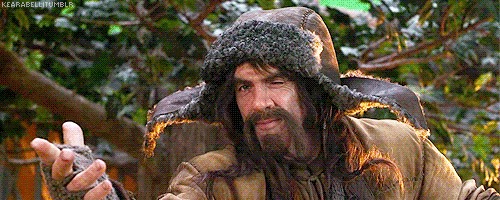
The Genius of Bofur

Whether they’re casual filmgoers, fantasy film lovers, or devout Tolkienites, most people seem to agree that Peter Jackson’s Hobbit movie trilogy is of a lesser quality than his Lord of the Rings trilogy. Reasons for this vary, though one of the most prevalent complaints is that the Hobbit films focus heavily on characters who had minor roles in the novel, weren’t in the novel at all, or weren’t in any work of Tolkien’s whatsoever. While this complaint is understandable, I do want to discuss one such character that has been well received by viewers: Bofur the dwarf.

Bofur obviously falls into the first of the above three categories. A dwarf with his name and same colored clothing is present in the book, but his characterization—that of a witty, fun-loving prankster who’s protective of Bilbo despite constantly teasing him—is not. Although hints of that persona can be read into the original text, particularly in a scene where he trips over a sleeping Bilbo and finds a reason to scold the hobbit for it, the Bofur that we see onscreen is largely a creation of the filmmakers.
 

You would think that being so embellished from his book counterpart would turn fans off to him, but he’s had the opposite effect. The Internet has been swarming with fanart, fanfiction, fanvideos, memes, and cosplay photos proclaiming our love for the dwarf in the silly hat ever since December 2012. We love Bofur so much that we were even disappointed when he didn’t get his seemingly promised character arc in the third film. Really think about that. Fans of The Hobbit, including fans of the novel, were disappointed that a character made almost from scratch for the movies didn’t get more screentime.

So why do we love him so much?

Well, he gets points for technically being a major character who’s supposed to be in the story. Bofur is one of Bilbo’s thirteen main traveling companions from the book, so it makes sense that the movies would want to give him a better-defined personality and more development. He also gets points for being a nice guy, as well as for being funny and optimistic to a degree that isn’t annoying or forced. And yes, being played by a charismatic actor like James Nesbitt also helps. These qualities certainly make Bofur likeable, but I think what really made his character stand out was the way the movies unveiled him.

We probably weren’t expecting the supporting dwarves to be very complex when we first saw An Unexpected Journey. They were barely more than names on a list in the book, and since we had a much bigger main cast and a shorter running time than the Lord of the Rings films, we may have figured that those dwarves would each fall into a standard “token” role. The tough-looking dwarf with the tattoos would be the token muscle, the little dwarf with the slingshot would be the token kid, and that dwarf with the floppy hat and the jaunty accent would be the token comic relief.

There’s nothing inherently wrong with keeping film characters simple when you’ve got so many of them, especially in an adaptation. Leaving any of the dwarves out of the Hobbit films would have likely angered the fanbase, and since Peter Jackson’s team didn’t have much to go off of from the book in terms of their personalities, depicting the less important dwarves as one-note tropes would have been forgivable. The fact stood though that being an oblivious walking punchline didn’t make Bofur terribly engaging in the first two thirds of the film.

And then the cave scene happened.


To this day, I think that the conversation where Bilbo accidentally says the dwarves don’t belong anywhere and Bofur wishes him “all the luck in the world” is one of the most moving and ingenious moments in the whole Hobbit film trilogy, and it wasn’t even written by Tolkien. Not only did it reveal that Bofur actually had feelings to hurt underneath his wisecracks, but it also changed our perspective on a lot of his previous actions towards Bilbo. He wasn’t an insensitive idiot; he was a well-intentioned friend who just liked to poke fun at the hobbit for being so uptight.

That’s why I think we came to love Bofur so much. He caught us by surprise in a really good way, and we were excited to see what he would do next. The Desolation of Smaug and The Battle of the Five Armies may not have given us anything quite as impressive, at least not yet in the latter’s case, but after Bofur got our attention, he stayed interesting enough to keep it.

As superior as the Lord of the Rings movies are considered to be, I do think that the filmmakers learned a lesson from their slapstick portrayal of Gimli. They may have learned that lesson so well, in fact, that they decided to play to our expectations by introducing Bofur as another clown before revealing more of his layers. Granted, there are still a few comedic misfires among the cast of The Hobbit, and the cave scene with Bilbo was actually a later idea shot in pickups, but it’s clear that movie Bofur was always meant to be something new to Peter Jackson’s Middle-Earth. He was meant to be (and is) self-aware comic relief.

How often in movies like this are the funny characters in on their own jokes? Most of the time, it seems like the audience is meant to laugh at them rather than with them. Even with previous three-dimensional comic relief characters like Merry and Pippin, the humor usually came from how foolish or awkward they were, not from how witty they were.

Bofur is a different breed. While he does have a few comical misfortunes, such as hitting his head on the bottom of a table and saying that things “could have been worse” right before the Great Goblin falls on him, the majority of his humor comes from him mocking or making light of serious situations. The character himself has a sense of humor, and he deliberately uses it throughout the films to try and boost his company's moral.

Case in point, the scene in The Desolation of Smaug where he leaves to find Athelas for Kili's poisonous arrow wound. Just before Bofur runs out the door to begin his search, he stops in front of the younger dwarf and orders him not to move, earning a few stares from his other companions. This line might seem obtuse at first, but a moment's thought makes us realize the true spirit behind it. 

Bofur knows full well how dire the situation is. He was the one who told Bard in the first place that Kili was "very sick," after all. He's aware that a dying, violently convulsing person isn't going to wander off while he's gone, but he's making a joke anyway to try and cheer up Kili.

Another case is the scene in An Unexpected Journey where he describes to Bilbo what it’s like to be incinerated by dragon fire. Bofur obviously has no idea what that’s really like, but since Bilbo is taking the threat of it so seriously, the dwarf is trying to play it down and make it sound ridiculous. Some might see this as him trying to scare Bilbo more, since it ends with the hobbit passing out, but remember that it comes after Bofur’s thoughtful reaction to Gandalf saying that there’s more to the hobbit “than appearances suggest.” He’s putting on a goofy act to try and make Bilbo laugh off the danger. 


That’s what makes Bofur’s movie persona so ingenious, in my opinion. He’s a person first and an archetype second, and he knows it in a way. Because of that, he’s versatile enough to carry a completely serious moment just as naturally as a completely funny one, just like a real person who has a sense of humor.

The fact that he carries out those funny moments on purpose makes him all the more endearing, because he’s putting forth a conscious effort to make the events we see onscreen more enjoyable. We almost feel like Bofur, not just the actor and film crew behind his character, is trying to entertain us and get us through things as much as he’s trying to do that for Bilbo and the other dwarves. That makes us feel more like we’re part of the company, rather than a bunch of spectators watching them from a theater. The experience of viewing the Hobbit movies is more immersive because his character is so genuine.

No official word has been given so far on Bofur’s role in the Extended Edition of The Battle of the Five Armies. The only guesses we can make are from hints by screenwriter Philippa Boyens and a couple castmembers about what was meant for him prior to the film’s theatrical release. Whether or not we’ll see him come more into his own or have another conversation with Bilbo this November is unclear, but given his history with the Extended Editions and that thirty minutes will be added to this coming one—and that the filmmakers seem to like him as much as we do—it’s a safe bet that he’ll get his chance to shine one last time.


Friday, January 16, 2015

The Line of Thorin Would Not Be So Easily Cut

Ever since Peter Jackson announced last month that the Extended Edition of The Hobbit: The Battle of the Five Armies was set to be thirty minutes longer, the Internet has been buzzing with predictions. We've all heard tidbits from the writers and cast about things we might expect to see, such as Radagast giving his staff to Gandalf and Bilbo having a talk with Bofur before sneaking out of Erebor, but a lot of hints at other bonus scenes can be found right in the film's promos. Even the two main trailers feature a considerable chunk of material that didn't make it into the final cut.


Looking at some of that material, fans can gather evidence and piece together a few potential scenes.

The scene I want to piece together today centers around Thorin Oakenshield. For as much as the King Under the Mountain gets rebuked in the official trailer, he does get one thing to say for himself: "Everything I did, I did for them." Since he's most likely referring to his nephews Fili and Kili, I think I know exactly what the context of that line is.


First of all, Thorin isn't wearing any of his kingly attire in the shot where he says it. This means that the scene either takes place before Fili, Kili, Bofur, and Oin arrive at Erebor or after Thorin overcomes his "Dragon Sickness" and decides to join the battle for the climax. He doesn't seem to be wearing any armor, so the first theory is probably the case.

Second of all, the trailer shows a shot right before that where Thorin appears to be standing among Erebor's treasure hoard without his crown on. If memory serves me correctly, I don't think that's a scenario we ever saw in the theatrical cut. Since he doubtfully would have gone back to the treasure after casting away his crown, that shot most likely takes place before the four dwarves in Laketown arrive at the mountain. Therefore, the shot where Thorin says his line probably occurs around that same time.


I found it a bit jarring in the theatrical cut when Fili, Kili, Bofur, and Oin arrive at Erebor and Bilbo just runs up to them saying, "FYI, Thorin's a totally different person now." It's understandable that this is how those characters would be informed of Thorin's transformation, but it's also how the audience is informed of it. No more gradually watching his character spiral downward -- he's just completely corrupt now. Since Bilbo mentions that Thorin has been counting the treasure in the mountain for days, we can assume that a scene of that downfall was originally included in the film and might return in the Extended Edition.

So how will it occur?

Well, let's look at Thorin's introduction in The Battle of the Five Armies. As Bilbo and the dwarves watch Smaug attack Laketown in the prologue, we see Nori trying to console his brother Ori. After that, we see Gloin looking dreadful and Bombur looking horrified. I always interpreted that as Gloin and Bombur realizing that their brothers, Oin and Bofur, are still in Laketown and caught in the middle of the carnage. Given that, I see Thorin's reaction, standing away from the group with his back to Laketown, as him realizing that Fili and Kili are also caught in the attack and not being able to watch.

It's likely that the Company's next scene in the Extended Edition will be a new one where they discuss their concern for the dwarves left in Laketown. Since Thorin isn't the most optimistic dwarf, he'll probably be convinced that Fili and Kili didn't survive Smaug's attack. That will prompt him to dismally say his line, "Everything I did, I did for them."

You can imagine what a horrible state of mind that would leave him in. He thinks his nephews are dead. The whole reason he set out to reclaim Erebor was to build a better future for them, and now the whole quest has been for nothing and he no longer has a purpose. And it's pretty much all his fault that Fili and Kili were left behind in Laketown to begin with. Adding the fact that all of his loyal followers are now mourning over two other dwarves that he left behind, it's a wonder Thorin didn't jump right off that cliff he was standing on at the start of the film.

It's pretty easy to guess where things might go from there. Thorin will probably wander away from the others in his depression, come across the treasure hoard, and literally lose himself in it. As we see in the theatrical cut, he gets so lost in it that when Fili, Kili, Bofur, and Oin turn up alive in Erebor, he barely even cares. The only thing he wants to do is show off all of his new treasure to them.


Let me just state for the record how much I hate the concept of "Dragon Sickness." It seems to be presented, at least in the movies, as a mental disorder caused by something in Erebor's gold that descendants of the dwarf king Durin are especially susceptible to. Being corrupted by greed has nothing to do with who those descendants are as people; they have a certain genotype, so they're going to catch that disorder from the contaminated gold. It's the same problem people have with the Midi-chlorians from Star Wars -- it reduces what should be a character trait to a condition.

Having Thorin succumb to "Dragon Sickness" because of his grief over his nephews, however, would fix that. He wouldn't have fallen to temptation because of his bloodline. He would have fallen to it because he lost hope and momentarily lost the will to resist it. That would have everything to do with who he is as a person. It would even make us wonder if he might have endured had Fili and Kili been with him the whole time.

That's about the only extra screentime I see Thorin needing in the Extended Edition (aside from his funeral). I'm very much in the camp that the bulk of that bonus footage should go to the supporting dwarves and characters like Beorn who got seriously shortchanged in this adaptation. We'll probably get more news about the Extended Edition closer to its release, but in the meantime, we'll just have to keep wandering the glorious halls of Tumblr and Twitter while counting the piles of rumors sparkling around us...