Wednesday, October 14, 2015
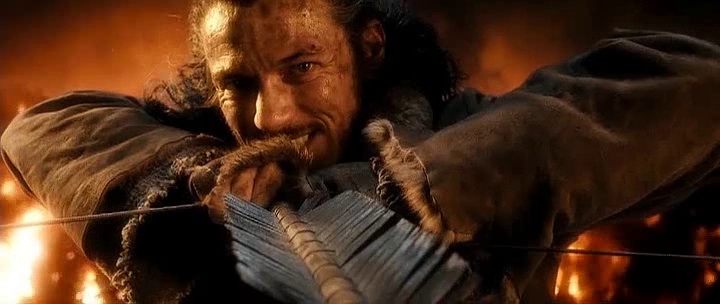
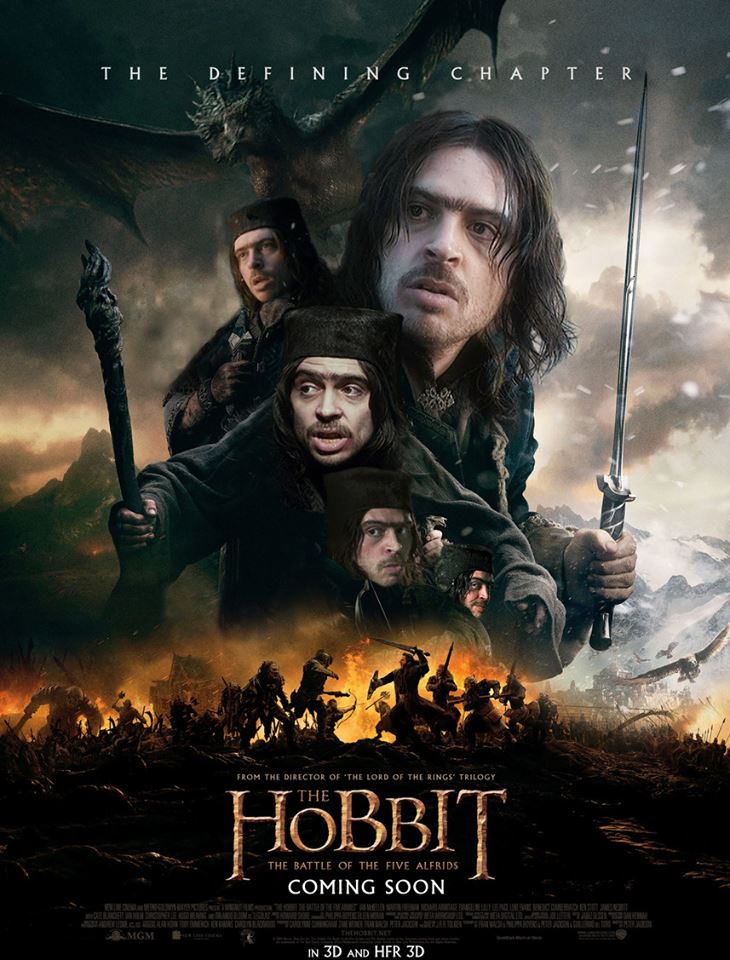
"The Battle of the Five Armies" Extended Edition - Early Review
I've finally seen it.
After ten months of blogging theories and a few days of trying to find a construction-free route to the one theater in town that was showing it, I've finally seen the Extended Edition of The Hobbit: The Battle of the Five Armies.
I should backtrack a little though to talk about this event as a whole. Just as they did with the Lord of the Rings trilogy in June of 2011, the company Fathom Events recently hosted a one-time-only, three-night screening of the Extended Editions of the Hobbit film trilogy in select theaters across the country. Fans like myself naturally flocked to cinemas to see the Extended Editions of the first two films last week, and both were highly entertaining experiences. However, this week's screening of the never-before-seen third Extended Edition was the star attraction of this event.
This was apparent not only from the much larger turnout in the audience, but also from the much more visual presentation of Peter Jackson's pre-movie introduction. Instead of showing one simple shot of the director talking to the camera like the first two Extended Editions did, the third one's intro featured music and clips from all three movies along with a full-screen graphic at the end. This extra bravado for the third Extended Edition makes sense, seeing how underwhelmed so many people were by the theatrical cut, and I for one was very excited for the movie to start after Mr. Jackson was done giving his thank-you's.
With that said, and with the promise not to give away much, what did I think of the Extended Edition of The Battle of the Five Armies?
To begin, there's only about 20 minutes of bonus footage added, not 30 minutes as was originally planned, and the bulk of it is more battle scenes. There are some scenes added before the battle, including a simple but poignant one that fans have been hoping to see since almost last December, but expect a first half that's very similar to the theatrical cut. There's also a bit more wrap-up after the fighting is over, though most of the minor storylines still don't get the closure that a lot of people probably wanted for them.
On a more praising note, there's actually quite a lot of humor throughout the bonus footage. Some of it is just goofy slapstick and sight gags, but the jokes involving the main characters give this version of the film something that was sorely missing from the other: a sense of fun.
Bilbo may be the heart of this story, but in the movies, the dwarves are the soul of it. They're the key to what made Bilbo and the audience come to enjoy this whole adventure in the first place, and having their presence diminished so much in the theatrical cut of The Battle of the Five Armies sapped nearly all of the enthusiasm out of it and left us with a terribly bleak final act of the Hobbit trilogy. Thankfully, the dwarves get way more screentime during the battle and we get more of their action antics like those in the first two films. Fans of Bifur, Bofur, and Bombur are especially going to walk away happy from this movie.
For anyone concerned about the Extended Edition's R rating, don't worry. I can point the finger for that at exactly two shots, and what happens in them is mostly aimed to draw cheers and laughter from the audience. What that says about our modern-day senses of humor is probably more disturbing than the actual onscreen content.
There's really only one deleted scene that I lamented not making it into the Extended Edition, since it likely would have been a major character development moment and was sort of a centerpiece of the film's original trailer, but ultimately, I do understand why it was cut. There's also a scene added in that I've thoroughly spoken against in a previous blog entry, although the way that it unfolds is just so ludicrous and yet poetically fitting that another part of me couldn't help liking it.
And since it's been almost a year since I wrote my "There's Something About Ori" essay, I might as well mention that the little dwarf scribe photobombs Bilbo twice in one bonus scene. It's not the journal scene that I was hoping to get, but I'll still call it a victory.
In short, the Extended Edition of The Hobbit: The Battle of the Five Armies is worth the wait. I wish we had gotten this version in theaters instead last year, and given its 164-minute run time, it feels more like a theatrical cut anyway. Like I said back in December, hardcore fans are probably going to look back on this movie and all five of its predecessors as films that were preceded by condensed editions rather than followed by Extended Editions.
But in the end, I'm grateful that the filmmakers of the six Middle-earth movies cared enough about their fans to give us two versions of each to choose from. We're a very lucky bunch, if you do believe in luck.
Tuesday, October 6, 2015
"The Last Creator - Part 1" Now Available
Here it is! My novel "The Last Creator - Part 1" is now available on Kindle for $2.99.
The Last Creator - Part 1 by Katelyn Rushe
Amber Brenin is as new to the world as a twelve-year-old can be. Life in
a care center for autistic children such as herself allows her very
little interaction with other people, including her geologist father
Robert. When an upcoming expedition threatens to separate them for
months, Robert smuggles his daughter along on the trip, only to lose her
when he finds the thing that he's looking for.
Now Amber is stranded on Rökshena, a world far away from Earth where no one knows how to communicate with her or understands her condition. As she begins to cope with her strange surroundings and stranger allies, a chain of mysterious disasters strikes that could doom all life on Rökshena. Questions mount as Amber attempts to uncover the cause of these events while also discovering herself—and most importantly, finding her place in her new world.
The Last Creator - Part 1 by Katelyn Rushe
Amber Brenin is as new to the world as a twelve-year-old can be. Life in
a care center for autistic children such as herself allows her very
little interaction with other people, including her geologist father
Robert. When an upcoming expedition threatens to separate them for
months, Robert smuggles his daughter along on the trip, only to lose her
when he finds the thing that he's looking for.
Now Amber is stranded on Rökshena, a world far away from Earth where no one knows how to communicate with her or understands her condition. As she begins to cope with her strange surroundings and stranger allies, a chain of mysterious disasters strikes that could doom all life on Rökshena. Questions mount as Amber attempts to uncover the cause of these events while also discovering herself—and most importantly, finding her place in her new world.
Friday, September 18, 2015
The Last Creator - Part 1
The Rökshena Revolution is a young adult sci-fi/fantasy book series that will launch in October 2015. The series documents the history of Rökshena, a world in an alternate dimension that is connected to Earth by a series of portals.
The first book, The Last Creator, begins the story of Amber Brenin, an autistic girl whose kidnapping leads her to one such portal.
Thursday, September 17, 2015
Talking Animals in the Middle-earth Movies
Keeping with something of a theme that’s come up in my past couple of essays, I want to discuss the subject of talking animals in the Middle-earth books and explore why this aspect of Tolkien’s universe has been mostly left out of the Peter Jackson film adaptations. It’s understandable that not everything on the page can make it onto the screen, but in the case of certain animals, this change in depiction is a bit more noticeable and raises a few questions about why it was made. This is especially the case for the talking animals in The Hobbit, who play much larger roles in that story than in The Lord of the Rings.
To start off, not every animal in Tolkien's source material talks. The majority of them don't, in fact. The only ones who do, at least in The Hobbit and The Lord of the Rings, are Shelob and the spiders in Mirkwood, the ravens of Erebor, and the eagles. Sometimes a character will be able to speak the language of an animal in order to gain information from it, and the reader is occasionally treated to the thoughts of an animal that crosses paths with the heroes, but those individuals never voice their thoughts out loud.
In the six movies, the only animals who speak are the spiders in Mirkwood, and even the circumstances of that are changed so that their voices can only be heard after the hero puts on the One Ring of Power. It's implied that the dwarves might be able to communicate with the ravens of Erebor, but no conversations between them are ever shown on screen. Shelob says nothing, now arguably because no one ever wears the One Ring in her presence, and of course, the eagles never speak with anyone to explain why they won't just fly the characters all the way to their destinations. Jackson's team didn't even modify that in the Hobbit films after a decade of hearing fans complain about it from the Lord of the Rings films.
The question then is why these changes were made to the
adaptations. Why were the filmmakers so opposed to including this particular
aspect of Tolkien’s stories?
The first possible reason is the change in depiction from
the books to the movies. The Middle-earth that we see on the screen is a less
magical and more reality-based world than the one we read about on the page.
This helps to make the setting a bit more familiar and relatable to movie
audiences and thus makes the world in the movies easier to step into in a
shorter amount of time, as well as to give it a bit more credibility to viewers
who aren’t familiar with the source material. Talking animals are obviously not
a realistic concept, so their inclusion would detract from what the movies are
trying to do.
Another possible reason is the change in tone from the books to the movies. It’s not to say that
the books were geared entirely for children, particularly not The
Lord of the Rings, but the films are much
more graphic than what Tolkien wrote. Case in point, the upcoming Extended
Edition of the third Hobbit movie
is going to be rated R for “extended sequences of intense fantasy action
violence, and frightening images.” Talking animals in this day and age carry a
more Disney-esque kid-friendly connotation that most teens and adults probably
wouldn’t take seriously, so they don’t fit so nicely into a more mature
adaptation.
And that’s the third possible reason for taking away most of
the animals’ voices in the movies: the change in times from the books to the movies. The Hobbit was originally published in the 1930’s, a time when
epic fantasy was still blossoming as a genre, and The Lord of the
Rings trilogy was published in the 1950’s,
a time when popular entertainment was just starting to become a little
grittier. I would dare say that both of those works played a major role in
revolutionizing the genre and the grit, but to stay on point, talking animals
in fiction were not considered so childish back in those decades. Times have
changed so much since then that even modern-day Disney films like Enchanted
and Frozen not only steer away from using talking animals, but
also poke fun at the idea.
To put things into perspective, compare the Lord of the
Rings and Hobbit films to another recent big screen adaptation of a
popular fantasy series, The Chronicles of Narnia. Written by C.S. Lewis and also published in the
1950’s, the Narnia books were
very much intended for children and are filled with talking animals who play
major roles in each story. While a few funny lines are added to the films to
properly convey the humans’ surprise at these animals, not much of that aspect
is changed and the series remains very much geared to a younger audience.
The three Narnia films
that have come out to date made a total of roughly $1.5 billion worldwide at
the box office—about half of what the Lord of the Rings film trilogy and the Hobbit film trilogy made apiece.
I’m not saying that talking animals were to blame for the Narnia movies not being more successful. I’m saying that
they were just one element of an overall tone that doesn’t appeal to fans of
fantasy movies so much anymore. Granted, the Lord of the Rings films probably gave a lot of viewers certain
expectations for future fantasies that the Narnia films didn’t live up to, but the fact remains that
more realism and less whimsy seems to be a bigger draw for the genre nowadays.
So why then did the Hobbit movies give us talking spiders in Mirkwood? Why not stick to the rule
of silence and let them go on making disgusting little noises like Shelob
instead of inventing a way for Bilbo to decipher their language? My best guess
is that the filmmakers wanted to give a nod to the very vocal spiders from the
source material and to perhaps lighten the mood of the scene a little.
The intention of the Hobbit trilogy was to start out lighthearted and fun like the book and then
gradually take on the darker tone of The Lord of the Rings, which is understandable since those books are extremely
different in tone. Since the spiders show up early in the second Hobbit film and the scene where Bilbo saves the dwarves
from them is supposed to be an enjoyable moment, it’s still fitting to make
them silly, and a good way to do that is by making them complain and comment on
their still-living food just like they do in the book. They can be seen as sort
of a less cartoony version of the three trolls from the first film, and then
Smaug can be seen as an even further transition from that.
In short, I think that talking animals were largely left out
of the Peter Jackson Middle-earth movies because they’re seen as something too
innocent for what Middle-earth has become since the 1930’s. Tolkien’s books
themselves offer some hint of that, as the only talking animals in the more
adult Lord of the Rings books are
carry-overs from the more child-friendly Hobbit. The lessening presence of talking animals in that
world, as well as in our world’s popular culture, seems to reflect an overall
transition towards maturity that has occurred over nearly the past eight
decades. Whether this is good or bad is debatable, but in the case of Middle-earth, it is perhaps a sign of Tolkien's universe simply growing up alongside its readers.
Monday, August 17, 2015
How Do You Talk to a Dragon?
By far one of the most iconic figures from any work of
J.R.R. Tolkien’s is Smaug from 1937’s The Hobbit. While not the first treasure-obsessed dragon
to terrorize villagers in the history of literature, Smaug is one of the most
memorable and widely portrayed. This is possibly because he was one of the first and still one of the few who
speaks.
Dragons in fantasy traditionally don’t serve as characters, but rather as plot devices; they are obstacles without personalities or voices that are in the story for no other reason than to be vanquished by the heroes. Tolkien’s fiery villain, in contrast, is a character with a cunning and cocky personality that he frequently makes known to Bilbo Baggins and the readers by boasting of his abilities in words.
With that said, here’s my latest fan theory that I want to put to the test: that the Smaug played by Benedict Cumberbatch in the Peter Jackson Hobbit film trilogy does not in fact speak English.
Just look at the third Hobbit film. When it becomes clear to Thorin that he and his company will have to defend the Lonely Mountain from the Lake-town survivors and the Mirkwood elves, he sends a raven to his cousin Dain to call for reinforcements. The raven isn’t carrying any letters when it leaves the mountain, and since the dwarves are able to communicate with the ravens in the book, it has to be assumed that Thorin verbally gave the bird his message to deliver and Dain was able to understand the animal in order to receive that message.
If the film dwarves are able to converse with one creature, then they may be able to converse with others. And who knows? It’s possible that Thorin’s susceptibility to dragon sickness could have given him the ability to understand Smaug, similar to how the One Ring may have given it to Bilbo. Durin's line is said to be more susceptible to dragon sickness than other dwarves are, and since none of the other members of Thorin's company attempt to speak with Smaug during their confrontation, it could be common knowledge among them that only their leader has the skill to do so. They may not know that dragon sickness is the cause of it, though.
By either of these rationals, Bard remains the one character out of the three addressed by Smaug who can't decipher the villain's words; the plot point of him learning of Smaug’s weak spot from the thrush is written out of the films, implying that this version of Bard can’t communicate with other species, and he of course is never corrupted by dragon sickness.
Dragons in fantasy traditionally don’t serve as characters, but rather as plot devices; they are obstacles without personalities or voices that are in the story for no other reason than to be vanquished by the heroes. Tolkien’s fiery villain, in contrast, is a character with a cunning and cocky personality that he frequently makes known to Bilbo Baggins and the readers by boasting of his abilities in words.
With that said, here’s my latest fan theory that I want to put to the test: that the Smaug played by Benedict Cumberbatch in the Peter Jackson Hobbit film trilogy does not in fact speak English.
One of the films’ more clever changes to the story of The Hobbit is the
One Ring’s power to make its bearer understand the language of magical
creatures while wearing it. We see this occur once in the second film, when
Bilbo rescues his companions from a nest of giant spiders. This concept was
obviously created as a means of being true to the source material, where Bilbo
hears the spiders talking, while also keeping with the screen adaptation’s more
realistic approach of not having any of the animals actually talk. What’s
interesting about it though is that we clearly hear one of the spiders say something in English to Bilbo after he takes off the Ring. Some viewers may see
this as a continuity error, but others see it as Bilbo retaining his ability to understand the creature's words once the Ring grants him with that
power.
It’s possible then that the same thing occurs during his
meeting with Smaug later in the film. Bilbo initially puts on the One Ring to
conceal himself from the dragon, then he reluctantly takes it off when its
power becomes too overwhelming. From there, the hobbit and Smaug share two
conversations until the latter exits the Lonely Mountain to attack Lake-town.
One wonders if either conversation would have taken place if Bilbo had kept the
Ring in his pocket the entire time that he was in the mountain.
This theory gains a bit more weight when looking at Smaug’s
scenes without the burglar. We see the dragon assault the city of Dale and take
over the Lonely Mountain in the opening of the trilogy’s first film, but not
once does he ever say anything during that massacre. The argument can be made
that he’s too preoccupied with his task to comment on it, as it’s probably
difficult to speak while breathing fire, and the filmmakers are clearly trying to keep him under wraps until Bilbo meets him. Still, from what we learn about Smaug in
the next film, it seems odd that he would do something so
catastrophic without bragging about it to the people he’s killing.
Smaug doesn’t say very much when the dwarves are trying to
apprehend him in the second film either. The only times he ever seems to
address anyone in those scenes is when Bilbo is present. He says a great deal
to Bard the Bowman while attacking Lake-town, which Mr. Baggins is not present
during, but upon closer inspection, that exchange doesn’t seem quite as
interactive as the ones with the hobbit.
Bard never speaks to Smaug. He just goes about his business
of preparing to fire his black arrow while the dragon taunts him. Again, it’s
possible that the man is too preoccupied with what he’s doing to say anything
(and really, what can anyone say to a dragon who just burned down their entire
town?), but the notion that the audience is being allowed to hear something that
he can’t in that scene holds up fairly well. Bard’s supposed reactions to some
of the things that Smaug says could be seen as Smaug commenting on things as
Bard is realizing them for himself.
For instance, the bowman looks at his son Bain after the
dragon makes a comment about the boy; Smaug’s glare at Bain while making that
comment would be enough indication that he’s taking note of the youngster and
would give Bard enough reason to look at his son with concern. Also,
Cumberbatch’s Smaug certainly seems like the type who would gloat at someone
even when he knows they can’t understand him.
The only other person that the dragon speaks to, just before
flying to Lake-town, is Thorin Oakenshield. The following lines are said:
THORIN: Here, you witless worm!
SMAUG: You.
THORIN: I have taken back what you stole.
SMAUG: You will take nothing from me, dwarf. I laid low your warriors of old. I instilled terror in the hearts of men. I am King Under the Mountain.
THORIN: This is not your kingdom. These are dwarf lands, this is dwarf gold, and we will have our revenge.
SMAUG: Revenge? I will show you revenge!
This could almost read as Thorin giving a separate speech to Smaug that just happens to be about the same thing as the dragon's speech to him, unbeknownst to the dwarf king. It would make sense for both characters to have similar mindsets like this since they’ve spent the past several minutes fighting each other for the mountain, and since Smaug's ability to understand English is not being questioned, it makes sense for him to give the appropriate reactions and responses to what Thorin says. However, Thorin's reply to Smaug calling himself King Under the Mountain can read as a comprehending dialogue between the two and is probably the strongest argument against the “Smaug doesn’t speak English” theory.
THORIN: Here, you witless worm!
SMAUG: You.
THORIN: I have taken back what you stole.
SMAUG: You will take nothing from me, dwarf. I laid low your warriors of old. I instilled terror in the hearts of men. I am King Under the Mountain.
THORIN: This is not your kingdom. These are dwarf lands, this is dwarf gold, and we will have our revenge.
SMAUG: Revenge? I will show you revenge!
This could almost read as Thorin giving a separate speech to Smaug that just happens to be about the same thing as the dragon's speech to him, unbeknownst to the dwarf king. It would make sense for both characters to have similar mindsets like this since they’ve spent the past several minutes fighting each other for the mountain, and since Smaug's ability to understand English is not being questioned, it makes sense for him to give the appropriate reactions and responses to what Thorin says. However, Thorin's reply to Smaug calling himself King Under the Mountain can read as a comprehending dialogue between the two and is probably the strongest argument against the “Smaug doesn’t speak English” theory.
To still humor that idea though, this scene could perhaps be
interpreted not as the dragon speaking English to Thorin, but as Thorin also having the ability to understand dragon speech.
Just look at the third Hobbit film. When it becomes clear to Thorin that he and his company will have to defend the Lonely Mountain from the Lake-town survivors and the Mirkwood elves, he sends a raven to his cousin Dain to call for reinforcements. The raven isn’t carrying any letters when it leaves the mountain, and since the dwarves are able to communicate with the ravens in the book, it has to be assumed that Thorin verbally gave the bird his message to deliver and Dain was able to understand the animal in order to receive that message.
If the film dwarves are able to converse with one creature, then they may be able to converse with others. And who knows? It’s possible that Thorin’s susceptibility to dragon sickness could have given him the ability to understand Smaug, similar to how the One Ring may have given it to Bilbo. Durin's line is said to be more susceptible to dragon sickness than other dwarves are, and since none of the other members of Thorin's company attempt to speak with Smaug during their confrontation, it could be common knowledge among them that only their leader has the skill to do so. They may not know that dragon sickness is the cause of it, though.
By either of these rationals, Bard remains the one character out of the three addressed by Smaug who can't decipher the villain's words; the plot point of him learning of Smaug’s weak spot from the thrush is written out of the films, implying that this version of Bard can’t communicate with other species, and he of course is never corrupted by dragon sickness.
Whatever language Smaug does speak, he remains one of epic
fantasy’s most outspoken dragons. He rightfully deserves his distinction as one
of the most famous (or infamous) as well, and Cumberbatch’s eerily arrogant
portrayal of him in the Hobbit film
trilogy will no doubt be the most prevalent one in people’s minds for many
years to come. If the above theory has intrigued anybody, then perhaps the
regard of that portrayal will be just a little more open to interpretation
— so to speak.
Thursday, July 16, 2015
Did the Dwarves Pre-write "Blunt The Knives"?
Something that I should probably clarify at the beginnings of my Hobbit theory essays is what a "fan theory" is. The best definition that I can think of is that it's an idea regarding something in a film, show, book, or some other storytelling medium that members of the fanbase choose to believe even though that idea is typically not the intention of the original creator. Fans conceive such ideas for various reasons, sometimes to fill in plotholes or to connect things in the narrative that seem like they could fit together, but the purpose of most fan theories is to provide a more interactive way of enjoying a story. We like to feel as if we contributed something to our favorite films, shows, books, and so forth, and putting together evidence to support our theories can make for a fun brain exercise.
With that said, I want to present another fan theory about the Peter Jackson Hobbit films: that the dwarves of Thorin Oakenshield's company wrote and rehearsed the song "Blunt the Knives" prior to meeting Bilbo Baggins.
This theory could perhaps apply to the book as well, but I'll be discussing it mainly in the context of the movies. That's because the song's inclusion is a bit more conspicuous in the film adaptation.
By in large, the six Peter Jackson Middle-earth movies try to ground the stories of The Hobbit and The Lord of the Rings in reality more than the books do. The animals don't speak for the most part, uses of magic are depicted very subtly, and aside from a few goofy combat physics (mostly on the part of the mystical elves), the characters don't bend the laws of time and space too much. Considering this, it's a bit jarring to see twelve dwarves break out into an improvised, well-timed song and dance number where everyone sings along in perfect harmony and knows every word. When does that ever happen outside of a musical?
It's easy to believe other singing scenes in the Hobbit movies, namely the dwarves' renditions of "The Misty Mountains Cold" and "The Man in the Moon Stayed Up Too Late," but that's because we can assume that they've known those songs for a long time and have probably sung them before. This leads me to wonder if perhaps the song "Blunt the Knives" wasn't improvised after all, but was in fact another piece that the dwarves knew well before performing it.
They would have had the time to compose it; Gandalf decides on the morning of the Unexpected Party that he will send the dwarves to Bag End, and they don't arrive there until late in the evening. Furthermore, the first dozen arrive at roughly the same time, which could mean that they spent a good portion of their journey from the Blue Mountains to the Shire traveling together. A trip that long can get boring, and since Middle-earth dwarves are shown to be musically inclined, the twelve of them could have easily come up with and memorized a song about their soon-to-be host along the way. They would know his name, since Gandalf says that morning that he will "inform the others" of Bilbo's inclusion on their quest and Kili almost says it correctly upon meeting Bilbo.
The song's lead-in at the party is also somewhat suspicious. Right in the middle of their rowdy celebration, the dwarves all start pounding their silverware on the table in perfect rhythm until Bilbo complains that they'll blunt them, then the dwarf Bofur very slyly relays this concern to the others. It's as if they were deliberately baiting Bilbo into saying something close to their song's opening line and then Bofur cued everyone to start singing it. This begs the question of whether all of their rude behavior before that really was plain ignorance or actually one big act to get Mr. Baggins fired up.
The next question is why the dwarves would want to tease him so thoroughly. Most likely, it's because Gandalf mentioned while informing them of Bilbo that the hobbit was sort of a stick in the mud. The wizard makes it clear while talking to Bilbo that morning that he's unhappy with the way Belladonna Took's son has turned out, so he probably conveyed that unhappiness to the company and painted a less than flattering picture of the halfling. This may have given the dwarves the (correct) impression that they wouldn't be welcome in Bag End, so they may have decided to give Bilbo the same treatment that they give to most hosts who don't appreciate their company.
Just look at their behavior in Rivendell later: they make a mess at the dinner table, sing a song that the elves clearly don't like, eat them out of house and home, trash the furniture, and do something in a public fountain that probably also caused a few plumbing issues.
Compare that then to their respectful behavior in the house of Beorn, a giant skin-changer who makes a habit of tearing apart unwanted visitors, and their reverence in Erebor, the home of their forefathers. Dwarves are entirely capable of civility, but they'll be stubborn and proud if they can afford to be. If they pick up any holier-than-thou vibes from someone and believe that they can get away with a few pranks, they'll gladly entertain themselves at that person's expense. Writing a song about ruining said person's belongings is one of the tamer things they can do.
With that said though, they seem to like Bilbo a lot more than they like the elves. Why else would they clean his dishes after all was said and done? If "Blunt the Knives" was a pre-written prank, then it was obviously meant in good nature. It's almost flattering, really, that the dwarves went to the trouble to compose a song specifically about Bilbo instead of just singing any old tune. Maybe like Gandalf, they sensed that the hobbit wasn't as prim and proper as he tried to be and just wanted to nudge him out of his shell a little.
Dwarves just nudge a little harder than most folk, as we all know.
With that said, I want to present another fan theory about the Peter Jackson Hobbit films: that the dwarves of Thorin Oakenshield's company wrote and rehearsed the song "Blunt the Knives" prior to meeting Bilbo Baggins.
This theory could perhaps apply to the book as well, but I'll be discussing it mainly in the context of the movies. That's because the song's inclusion is a bit more conspicuous in the film adaptation.
By in large, the six Peter Jackson Middle-earth movies try to ground the stories of The Hobbit and The Lord of the Rings in reality more than the books do. The animals don't speak for the most part, uses of magic are depicted very subtly, and aside from a few goofy combat physics (mostly on the part of the mystical elves), the characters don't bend the laws of time and space too much. Considering this, it's a bit jarring to see twelve dwarves break out into an improvised, well-timed song and dance number where everyone sings along in perfect harmony and knows every word. When does that ever happen outside of a musical?
It's easy to believe other singing scenes in the Hobbit movies, namely the dwarves' renditions of "The Misty Mountains Cold" and "The Man in the Moon Stayed Up Too Late," but that's because we can assume that they've known those songs for a long time and have probably sung them before. This leads me to wonder if perhaps the song "Blunt the Knives" wasn't improvised after all, but was in fact another piece that the dwarves knew well before performing it.
They would have had the time to compose it; Gandalf decides on the morning of the Unexpected Party that he will send the dwarves to Bag End, and they don't arrive there until late in the evening. Furthermore, the first dozen arrive at roughly the same time, which could mean that they spent a good portion of their journey from the Blue Mountains to the Shire traveling together. A trip that long can get boring, and since Middle-earth dwarves are shown to be musically inclined, the twelve of them could have easily come up with and memorized a song about their soon-to-be host along the way. They would know his name, since Gandalf says that morning that he will "inform the others" of Bilbo's inclusion on their quest and Kili almost says it correctly upon meeting Bilbo.
The song's lead-in at the party is also somewhat suspicious. Right in the middle of their rowdy celebration, the dwarves all start pounding their silverware on the table in perfect rhythm until Bilbo complains that they'll blunt them, then the dwarf Bofur very slyly relays this concern to the others. It's as if they were deliberately baiting Bilbo into saying something close to their song's opening line and then Bofur cued everyone to start singing it. This begs the question of whether all of their rude behavior before that really was plain ignorance or actually one big act to get Mr. Baggins fired up.
The next question is why the dwarves would want to tease him so thoroughly. Most likely, it's because Gandalf mentioned while informing them of Bilbo that the hobbit was sort of a stick in the mud. The wizard makes it clear while talking to Bilbo that morning that he's unhappy with the way Belladonna Took's son has turned out, so he probably conveyed that unhappiness to the company and painted a less than flattering picture of the halfling. This may have given the dwarves the (correct) impression that they wouldn't be welcome in Bag End, so they may have decided to give Bilbo the same treatment that they give to most hosts who don't appreciate their company.
Just look at their behavior in Rivendell later: they make a mess at the dinner table, sing a song that the elves clearly don't like, eat them out of house and home, trash the furniture, and do something in a public fountain that probably also caused a few plumbing issues.
Compare that then to their respectful behavior in the house of Beorn, a giant skin-changer who makes a habit of tearing apart unwanted visitors, and their reverence in Erebor, the home of their forefathers. Dwarves are entirely capable of civility, but they'll be stubborn and proud if they can afford to be. If they pick up any holier-than-thou vibes from someone and believe that they can get away with a few pranks, they'll gladly entertain themselves at that person's expense. Writing a song about ruining said person's belongings is one of the tamer things they can do.
With that said though, they seem to like Bilbo a lot more than they like the elves. Why else would they clean his dishes after all was said and done? If "Blunt the Knives" was a pre-written prank, then it was obviously meant in good nature. It's almost flattering, really, that the dwarves went to the trouble to compose a song specifically about Bilbo instead of just singing any old tune. Maybe like Gandalf, they sensed that the hobbit wasn't as prim and proper as he tried to be and just wanted to nudge him out of his shell a little.
Dwarves just nudge a little harder than most folk, as we all know.
Labels:
bag end,
baggins,
bilbo,
blunt the knives,
bofur,
dwarves,
elves,
fanbase,
gandalf,
hobbit,
kili,
middle-earth,
peter jackson,
rivendell,
shire,
song,
theory
Friday, June 19, 2015
To Kill an Alfrid
Well, it's finally happened. After months of theorizing and speculating, fans of The Hobbit have finally received a list of bonus scenes to expect in the Extended Edition of The Battle of the Five Armies. I don't recall a list like this coming out for any of the previous five Extended Editions, at least not this early. If I'm correct to think that it hasn't been done before, this could serve as further evidence that Peter Jackson was forced to trim down this film far beyond his liking for the theaters.
In any case, here's the list:
- More scenes of Bard attempting to kill Smaug
- More scenes of Smaug destroying Lake-town
- An extended scene of Azog's invasion forces
- Elf archers firing at Orcs, Wargs, and Trolls
- Dwarves with Ballistas firing at Orcs and Trolls
- Dwarven Goat Riders and Rams join the battle to attack Orcs and Wargs
- Funeral of Thorin, Fili, and Kili
- Coronation of Dain II Ironfoot, Now King Dain II Ironfoot
- Bard becoming the new king of New Dale
- Gifts of treasures given to Bilbo, Bard, Thranduil, and the People of Lake-town
- Bilbo and Gandalf revisit the Trollshaws
- An Exchange between Thranduil and Gloin during the battle
- Beorn tortured in Dol Guldor
- Sauron interrogates Gandalf in Dol Guldor
- The death of Alfrid Lickspittle
- More fighting in the city of Dale
- More battle scenes
- The war beasts Azog sends just after the battle begins
- Axe blade removed from Bifur's forehead
- Conversation between Bilbo and Bofur before Bilbo hands over the Arkenstone
- Smaug destroys the Dwarven Wind lance
- Galadriel unveils true the power of her Elven ring, Nenya
- Thorin and Company start counting and assessing their treasure hoard
- Bilbo buries his acorn in Dale
- Beorn brings a dead Thorin II Oakenshield back to the Lonely Mountain
- More graphic and brutal Orc kills
The only scene on this list that I have reservations about, strangely enough, is Alfrid's death.
I've been all over the spectrum with this character since the release of The Battle of the Five Armies. In the span of a few months, I've gone from saying that he shouldn't be disposed of so quickly and that he should get more screentime to saying that his only screentime at all should consist of Bilbo kicking him in the shin. The whole "Alfrid Problem" is just so befuddling because he had so much potential in the second Hobbit film that went utterly wasted in the third, and it leaves many of us scratching our heads about why he was even written into this trilogy.
The question then is why I would take issue with seeing him die if that's pretty much the only gratifying thing he can do at this point. Well, there may be a few answers for that.
First of all, there is a legitimate reason for adding Alfrid's character to the films. Giving the Master of Lake-town an accomplice makes sense from a screenwriting standpoint because it's easier to convey his plans to the audience when he has someone to discuss them with out loud. The puzzlement is why the Master becomes the one to die in the third film's opening while his accomplice gets to stick around afterwards for the majority of the plot. It would be a lot truer to the book if the opposite happened, with Alfrid the watchful manipulator dying in Lake-town and the Master being reduced to a powerless weasel without his aide around to manage things.
The screenwriters wouldn't even have to change all that much; Alfrid could get killed by Smaug right after the Master pushes him off their boat, then Bard's lasso could pull the Master overboard and Smaug could fall on the boat before the Master can return to it to save his gold. The Master could spend the rest of the movie doing the exact same things that Alfrid does, discovering how ineffectual he really is on his own, then decide to skirt off—so to speak—after finding the gold hoard in Dale because wealth was all he ever cared about.
It doesn't make as much sense for Alfrid to have that story arc in the third film because he was never established as being so materialistic before Smaug's attack. He actually suggests dumping some of the Master's gold overboard to lighten the boat during their escape attempt, so it seems somewhat out of character for him to become obsessed with getting his hands on Erebor's gold later. I guess the argument can be made that he starts falling into the same greedy vices as the Master once he comes into his own, much like Thorin does after succeeding Thror, but the movie never indicates that this sort of character development is going on. It almost feels like the roles were the other way around originally and then Alfrid was dumped into the Master's place at the last minute without any other changes being made to those scenes.
That brings me to my first issue with Alfrid's death. In my opinion, if this adaptation is going to give him the Master's story arc, then the least it can do is be true to the Master's arc in the book. Killing Alfrid robs that arc of one of the few things it had in common with the source material. Granted, we don't know what "The Death of Alfrid Lickspittle" entails, if we'll see him get killed during the battle or starve to death in the wilderness like the Master eventually does in Tolkien's writings, but knowing these movies, it's likely that he'll meet a more theatrical demise.
My second issue with Alfrid’s death, which I admit is my own problem, is that I had been very on board with the headcanon that he was actually Grima Wormtongue’s father in the movies. One of the biggest grievances that people have always had with Alfrid is that he’s a knockoff of Wormtongue, so what better solution is there for that resemblance than to make them relatives? It would have explained a few things about Wormtongue too, such as why he has a drastically different appearance from the other Rohan natives, and it would have given fans something neat to further tie the two trilogies together.
Any chance of that being canon dies with Alfrid in the
Extended Edition of the third Hobbit movie though, which means we have to go
right back to accepting that he looks, sounds, and acts exactly like another
Middle-earth character by complete coincidence. In that sense, his storyline is
one that the filmmakers might have been better off leaving open-ended.
My third issue comes from looking at the Hobbit films in a wider scope with the Lord of the Rings films. For as much as The Lord of the Rings gets dubbed the darker of the two stories, it leaves surprisingly few casualties on the good guys' side. The only significant, permanent, onscreen deaths that I can think of are Boromir's, King Theoden's, and Haldir's. On the bad guys' side, however, virtually everyone dies. Sure, Shelob lives and some of the orcs escape from that earthquake outside Mordor at the end of The Return of the King, but none of them were really characters that we grew to personally know or hate.
That makes Alfrid's apparent survival in the theatrical cut of The Battle of the Five Armies rather unique. Instead of dying like every other notable antagonist, his comeuppance is running away alone and disgraced with nothing wholesome or meaningful in his future. That's arguably an even worse fate. It's also a much more mature and thought-provoking one when compared to the deaths of the heroes Thorin, Fili, and Kili.
It all hearkens back to Gandalf's line in The Fellowship of the Ring about how "many that live deserve death" while "some that die deserve life." I think that this line resonates a lot more if we've seen examples of both play out in a previous film. Keeping Alfrid alive adds an extra dose of reality to the whole six-film series, however unfair that reality is, and it creates something of another legacy from The Hobbit that didn't exist so clearly in the first Lord of the Rings movie prior to last December. Having him turn out to die after all, in my mind, undoes the one substantial thing that he contributed to The Battle of the Five Armies.
I'm not sure how any of the decisions on Alfrid's role in the trilogy were made. My theory is that the filmmakers really liked actor Ryan Gage and decided to do a lot of tinkering with the script after realizing that they had to scrap the character he was originally cast for, but that's mostly just a hunch. In the end, Alfrid is what he is, and no amount of complaining is going to change that. It's possible that the upcoming Extended Edition could give some depth to his character like the last one did, but if not, I can look on the bright side. If his death is the only bonus scene that I have reservations about on a list of twenty-six, then I’ve got it pretty good.
Labels:
alfrid,
armies,
battle,
beorn,
bilbo baggins,
dwarves,
extended edition,
five,
grima,
hobbit,
laketown,
lord of the rings,
master,
peter jackson,
ryan gage,
smaug,
thorin,
wormtongue
Subscribe to:
Posts (Atom)