Monday, August 17, 2015

How Do You Talk to a Dragon?

By far one of the most iconic figures from any work of J.R.R. Tolkien’s is Smaug from 1937’s The Hobbit. While not the first treasure-obsessed dragon to terrorize villagers in the history of literature, Smaug is one of the most memorable and widely portrayed. This is possibly because he was one of the first and still one of the few who speaks. 

Dragons in fantasy traditionally don’t serve as characters, but rather as plot devices; they are obstacles without personalities or voices that are in the story for no other reason than to be vanquished by the heroes. Tolkien’s fiery villain, in contrast, is a character with a cunning and cocky personality that he frequently makes known to Bilbo Baggins and the readers by boasting of his abilities in words.


With that said, here’s my latest fan theory that I want to put to the test: that the Smaug played by Benedict Cumberbatch in the Peter Jackson Hobbit film trilogy does not in fact speak English.


One of the films’ more clever changes to the story of The Hobbit is the One Ring’s power to make its bearer understand the language of magical creatures while wearing it. We see this occur once in the second film, when Bilbo rescues his companions from a nest of giant spiders. This concept was obviously created as a means of being true to the source material, where Bilbo hears the spiders talking, while also keeping with the screen adaptation’s more realistic approach of not having any of the animals actually talk. What’s interesting about it though is that we clearly hear one of the spiders say something in English to Bilbo after he takes off the Ring. Some viewers may see this as a continuity error, but others see it as Bilbo retaining his ability to understand the creature's words once the Ring grants him with that power.


It’s possible then that the same thing occurs during his meeting with Smaug later in the film. Bilbo initially puts on the One Ring to conceal himself from the dragon, then he reluctantly takes it off when its power becomes too overwhelming. From there, the hobbit and Smaug share two conversations until the latter exits the Lonely Mountain to attack Lake-town. One wonders if either conversation would have taken place if Bilbo had kept the Ring in his pocket the entire time that he was in the mountain.

This theory gains a bit more weight when looking at Smaug’s scenes without the burglar. We see the dragon assault the city of Dale and take over the Lonely Mountain in the opening of the trilogy’s first film, but not once does he ever say anything during that massacre. The argument can be made that he’s too preoccupied with his task to comment on it, as it’s probably difficult to speak while breathing fire, and the filmmakers are clearly trying to keep him under wraps until Bilbo meets him. Still, from what we learn about Smaug in the next film, it seems odd that he would do something so catastrophic without bragging about it to the people he’s killing.

Smaug doesn’t say very much when the dwarves are trying to apprehend him in the second film either. The only times he ever seems to address anyone in those scenes is when Bilbo is present. He says a great deal to Bard the Bowman while attacking Lake-town, which Mr. Baggins is not present during, but upon closer inspection, that exchange doesn’t seem quite as interactive as the ones with the hobbit.
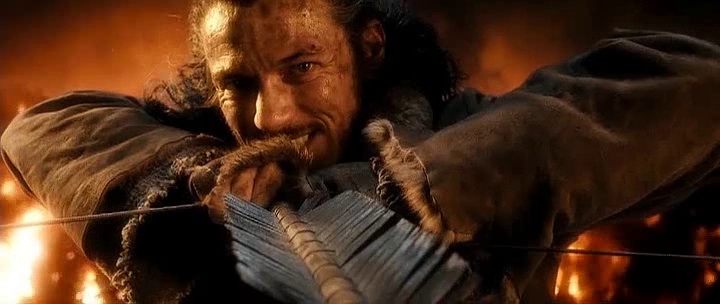
Bard never speaks to Smaug. He just goes about his business of preparing to fire his black arrow while the dragon taunts him. Again, it’s possible that the man is too preoccupied with what he’s doing to say anything (and really, what can anyone say to a dragon who just burned down their entire town?), but the notion that the audience is being allowed to hear something that he can’t in that scene holds up fairly well. Bard’s supposed reactions to some of the things that Smaug says could be seen as Smaug commenting on things as Bard is realizing them for himself.

For instance, the bowman looks at his son Bain after the dragon makes a comment about the boy; Smaug’s glare at Bain while making that comment would be enough indication that he’s taking note of the youngster and would give Bard enough reason to look at his son with concern. Also, Cumberbatch’s Smaug certainly seems like the type who would gloat at someone even when he knows they can’t understand him.

The only other person that the dragon speaks to, just before flying to Lake-town, is Thorin Oakenshield. The following lines are said:


THORIN: Here, you witless worm!
SMAUG: You.
THORIN: I have taken back what you stole.
SMAUG: You will take nothing from me, dwarf. I laid low your warriors of old. I instilled terror in the hearts of men. I am King Under the Mountain.
THORIN: This is not your kingdom. These are dwarf lands, this is dwarf gold, and we will have our revenge.
SMAUG: Revenge? I will show you revenge!


This could almost read as Thorin giving a separate speech to Smaug that just happens to be about the same thing as the dragon's speech to him, unbeknownst to the dwarf king. It would make sense for both characters to have similar mindsets like this since they’ve spent the past several minutes fighting each other for the mountain, and since Smaug's ability to understand English is not being questioned, it makes sense for him to give the appropriate reactions and responses to what Thorin says. However, Thorin's reply to Smaug calling himself King Under the Mountain can read as a comprehending dialogue between the two and is probably the strongest argument against the “Smaug doesn’t speak English” theory.

To still humor that idea though, this scene could perhaps be interpreted not as the dragon speaking English to Thorin, but as Thorin also having the ability to understand dragon speech.

Just look at the third Hobbit film. When it becomes clear to Thorin that he and his company will have to defend the Lonely Mountain from the Lake-town survivors and the Mirkwood elves, he sends a raven to his cousin Dain to call for reinforcements. The raven isn’t carrying any letters when it leaves the mountain, and since the dwarves are able to communicate with the ravens in the book, it has to be assumed that Thorin verbally gave the bird his message to deliver and Dain was able to understand the animal in order to receive that message. 


If the film dwarves are able to converse with one creature, then they may be able to converse with others. And who knows? It’s possible that Thorin’s susceptibility to dragon sickness could have given him the ability to understand Smaug, similar to how the One Ring may have given it to Bilbo. Durin's line is said to be more susceptible to dragon sickness than other dwarves are, and since none of the other members of Thorin's company attempt to speak with Smaug during their confrontation, it could be common knowledge among them that only their leader has the skill to do so. They may not know that dragon sickness is the cause of it, though.

By either of these rationals, Bard remains the one character out of the three addressed by Smaug who can't decipher the villain's words; the plot point of him learning of Smaug’s weak spot from the thrush is written out of the films, implying that this version of Bard can’t communicate with other species, and he of course is never corrupted by dragon sickness.


Whatever language Smaug does speak, he remains one of epic fantasy’s most outspoken dragons. He rightfully deserves his distinction as one of the most famous (or infamous) as well, and Cumberbatch’s eerily arrogant portrayal of him in the Hobbit film trilogy will no doubt be the most prevalent one in people’s minds for many years to come. If the above theory has intrigued anybody, then perhaps the regard of that portrayal will be just a little more open to interpretation — so to speak.


Thursday, July 16, 2015

Did the Dwarves Pre-write "Blunt The Knives"?

Something that I should probably clarify at the beginnings of my Hobbit theory essays is what a "fan theory" is. The best definition that I can think of is that it's an idea regarding something in a film, show, book, or some other storytelling medium that members of the fanbase choose to believe even though that idea is typically not the intention of the original creator. Fans conceive such ideas for various reasons, sometimes to fill in plotholes or to connect things in the narrative that seem like they could fit together, but the purpose of most fan theories is to provide a more interactive way of enjoying a story. We like to feel as if we contributed something to our favorite films, shows, books, and so forth, and putting together evidence to support our theories can make for a fun brain exercise.

With that said, I want to present another fan theory about the Peter Jackson Hobbit films: that the dwarves of Thorin Oakenshield's company wrote and rehearsed the song "Blunt the Knives" prior to meeting Bilbo Baggins.


This theory could perhaps apply to the book as well, but I'll be discussing it mainly in the context of the movies. That's because the song's inclusion is a bit more conspicuous in the film adaptation.

By in large, the six Peter Jackson Middle-earth movies try to ground the stories of The Hobbit and The Lord of the Rings in reality more than the books do. The animals don't speak for the most part, uses of magic are depicted very subtly, and aside from a few goofy combat physics (mostly on the part of the mystical elves), the characters don't bend the laws of time and space too much. Considering this, it's a bit jarring to see twelve dwarves break out into an improvised, well-timed song and dance number where everyone sings along in perfect harmony and knows every word. When does that ever happen outside of a musical?

It's easy to believe other singing scenes in the Hobbit movies, namely the dwarves' renditions of "The Misty Mountains Cold" and "The Man in the Moon Stayed Up Too Late," but that's because we can assume that they've known those songs for a long time and have probably sung them before. This leads me to wonder if perhaps the song "Blunt the Knives" wasn't improvised after all, but was in fact another piece that the dwarves knew well before performing it.

They would have had the time to compose it; Gandalf decides on the morning of the Unexpected Party that he will send the dwarves to Bag End, and they don't arrive there until late in the evening. Furthermore, the first dozen arrive at roughly the same time, which could mean that they spent a good portion of their journey from the Blue Mountains to the Shire traveling together. A trip that long can get boring, and since Middle-earth dwarves are shown to be musically inclined, the twelve of them could have easily come up with and memorized a song about their soon-to-be host along the way. They would know his name, since Gandalf says that morning that he will "inform the others" of Bilbo's inclusion on their quest and Kili almost says it correctly upon meeting Bilbo.

The song's lead-in at the party is also somewhat suspicious. Right in the middle of their rowdy celebration, the dwarves all start pounding their silverware on the table in perfect rhythm until Bilbo complains that they'll blunt them, then the dwarf Bofur very slyly relays this concern to the others. It's as if they were deliberately baiting Bilbo into saying something close to their song's opening line and then Bofur cued everyone to start singing it. This begs the question of whether all of their rude behavior before that really was plain ignorance or actually one big act to get Mr. Baggins fired up.

The next question is why the dwarves would want to tease him so thoroughly. Most likely, it's because Gandalf mentioned while informing them of Bilbo that the hobbit was sort of a stick in the mud. The wizard makes it clear while talking to Bilbo that morning that he's unhappy with the way Belladonna Took's son has turned out, so he probably conveyed that unhappiness to the company and painted a less than flattering picture of the halfling. This may have given the dwarves the (correct) impression that they wouldn't be welcome in Bag End, so they may have decided to give Bilbo the same treatment that they give to most hosts who don't appreciate their company.


Just look at their behavior in Rivendell later: they make a mess at the dinner table, sing a song that the elves clearly don't like, eat them out of house and home, trash the furniture, and do something in a public fountain that probably also caused a few plumbing issues.

Compare that then to their respectful behavior in the house of Beorn, a giant skin-changer who makes a habit of tearing apart unwanted visitors, and their reverence in Erebor, the home of their forefathers. Dwarves are entirely capable of civility, but they'll be stubborn and proud if they can afford to be. If they pick up any holier-than-thou vibes from someone and believe that they can get away with a few pranks, they'll gladly entertain themselves at that person's expense. Writing a song about ruining said person's belongings is one of the tamer things they can do.

With that said though, they seem to like Bilbo a lot more than they like the elves. Why else would they clean his dishes after all was said and done? If "Blunt the Knives" was a pre-written prank, then it was obviously meant in good nature. It's almost flattering, really, that the dwarves went to the trouble to compose a song specifically about Bilbo instead of just singing any old tune. Maybe like Gandalf, they sensed that the hobbit wasn't as prim and proper as he tried to be and just wanted to nudge him out of his shell a little.

Dwarves just nudge a little harder than most folk, as we all know.


Friday, June 19, 2015

To Kill an Alfrid


Well, it's finally happened. After months of theorizing and speculating, fans of The Hobbit have finally received a list of bonus scenes to expect in the Extended Edition of The Battle of the Five Armies. I don't recall a list like this coming out for any of the previous five Extended Editions, at least not this early. If I'm correct to think that it hasn't been done before, this could serve as further evidence that Peter Jackson was forced to trim down this film far beyond his liking for the theaters.

In any case, here's the list:
  • More scenes of Bard attempting to kill Smaug
  • More scenes of Smaug destroying Lake-town
  • An extended scene of Azog's invasion forces
  • Elf archers firing at Orcs, Wargs, and Trolls
  • Dwarves with Ballistas firing at Orcs and Trolls
  • Dwarven Goat Riders and Rams join the battle to attack Orcs and Wargs
  • Funeral of Thorin, Fili, and Kili
  • Coronation of Dain II Ironfoot, Now King Dain II Ironfoot
  • Bard becoming the new king of New Dale
  • Gifts of treasures given to Bilbo, Bard, Thranduil, and the People of Lake-town
  • Bilbo and Gandalf revisit the Trollshaws
  • An Exchange between Thranduil and Gloin during the battle
  • Beorn tortured in Dol Guldor
  • Sauron interrogates Gandalf in Dol Guldor
  • The death of Alfrid Lickspittle
  • More fighting in the city of Dale
  • More battle scenes
  • The war beasts Azog sends just after the battle begins
  • Axe blade removed from Bifur's forehead
  • Conversation between Bilbo and Bofur before Bilbo hands over the Arkenstone
  • Smaug destroys the Dwarven Wind lance
  • Galadriel unveils true the power of her Elven ring, Nenya
  • Thorin and Company start counting and assessing their treasure hoard
  • Bilbo buries his acorn in Dale
  • Beorn brings a dead Thorin II Oakenshield back to the Lonely Mountain
  • More graphic and brutal Orc kills 
Most of these scenes seem like promising additions, particularly the ones involving the dwarves from Thorin's Company. The only extra footage of Smaug's attack on Lake-town that I think we need is him destroying the Wind lance to explain why Bard doesn't use it, but if more destruction and attempts to kill him better illustrate the horror of that attack, then I'll take it. Scenes like Beorn being tortured and Bilbo planting his acorn should also be interesting, and it looks like a lot more very welcome closure is in store for the end of this version.

The only scene on this list that I have reservations about, strangely enough, is Alfrid's death.

I've been all over the spectrum with this character since the release of The Battle of the Five Armies. In the span of a few months, I've gone from saying that he shouldn't be disposed of so quickly and that he should get more screentime to saying that his only screentime at all should consist of Bilbo kicking him in the shin. The whole "Alfrid Problem" is just so befuddling because he had so much potential in the second Hobbit film that went utterly wasted in the third, and it leaves many of us scratching our heads about why he was even written into this trilogy.

The question then is why I would take issue with seeing him die if that's pretty much the only gratifying thing he can do at this point. Well, there may be a few answers for that.

First of all, there is a legitimate reason for adding Alfrid's character to the films. Giving the Master of Lake-town an accomplice makes sense from a screenwriting standpoint because it's easier to convey his plans to the audience when he has someone to discuss them with out loud. The puzzlement is why the Master becomes the one to die in the third film's opening while his accomplice gets to stick around afterwards for the majority of the plot. It would be a lot truer to the book if the opposite happened, with Alfrid the watchful manipulator dying in Lake-town and the Master being reduced to a powerless weasel without his aide around to manage things.


The screenwriters wouldn't even have to change all that much; Alfrid could get killed by Smaug right after the Master pushes him off their boat, then Bard's lasso could pull the Master overboard and Smaug could fall on the boat before the Master can return to it to save his gold. The Master could spend the rest of the movie doing the exact same things that Alfrid does, discovering how ineffectual he really is on his own, then decide to skirt off—so to speak—after finding the gold hoard in Dale because wealth was all he ever cared about.

It doesn't make as much sense for Alfrid to have that story arc in the third film because he was never established as being so materialistic before Smaug's attack. He actually suggests dumping some of the Master's gold overboard to lighten the boat during their escape attempt, so it seems somewhat out of character for him to become obsessed with getting his hands on Erebor's gold later. I guess the argument can be made that he starts falling into the same greedy vices as the Master once he comes into his own, much like Thorin does after succeeding Thror, but the movie never indicates that this sort of character development is going on. It almost feels like the roles were the other way around originally and then Alfrid was dumped into the Master's place at the last minute without any other changes being made to those scenes.

That brings me to my first issue with Alfrid's death. In my opinion, if this adaptation is going to give him the Master's story arc, then the least it can do is be true to the Master's arc in the book. Killing Alfrid robs that arc of one of the few things it had in common with the source material. Granted, we don't know what "The Death of Alfrid Lickspittle" entails, if we'll see him get killed during the battle or starve to death in the wilderness like the Master eventually does in Tolkien's writings, but knowing these movies, it's likely that he'll meet a more theatrical demise.

My second issue with Alfrid’s death, which I admit is my own problem, is that I had been very on board with the headcanon that he was actually Grima Wormtongue’s father in the movies. One of the biggest grievances that people have always had with Alfrid is that he’s a knockoff of Wormtongue, so what better solution is there for that resemblance than to make them relatives? It would have explained a few things about Wormtongue too, such as why he has a drastically different appearance from the other Rohan natives, and it would have given fans something neat to further tie the two trilogies together.


Any chance of that being canon dies with Alfrid in the Extended Edition of the third Hobbit movie though, which means we have to go right back to accepting that he looks, sounds, and acts exactly like another Middle-earth character by complete coincidence. In that sense, his storyline is one that the filmmakers might have been better off leaving open-ended.

My third issue comes from looking at the Hobbit films in a wider scope with the Lord of the Rings films. For as much as The Lord of the Rings gets dubbed the darker of the two stories, it leaves surprisingly few casualties on the good guys' side. The only significant, permanent, onscreen deaths that I can think of are Boromir's, King Theoden's, and Haldir's. On the bad guys' side, however, virtually everyone dies. Sure, Shelob lives and some of the orcs escape from that earthquake outside Mordor at the end of The Return of the King, but none of them were really characters that we grew to personally know or hate.

That makes Alfrid's apparent survival in the theatrical cut of The Battle of the Five Armies rather unique. Instead of dying like every other notable antagonist, his comeuppance is running away alone and disgraced with nothing wholesome or meaningful in his future. That's arguably an even worse fate. It's also a much more mature and thought-provoking one when compared to the deaths of the heroes Thorin, Fili, and Kili.

It all hearkens back to Gandalf's line in The Fellowship of the Ring about how "many that live deserve death" while "some that die deserve life." I think that this line resonates a lot more if we've seen examples of both play out in a previous film. Keeping Alfrid alive adds an extra dose of reality to the whole six-film series, however unfair that reality is, and it creates something of another legacy from The Hobbit that didn't exist so clearly in the first Lord of the Rings movie prior to last December. Having him turn out to die after all, in my mind, undoes the one substantial thing that he contributed to The Battle of the Five Armies.

I'm not sure how any of the decisions on Alfrid's role in the trilogy were made. My theory is that the filmmakers really liked actor Ryan Gage and decided to do a lot of tinkering with the script after realizing that they had to scrap the character he was originally cast for, but that's mostly just a hunch. In the end, Alfrid is what he is, and no amount of complaining is going to change that. It's possible that the upcoming Extended Edition could give some depth to his character like the last one did, but if not, I can look on the bright side. If his death is the only bonus scene that I have reservations about on a list of twenty-six, then I’ve got it pretty good.


Saturday, May 16, 2015

The Road to Bilbo's Oak Tree


One of the more talked about scenes in The Hobbit: The Battle of the Five Armies is the scene where Bilbo shows Thorin the acorn from Beorn's garden. It's not a long scene, and like many in that film, it wasn't in the book, but there's always been a bit of buzz surrounding it. Some people like it for being one of the happier and more tender moments in Battle, and others like it for the metaphor comparing Bilbo's character to an acorn, which had been very subtly hinted at up until that point. This is especially clever when contrasted with Thorin, who is often associated with an oak tree because of his oakenshield.

I think one of the biggest reasons why people talk about the scene is because we don't really get a payoff for it. Thorin tells Bilbo to go home and plant his tree, but we never see the hobbit do that. We want to know what became of the acorn since it tugged at our heartstrings so much.

Popular belief for a little while was that the oak tree on top of Bag End was the tree that Bilbo planted from it. However, the few exterior shots that we see of his house in the beginning of An Unexpected Journey and the end of The Battle of the Five Armies seem to show that the tree was already there prior to his adventure.


I tried comparing those shots with shots of Bag End from The Fellowship of the Ring to see if any other trees had appeared there since the Hobbit movies. There's one lighter colored tree on the side of the hill in Fellowship that looks small enough to have been planted fairly recently, but it's hard to tell from the angle in Battle if it's already there or not. In any case, it doesn't look like an oak tree.


This left me in a bit of a quandary. Was I overlooking something? Was the acorn scene such a last-minute idea for the Hobbit movies that the filmmakers didn't have time to go back and remove one of the trees from Bag End's exterior shots? Was there a deleted scene showing where Bilbo planted the acorn? These questions were nagging me so much one day that I decided to research the matter using one of the greatest sources of information known to modern man.

Tumblr.

And sure enough, I found an answer. Apparently, there is going to be a bonus scene in the Battle of the Five Armies Extended Edition that shows Bilbo planting his acorn—in Dale.

This of course raises all sorts of new questions. Why would Bilbo do that when Thorin told him to plant the tree at his home? Did Bilbo not want to remember his journey after all? Did he do it to leave a reminder of himself in the closest place to Erebor where a tree could grow?

My personal theory is that Bilbo knew by then that Bag End was never really going to be his home anymore, so he didn't want to plant his tree there. Maybe a part of him always knew that he was going to leave the Shire again one day and try to return to Erebor, so he saw the East as his home instead. It would certainly lend a more poignant subtext to his decision to leave in Lord of the Rings; one of his motivations could have been that he wanted to see his oak tree once before he died.

As most of my essays these days end though, no conclusions can really be drawn until the Extended Edition comes out. If there is a scene of Bilbo planting his acorn in Dale, it could contain dialogue or something else that conveys his reasoning. It's also entirely possible that it won't, and that the reasoning will be left up to the viewer's imagination. Either way, I suspect that Bilbo's acorn and the tree that grew from it will remain a popular topic of discussion among Hobbit fans after this November.


Friday, April 17, 2015

Was Bofur Left in Laketown On Purpose?

I've said before on this blog that the fun of watching a story play out over multiple installments is that it gets the creative wheels in your head turning. You would think that a film series like The Hobbit, which is based on one of the most thoroughly mapped out legendariums in literary history, wouldn't allow much room for fan theories, but through the power of book-to-screen adaptation, a lot of things have changed in the tale and a lot of questions have been raised about them. One such change is the screenwriters' decision to have four of the dwarves from Thorin Oakenshield's company stay behind in Laketown in the trilogy's second film, The Desolation of Smaug.


For the sake of this essay, here's a quick run-down of how that scene unfolds. Thorin is in a hurry to leave Laketown so his party can reach the secret door into Erebor by sundown, a deadline that their entire quest hinges on them meeting. Having learned that his nephew Kili is injured, Thorin orders him to stay behind for the time being since he will likely slow their progress. Outraged by this, Kili's brother Fili decides to stay behind with him, and the group's medic Oin decides to stay as well so he can tend to Kili's wound. In the midst of all of this, a fourth dwarf named Bofur wakes up late to discover that the group is leaving without him and he just misses the boat out of Laketown.

The controversy of this change aside, the only leaving-behind of the four that ever felt contrived to me was Bofur's. The reasons for the other three dwarves are fairly well set up and tie in naturally with each other, but in Bofur's case, it just sort of happens. No one has much to say about it, and it seems almost random that it even happens to him at all. We know from a storytelling standpoint why it does; he's one of the more likeable dwarves, and if he's in Laketown when the dragon Smaug attacks it, we'll be more invested. In the context of the movie though, it's a little hard to buy that twelve other dwarves (including his own brother and cousin) would fail to notice his absence from the group.

This leads me to my own personal fan theory about The Desolation of Smaug: that Bofur being left behind in Laketown is supposed to feel contrived because in the context of the movie, it was contrived. My theory is that the other dwarves left him there on purpose.

Why would they do that? The answer, I believe, lies with the person who most likely would have orchestrated the whole plan—Thorin.

Looking at his interactions with Bofur before that, it's easy to come up with a motive for the King Under the Mountain. For starters, Bofur doesn't seem to take Thorin all that seriously as a leader. He follows orders most of the time, even if he's not always thrilled with them, but when there's danger afoot, he makes his own judgement calls without waiting to hear what Thorin thinks.

Take for instance the warg chase from An Unexpected Journey. After the company takes cover from their pursuers in a cave, they discover a tunnel, which Bofur immediately declares they should venture into. The rest of the company obeys this direction without so much as consulting Thorin.


The end result of this is their arrival in Rivendell, where the elves and the White Council try to put a stop to their quest. This is a situation that Thorin's been trying to avoid from the very beginning of the journey, and Bofur more or less led their group into it.

There's another instance of Bofur overstepping his bounds at the beginning of The Desolation of Smaug. Upon learning that their company is in the vicinity of a giant, man-eating bear, he suggests to everyone that they turn around and go back the way they came. This time, however, Thorin dismisses the idea before it's considered.


This seems to show development on Thorin's part. He's aware by now that Bofur has a habit of going over his head and leading the group into troublesome situations, so he's ready to keep it in check. As we see though, Thorin becomes more desperate and obsessed with reaching Erebor the closer their deadline grows, and he becomes quicker to cast aside problematic group members than he is to deal with them. If he's willing to exclude his injured nephew from the home stretch of their journey, he's probably more than willing to exclude an apparent loose canon like Bofur.

Thorin's motive could also pertain to his plan for after he finds the entrance to Erebor. His intention is to send Bilbo into Smaug's lair alone to steal back one key piece of treasure while the dragon is sleeping. The other company members, being dwarves whose smell Smaug will recognize, are supposed to wait outside of the mountain the entire time. If something should go wrong with this plan, there's a very good chance that the hobbit and possibly the dwarves will be killed.

It's no secret to Thorin by the time they reach Laketown that Bofur is attached to Bilbo. He's there when Bofur tries to save their burglar from the cliff on the Misty Mountains, and we see him eavesdropping on the conversation in the cave where Bofur wishes Bilbo "all the luck in the world." Furthermore, he's the person that Bofur asks about Bilbo's whereabouts when the dwarves are captured by elves in Mirkwood.

Thorin has probably also noticed that the insolent dwarf tends to lose his head whenever Mr. Baggins is in danger. Bofur has to be pulled to safety himself at one point during the stone giants' battle while trying to keep Bilbo secured, and when the hobbit almost falls from the cliff, Bofur doesn't just throw himself over the edge to try and grab him. He also commands Ori, the youngest dwarf in the group, to do the same.

Given all of this, it's conceivable that Bofur might charge into Smaug's lair to rescue Bilbo at the first sign of trouble, which could have a disastrous outcome for everyone present. Thorin would never take a chance on something like that happening. It's doubtful that Bofur would obey an order to stay in Laketown, and since having him detained there might make him even less cooperative in the future, Thorin's best option would be to make his leaving-behind appear accidental.

If that is the case, then why would the other dwarves go along with that plan? They all seem to like Bofur, and while they may be anxious to reach the mountain and take back Erebor too, I don't think they're as keen as their leader is to accomplish their goal through deception. The most likely explanation is that Thorin told them it would be for Bofur's own good, for all of the previously mentioned reasons. It may have helped his argument that Bofur appeared to be hungover on the morning that they left Laketown. The other dwarves didn't want their reckless friend/brother/cousin to get hurt or killed, so they agreed not to wake him as they were preparing to leave.

Bilbo seems to have been left out of that conspiracy though, as he's the only person to ask where Bofur is on their way to the boats. It's possible that since he's so close to the dwarf and the others don't know him well enough to predict how he'd feel about such an idea, they decided it was best to just keep the hobbit out of the loop. Either that, or they figured Bilbo had enough to worry about that day as it was.


This leads me to wonder then what the screenwriters' other purpose was for keeping Bofur in Laketown, besides raising the stakes during Smaug's attack. Philippa Boyens has said on numerous occasions that they wanted his character to see that attack so he could come more into his own in The Battle of the Five Armies. That arc didn't make it into the film's final cut, but if it's restored in the Extended Edition, could the above theory play a part in it?

It would be easy enough to work into the plot. Perhaps in the excitement of their reunion, one of the other dwarves (the usually silent Bombur, perhaps?) could let it slip to Bofur that Thorin told them to leave him behind. This combined with their leader's refusal to help the Laketown survivors could cause Bofur to lose what little respect he did have for Thorin, prompting him to actively oppose the new dwarf king. Perhaps then Bofur would become the person that Thorin originally suspects of stealing the Arkenstone, and this mounting tension could lead to the alleged cut scene where Bofur sends Bilbo away from Erebor at night to ensure the hobbit's safety.

Once again though, this is just a fan theory. There's no way to determine whether or not any of this was the filmmakers' intent, but a lack of definitive proof rarely snuffs out speculations like these. Some Tolkien readers have believed ever since the 1970's that Gollum killed Frodo's parents, after all. Not knowing the truth is part of what makes fan theories so enjoyable; it inspires that same spark of imaginative storytelling that can sometimes lead to gems like The Hobbit.

All the same, I still hope very much that when the final Extended Edition comes out, Bofur's secret purpose does get included in the final leg of that journey.


Saturday, March 7, 2015

The Genius of Bofur

Whether they’re casual filmgoers, fantasy film lovers, or devout Tolkienites, most people seem to agree that Peter Jackson’s Hobbit movie trilogy is of a lesser quality than his Lord of the Rings trilogy. Reasons for this vary, though one of the most prevalent complaints is that the Hobbit films focus heavily on characters who had minor roles in the novel, weren’t in the novel at all, or weren’t in any work of Tolkien’s whatsoever. While this complaint is understandable, I do want to discuss one such character that has been well received by viewers: Bofur the dwarf.

Bofur obviously falls into the first of the above three categories. A dwarf with his name and same colored clothing is present in the book, but his characterization—that of a witty, fun-loving prankster who’s protective of Bilbo despite constantly teasing him—is not. Although hints of that persona can be read into the original text, particularly in a scene where he trips over a sleeping Bilbo and finds a reason to scold the hobbit for it, the Bofur that we see onscreen is largely a creation of the filmmakers.
 

You would think that being so embellished from his book counterpart would turn fans off to him, but he’s had the opposite effect. The Internet has been swarming with fanart, fanfiction, fanvideos, memes, and cosplay photos proclaiming our love for the dwarf in the silly hat ever since December 2012. We love Bofur so much that we were even disappointed when he didn’t get his seemingly promised character arc in the third film. Really think about that. Fans of The Hobbit, including fans of the novel, were disappointed that a character made almost from scratch for the movies didn’t get more screentime.

So why do we love him so much?

Well, he gets points for technically being a major character who’s supposed to be in the story. Bofur is one of Bilbo’s thirteen main traveling companions from the book, so it makes sense that the movies would want to give him a better-defined personality and more development. He also gets points for being a nice guy, as well as for being funny and optimistic to a degree that isn’t annoying or forced. And yes, being played by a charismatic actor like James Nesbitt also helps. These qualities certainly make Bofur likeable, but I think what really made his character stand out was the way the movies unveiled him.

We probably weren’t expecting the supporting dwarves to be very complex when we first saw An Unexpected Journey. They were barely more than names on a list in the book, and since we had a much bigger main cast and a shorter running time than the Lord of the Rings films, we may have figured that those dwarves would each fall into a standard “token” role. The tough-looking dwarf with the tattoos would be the token muscle, the little dwarf with the slingshot would be the token kid, and that dwarf with the floppy hat and the jaunty accent would be the token comic relief.

There’s nothing inherently wrong with keeping film characters simple when you’ve got so many of them, especially in an adaptation. Leaving any of the dwarves out of the Hobbit films would have likely angered the fanbase, and since Peter Jackson’s team didn’t have much to go off of from the book in terms of their personalities, depicting the less important dwarves as one-note tropes would have been forgivable. The fact stood though that being an oblivious walking punchline didn’t make Bofur terribly engaging in the first two thirds of the film.

And then the cave scene happened.


To this day, I think that the conversation where Bilbo accidentally says the dwarves don’t belong anywhere and Bofur wishes him “all the luck in the world” is one of the most moving and ingenious moments in the whole Hobbit film trilogy, and it wasn’t even written by Tolkien. Not only did it reveal that Bofur actually had feelings to hurt underneath his wisecracks, but it also changed our perspective on a lot of his previous actions towards Bilbo. He wasn’t an insensitive idiot; he was a well-intentioned friend who just liked to poke fun at the hobbit for being so uptight.

That’s why I think we came to love Bofur so much. He caught us by surprise in a really good way, and we were excited to see what he would do next. The Desolation of Smaug and The Battle of the Five Armies may not have given us anything quite as impressive, at least not yet in the latter’s case, but after Bofur got our attention, he stayed interesting enough to keep it.

As superior as the Lord of the Rings movies are considered to be, I do think that the filmmakers learned a lesson from their slapstick portrayal of Gimli. They may have learned that lesson so well, in fact, that they decided to play to our expectations by introducing Bofur as another clown before revealing more of his layers. Granted, there are still a few comedic misfires among the cast of The Hobbit, and the cave scene with Bilbo was actually a later idea shot in pickups, but it’s clear that movie Bofur was always meant to be something new to Peter Jackson’s Middle-Earth. He was meant to be (and is) self-aware comic relief.

How often in movies like this are the funny characters in on their own jokes? Most of the time, it seems like the audience is meant to laugh at them rather than with them. Even with previous three-dimensional comic relief characters like Merry and Pippin, the humor usually came from how foolish or awkward they were, not from how witty they were.

Bofur is a different breed. While he does have a few comical misfortunes, such as hitting his head on the bottom of a table and saying that things “could have been worse” right before the Great Goblin falls on him, the majority of his humor comes from him mocking or making light of serious situations. The character himself has a sense of humor, and he deliberately uses it throughout the films to try and boost his company's moral.

Case in point, the scene in The Desolation of Smaug where he leaves to find Athelas for Kili's poisonous arrow wound. Just before Bofur runs out the door to begin his search, he stops in front of the younger dwarf and orders him not to move, earning a few stares from his other companions. This line might seem obtuse at first, but a moment's thought makes us realize the true spirit behind it. 

Bofur knows full well how dire the situation is. He was the one who told Bard in the first place that Kili was "very sick," after all. He's aware that a dying, violently convulsing person isn't going to wander off while he's gone, but he's making a joke anyway to try and cheer up Kili.

Another case is the scene in An Unexpected Journey where he describes to Bilbo what it’s like to be incinerated by dragon fire. Bofur obviously has no idea what that’s really like, but since Bilbo is taking the threat of it so seriously, the dwarf is trying to play it down and make it sound ridiculous. Some might see this as him trying to scare Bilbo more, since it ends with the hobbit passing out, but remember that it comes after Bofur’s thoughtful reaction to Gandalf saying that there’s more to the hobbit “than appearances suggest.” He’s putting on a goofy act to try and make Bilbo laugh off the danger. 


That’s what makes Bofur’s movie persona so ingenious, in my opinion. He’s a person first and an archetype second, and he knows it in a way. Because of that, he’s versatile enough to carry a completely serious moment just as naturally as a completely funny one, just like a real person who has a sense of humor.

The fact that he carries out those funny moments on purpose makes him all the more endearing, because he’s putting forth a conscious effort to make the events we see onscreen more enjoyable. We almost feel like Bofur, not just the actor and film crew behind his character, is trying to entertain us and get us through things as much as he’s trying to do that for Bilbo and the other dwarves. That makes us feel more like we’re part of the company, rather than a bunch of spectators watching them from a theater. The experience of viewing the Hobbit movies is more immersive because his character is so genuine.

No official word has been given so far on Bofur’s role in the Extended Edition of The Battle of the Five Armies. The only guesses we can make are from hints by screenwriter Philippa Boyens and a couple castmembers about what was meant for him prior to the film’s theatrical release. Whether or not we’ll see him come more into his own or have another conversation with Bilbo this November is unclear, but given his history with the Extended Editions and that thirty minutes will be added to this coming one—and that the filmmakers seem to like him as much as we do—it’s a safe bet that he’ll get his chance to shine one last time.


Tuesday, February 17, 2015

Was Bilbo a Failure?

I was recently thinking about the third Hobbit movie, The Battle of the Five Armies, when I realized what my biggest issue with it is. It's not that it strays from the book or that the elves get more screentime than the dwarves, or even that Alfrid gets any screentime.

It's that the main protagonist, Bilbo Baggins, doesn't clearly accomplish anything by the end of it.


That's not to say that Bilbo doesn't do anything in the movie. He actually does quite a lot. It's just that for as much as he does, none of it really seems to pay off.

His main goal for about the first half of the plot is to save his thirteen dwarf friends by preventing the battle over the treasure that Thorin refuses to share with the Laketown survivors. Bilbo tries to accomplish this by giving the survivors Thorin's prized Arkenstone, which they can use as leverage to get their promised share of treasure from the corrupt dwarf king. It's an ingenious plan (despite Thorin trying to kill him over it), but then a bunch of other armies show up and make it all for nothing. Bilbo's new objective after that becomes to save Thorin and company from an ambush by Azog on Ravenhill during the battle. He does a good job of defying Gandalf's authority and reaching Thorin in time to warn him, but by then it's too late for them to escape from that ambush, so Thorin, Fili, and Kili end up dying anyway.

And then there's Bilbo's overall goal throughout the whole film: to save Thorin from his corruption. He does succeed at that, but Thorin's death soon afterwards makes it kind of a short life lesson, and since the other dwarves already disapproved of his greedy behavior, they don't really learn anything from the hobbit by the end either. What's more, instead of feeling uplifted by Thorin's noble redemption, Bilbo spends the rest of the movie and possibly the rest of his life so traumatized that he can barely even admit Thorin was his friend.

Man, and we say The Lord of the Rings is the darker story.

It's possible, like many issues with The Battle of the Five Armies, that this will be ironed out in the Extended Edition later this year. You can also make the argument that Bilbo's real goal throughout the entire trilogy was to help the dwarves of Erebor reclaim their homeland, which he did, and therefore he wasn't a failure. I heartily agree with that argument, but the third installment doesn't take the time to properly reflect on that and remind us of Bilbo's successes when all is said and done.

...And that's why I think The Battle of the Five Armies needed to establish Ori's journal.

If you read my essay "There's Something About Ori" back in November, you knew I was going to revisit that topic sooner or later after the third movie came out. Not only doesn't the mitten-wearing scribe get the payoff I was hoping to see for him in Battle, but he doesn't even photobomb Bilbo all that much. He does get to stand with Bofur at the front and center of the group when Bilbo says good-bye to the dwarves though, and I'm fairly certain there was a shot of him killing orcs during the company's charge onto the battlefield. It's also been brought to my attention that Ori did in fact draw the sketch of young Bilbo seen in An Unexpected Journey, so at least one speculation in my essay was right.

But I digress. In regards to Bilbo's successes, I think establishing Ori's journal would have done a world of good because it would have reintroduced a very important element of the story: legacy. That's the idea behind Bilbo's book, as well as all of the tales and songs presented in Middle-Earth. They're the means by which their writers pass along lessons and experiences so that future generations can learn from them as well. By informing Bilbo and the audience that one of the dwarves was documenting the quest the whole time, the third movie would have assured that the hobbit's part in that quest would become a major part of Erebor's history. Also, since Ori wrote that tale, we could assume that it would present Bilbo in a positive light and as a good role model.

Just think back to the company's prison-break from Mirkwood in The Desolation of Smaug. Right before Bilbo shows up with the keys, we see Ori very gloomily ask his brother, "We're never gonna reach the mountain, are we?" After Bilbo arrives and starts freeing the dwarves from their cells, we see Ori again, looking completely awestruck by him.


Wouldn't it be a great payoff to have Ori approach Bilbo, perhaps after Thorin's funeral in the Extended Edition, and tell him that every dwarf in Erebor who reads about its reclamation will know it was all thanks to a humble but decent hobbit? It might also be a nice touch if he mentions his notes including how that humble, decent hobbit made the fallen King Under the Mountain noble again. And just for continuity's sake, I would have Ori first break the ice by awkwardly giving Bilbo that portrait sketch.

Alas, like most of my recent Hobbit ramblings, whether or not something like this will happen remains to be seen. I don't know how much hype there's been for the last two Extended Editions, but I suspect the third one is going to stir up a heck of a lot more buzz. It might even stir up enough to rival the third film's theatrical release, at least among fans. And who can blame us? To me, the issue of Bilbo's undermined accomplishments at the end of The Battle of the Five Armies is the ultimate proof that we didn't get a whole movie last December.

And if by change the Extended Edition features a scene of Bilbo kicking Alfrid in the shin, I'll count that as another success.