Sunday, May 12, 2024

Return to the Planet of the Apes


Well, here's a review I never expected to be writing. 

That's not because I've been severely absent from my blog since 2019, but because I figured the Planet of the Apes reboots had ended seven years ago with a conclusion that was pretty solid and pretty final. The main protagonist of those reboots had died after all, and the last film had set things up in a way that could easily bring us full circle back to the events of the original 1968 film. What else could there be to cover?

Well, in the spirit of its subject matter, this franchise just showed us again that evolution is a never-ending process. As long as humans and hyper-intelligent apes share a planet, they'll keep finding newer and bigger problems to have with each other — and for screenwriters to write about.

And that's what's so interesting about these reboots: each installment jumps years ahead of the previous one to show us a new stage in the apes' history, so we get to see exactly how they and their problems are evolving. It also gives us the chance to explore a lot of the same themes and ideas from new perspectives since the power dynamics between humans and apes keep shifting. This latest film, Kingdom of the Planet of the Apes, actually has a fairly similar plot to War for the Planet of the Apes, except that the delusional villains who enslave the hero's people this time are other apes and we get a character who's sort of a human version of Koba.

Speaking of characters from the first three films, Caesar, Maurice, Rocket, and a few others have cameos in Kingdom's prologue, but that's it. This film is both a sequel and a soft reboot that jumps ahead "many generations later" to give us a new cast of characters, including a new chimp protagonist named Noa. I'm assuming the writers gave him that name as an allegory since he literally has to save his people from a flood at one point in the film.

We get tons of new world-building this time around. We get a new orangutan character who also steals the show. We get our first mention of gibbons in the whole franchise. We even get a surprise appearance from William H. Macy for some reason, although no casting choice in this series will ever be as much of a head-scratcher as Kris Kristofferson in the Tim Burton film. And of course, we get lots of action, lots of nods to the original film, and even more of what's still some of the best character CGI put to film. All in all, Kingdom is a fun ride.

So how does it fair as a Planet of the Apes film?

As I mentioned before, this installment treads new ground by giving us a large-scale ape vs. ape conflict and also seeming to play with a few allegories. The main villain is an ape who goes by the name Proximus Caesar, a cult leader/dictator whose goal is to advance ape-kind into the planet's dominant race by forcing humans to share the secrets of their history and technology. He's presumably done his research on the name Caesar, since he often references the Roman Empire, but his preachings on the values of Caesar the ape are either sorely mistaken or deliberately twisted in order to brainwash his followers and serve his own corrupt agenda. There's some obvious social, political, and religious commentary there, with Caesar the ape even having become a savior-like figure in the eyes of the current ape clans. Just like its predecessors though, Kingdom handles this commentary with a subtle enough hand to avoid the traps that a lot of other movies fall into these days. 

The same goes for the human side of the conflict. Kingdom gives us a strong female character done right in the form of Mae, a teenage girl who manages to stay engaging and somewhat sympathetic throughout the plot even as her deception and prejudice against the apes slowly reveals itself. She's not doing what she does to be evil, she's doing it because her world has been shattered by the apes and she hasn't seen enough of their good side to accept that there are shades of gray in the struggle around her. Again, obvious commentary that's handled well. What's more, the movie ends her arc on a note that seems to suggest further development from her character if she returns in any sequels. 

I will say though that Kingdom is probably still the weakest of the Apes reboots. Noa isn't as compelling of a protagonist as Caesar, the supporting ape characters (aside from Raka the orangutan) aren't as memorable as the ones from the previous films, and the pacing could stand to speed up in many places. Still, calling a film the weakest entry in this series is like saying The Two Towers is the weakest Lord of the Rings film. It's still something to be proud of.

As a minor nitpick though, if it's even canon, the Planet of the Apes Wiki claims that Proximus is a bonobo just like Koba. Why keep making bonobos the bad guys? They're way less aggressive than common chimpanzees and way more endangered. And could this series please give us a gorilla character who doesn't get killed off? They've been through enough! 

All in all, it's nice to make my own return of sorts alongside Planet of the Apes. I don't know how long we'll have to wait for the next installment, or if any more will come after this, but like the titular apes, I've seen enough strength and evolution along the way to be hopeful for the future.

And remember: if you ever tell Maurice the orangutan that gingers have no souls, he'll simply steal yours.

Monday, April 29, 2024

Book Fair Success


The Local Authors Book Fair at the Norwin Public Library went great this weekend! Thank you to everyone who came, and thank you to everyone for all of your help and support for the event.

Sold some books, donated one to the library, and met a lot of cool authors, including one I've actually crossed paths with multiple times before at the Pittsburgh Renaissance Festival. Events like these are a great way to network and share ideas for possible venues and ways to market your books.

...And since the event happened to take place on International Hyena Day, I gave away a lot of hyena fact pamphlets as an educational tie-in to my novel Crocuta!


Saturday, October 8, 2022

"Crocuta" Now Available!

My newest book Crocuta is now available in paperback on Amazon! Click here to check it out and order your copy today.


Vaka is the son of a clan leader, but for spotted hyenas, being male means being second best. When tradition forces him to leave home on his second birthday, the former prince reluctantly joins a rival clan and finds himself all the way at the bottom of their pecking order. This soon inspires Vaka to escape and start recruiting other rogues to form his own all-male clan. Can he manage his new followers and old enemies now that tradition has been broken, or will his rise to power be his undoing?


Or if you're more of the ebook type, click here to check out the original story on Kindle Vella. The first three chapters are free to read, and Vella provides new users with 200 free points that you can use to keep reading.

Friday, September 23, 2022

Neytiri's Necklace

Since the first sequel to James Cameron's Avatar is finally on the horizon after 13 years, I figured it's worth going back and talking about the original film. I've managed to walk the line with it since its release in 2009, owning it without being a huge fan and recognizing its flaws without being a hater, but I do get curious enough to do some digging into its lore every now and then. Some of the things I find curious about it are simple details that I don't even find answers for, but today, I want to discuss something that I may have found one for: Neytiri's necklace.

It's the choker with the three green beads. She seems to wear it the entire movie, even though the rest of her wardrobe changes throughout. I've always found it to be an interesting, subtle character detail that she seems to have a favorite accessory like that, but that was all I thought the necklace was until my most recent time watching the director's cut of the movie.

That cut mentions her sister, Sylwanin.

For anyone not familiar with that version, the additional scenes explain that Neytiri and Sylwanin were both students of Dr. Grace Augustine prior the film's events. One day, Sylwanin and some of her friends destroyed a bulldozer that the humans on Pandora were using to level her clan's home forest, and the humans' military responded by chasing her to Grace's school and gunning her down right in front of Neytiri. This explains why relations between the Na'vi and Grace's research team are so strained by the start of the main plot.

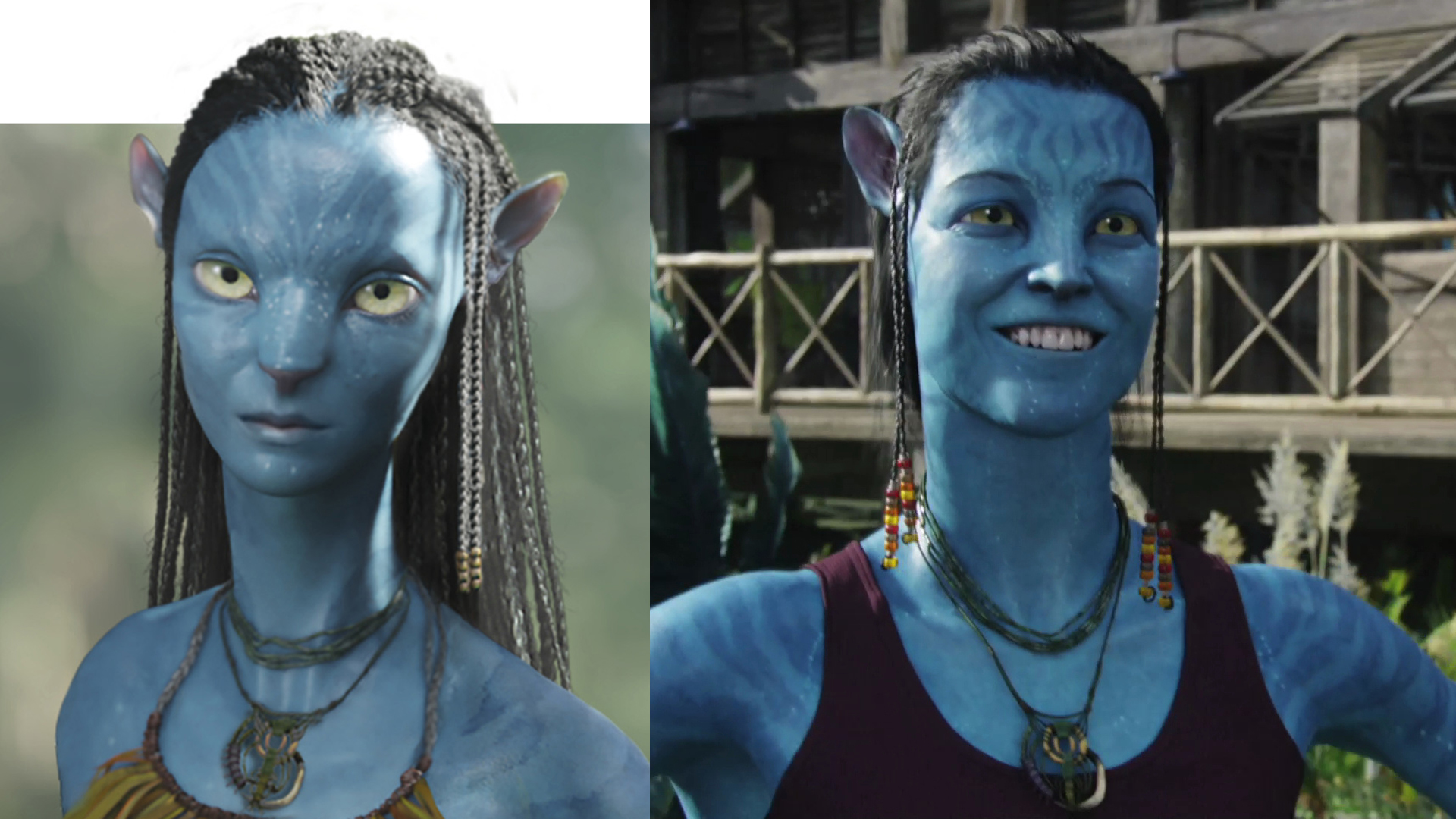
The only images we see of Sylwanin in the film are old photos that Grace shows protagonist Jake Sully while talking about what happened to the school. These are the images:

We see what appears to be Neytiri, wearing her green choker necklace, posing next to another young female Na'vi. Some Avatar sources like the Wiki website identify this female Na'vi as Sylwanin, but there's one issue with that. This sister seems to be the smaller of the two, but every source states that Sylwanin was older than Neytiri.

Obviously, younger siblings can be larger than the elder ones in many cases, but the size difference here seems too extreme for that. I don't know if Sylwanin was originally younger than Neytiri and then became older in a rewrite after these images were already made, but that's where we are now. This leads me to wonder if the smaller sister in these pictures could actually be a younger Neytiri while the larger one who looks like present-day Neytiri could actually be Sylwanin.

It would be a heck of a family resemblance between the two, but that is possible. And given how close the sisters seem to be from these pictures, and how tragically Sylwanin died, it stands to reason that her death was devastating to Neytiri. Perhaps so devastating that she kept some of her late sister's jewelry, including a green choker necklace, and wears it to remember her by?

Sylwanin also appears in a few Avatar video games, and on one occasion, we see her wearing a long hair accessory that appears to be made of red and gold feathers. It's hard to tell from the game's graphics, but it seems to closely resemble the red and gold accessory in one of the pictures above -- an accessory that we see present-day Neytiri wear on occasion. This could very well be an example of Neytiri wearing her sister's things as mementos.

This theory is complicated slightly when you notice the necklace that Grace's Avatar body wears -- which resembles the necklace worn by the smaller sister in the school photos.

If that smaller sister really is Sylwanin, it would make sense for Grace to keep something of hers to remember her by. It would seem strange for Sylwanin's parents to allow it though, given the falling out their clan had with Grace's team after that tragedy, but we don't know the circumstances of how Grace came to possess it. If that smaller sister is actually a younger version of Neytiri, it could be that she gave her own necklace to Grace as a parting gift when the school closed because she intended to wear her sister's green choker from then on. Sort of a symbolic gesture to show that she was letting go of her old self and choosing to literally carry her grief with her always.

Whatever the case, it's a real testament to Avatar's rich visuals that little details like that can hint at so much backstory and character connections without a single word being said. That's actually why I'm curious about the upcoming sequel; the first movie feels like it contains a much bigger world and way more stories than even a three-hour epic could flesh out. Maybe I'll become a full-fledged Avatar fan once it grows into a series, or maybe I'll remain a casual viewer who just rewatches it every few years. Either way, I'll be keeping my eyes on the smaller things when I go to see The Ways of Water this December.

Thursday, June 3, 2021

A Tale of Two Lokis


With the premiere of Marvel's "Loki" series less than a week away, I think it's time for me to finally dust off my book of speculations on the God of Mischief. I'm not familiar enough with the comics to weigh in on anything involving the Time Variance Authority, Mobius M. Mobius, or anything else from the source material that will appear in the series, but I have seen Avengers: Infinity War more times than I can count, and I still have a lot of unanswered questions about Loki's role in that film. As a writer myself, I see the "Loki" series as a prime opportunity for Marvel to finally answer those questions.

To recap, Infinity War begins with the villain Thanos slaughtering half of Thor and Loki's people in an attempt to steal the Space Stone for his Infinity Gauntlet. He almost gets Loki to hand over the Tesseract containing the stone when the Hulk intervenes, and Loki tackles his brother Thor out of the way to make room for the ensuing fight. We don't see Loki onscreen again until well after Thanos wins that fight, then the God of Mischief attempts to "join" Thanos and kill him while his foe's guard is supposedly down. This sadly fails, resulting in what appears to be Loki's death.


I've discussed this scene numerous times on my blog, and I've only grown more suspicious of it over the years. The lack of cutaway shots to Loki throughout the Hulk's fight with Thanos, the way Loki seems to emerge out of nowhere with a totally different demeanor after the fight, his extremely telegraphed and underwhelming attempt to kill Thanos -- it all adds up to a scene that simply doesn't add up at face value. I used to think that Loki faked his death, and that he'd spent his few minutes offscreen during the fight putting together some elaborate scheme that the filmmakers deliberately weren't showing us. Now that I've seen Avengers: Endgame and the trailers for the "Loki" series, I have a new theory: 


The Loki who tackles Thor out of the Hulk's way and the Loki who tries to kill Thanos are not the same Loki. The Loki who tries to kill Thanos is actually the alternate timeline Loki who will star in the "Loki" series.


Another quick recap: The Loki we see in Endgame is technically not the original Loki. He's an alternate version of Loki that the Avengers encounter while traveling back in time to the events of the first movie. Thanks to a snafu, that Loki manages to steal the Tesseract from our time-hopping heroes and teleport away, effectively creating a new parallel timeline to the one we saw in the movies. 

This new timeline will be the focus of the "Loki" series. What's more, the previews for the series suggest that this "New Loki" is going to do a lot of his own time-hopping on behalf of a possibly shady organization called the Time Variance Authority, or TVA. I say "possibly shady" because the purpose of Loki's time travel mission seems to be to alter key historical events that will drastically change the present. Knowing Loki though, it could instead turn out that the TVA means well and the God of Mischief just decides to deviate from his mission and change history for his own personal gain. That is why we love him, after all.


Bottom line, my theory is that New Loki will eventually realize that his meddling has caused some catastrophic ripple effect across multiple worlds, maybe even across the whole universe, and his conscience will finally get the better of him. His efforts to undo the damage he's caused could even be what the entire second half of the series focuses on. After several attempts to make things right again, New Loki will realize that the ripple effect has grown beyond his ability to repair it, and he'll then realize a solution: to convince the original Loki, who perhaps has more knowledge and wisdom due to his different life experiences, to take over the mission while New Loki ends his own alternate timeline.


In my opinion, Loki's scene in Infinity War will make so much more sense with this context. We don't see Loki during the Hulk's fight with Thanos because New Loki appeared and pulled him aside to brief him on another cosmic crisis, and the reason the Loki we see afterwards fails to kill Thanos is because he intends to fail. Because that Loki is New Loki who knows he needs to die in order to restore balance to the space-time continuum and cover the tracks of the original Loki who's leaving to resume the mission. This way, the fans who thought Loki died in Infinity War and the fans who didn't will both be right.


The series could even do something really heartfelt with this twist, having Loki reflect on his whole character arc by having a heart-to-heart with another version of himself. New Loki (who hasn't seen Thor since their fight in the first Avengers film) could see from the original Loki that he always had the capacity to make peace with his brother and his enemies on Earth, and the original Loki could see from New Loki that he's right to keep moving away from his old selfish ambitions and that he has the power to make a difference in the universe. There could even be a clever little payoff where New Loki tells the original Loki about some sort of MacGuffin from earlier in the series that will benefit the original Loki in some way. There's apparently going to be a scene in the series where we learn that the famous missing criminal D.B. Cooper was actually New Loki in disguise; perhaps telling his original self the location of a certain bag full of money would be a nice way to thank him for taking over the mission?


This is all just speculation of course. For all we know, the "Loki" series could kill this theory in the first five minutes and then conclude with Tom Hiddleston and Owen Wilson ad-libbing in a diner like the end of Pineapple Express. As always though, theories like this are a good way to practice plot and character development when you're involved in the creative field. My guess of where the "Loki" series will go could be way off, but when the time comes to start writing my next novel or fanfiction, I might be just a little better at managing the mischief I've created in my own new universe.


Tuesday, May 4, 2021

"The Last Good Man Part 3" Now Available!

The final novel in my "Last Good Man" trilogy is finally here. Check it out on Kindle today and in Amazon paperback on May 18th:


www.amazon.com/The-Last-Good-Man-Part-3


Owen Bronson and his companions are in a fight for their lives. Driven from their compound by the deadly Patrol agents and unable to survive in a virus-plagued world, their only hope is an army base in Ivydale, WV. The soldiers who live there seem helpful at first, but it isn't long before Owen starts questioning the motives of his strange new hosts—and what they could mean for his team's goal of curing the virus.

Meanwhile, Jodi Sullivan is in an even bigger mess. Captured and forced to join the Patrol alongside many other survivors, she's now surrounded by enemies who could discover her connection to Owen at any minute. Things get worse when she learns what the agents are planning: a full-scale assault on Ivydale to steal back the cure and eliminate Owen's team.

Time is running out as the Patrol close in. Can Jodi, Owen, and the soldiers of Ivydale band together to save themselves? More importantly, can they trust one another enough to finally save the human race?

Also be sure to check out the entire trilogy at this link: www.amazon.com/The-Last-Good-Man-Series


Tuesday, October 15, 2019

2019 3K Film Fest


Do you like filmmaking competitions but want something a little more off the wall? Do you want to win a 3K race but prefer one with (slightly) less running involved? There's still a few more weeks left to sign up for the 2019 3K Film Festival. 

From Nov 1 - Nov 3, teams will have 50 hours (3,000 minutes) to write, shoot, and edit a short film from scratch. We're currently offering a $35 entry fee, so be sure to check out our website for more details today!


> 3K Film Festival website <


Join the fun, and good luck!


*

Tuesday, September 10, 2019

Rereading "Remnants"


I want to start this review by adding to an idea from my Everworld review. I speculated that the Scholastic Corporation had been afraid to promote a young adult book series from the late 90's called Everworld, due to it being written by the same co-authors as Animorphs but possibly being too mature for the same audience. This seems all the more evident now that I've reacquainted myself with Remnants, a third book series that K.A. Applegate and Michael Grant also co-wrote together. The beginning of every Remnants book features a list of the pair's other Scholastic titles, and while that list includes Animorphs, it doesn't include Everworld.

This could be forgivable, since Remnants was also geared towards a younger audience than Everworld, but the final Everworld book actually promoted Remnants. The finales of both Animorphs and Everworld presented a full-page ad and a chapter-long excerpt from the first Remnants book, and yet only one of them got a shoutout in return when Remnants came out. I still can't say anything for certain, but this one-way "cross promotion" really suggests that Scholastic wanted readers to forget Everworld and embrace Remnants as "the other K.A. Applegate series" instead.

This is ironic for two reasons. The first is that despite its lack of adult content like swearing, sexuality, and alcoholism, Remnants is actually way darker than Everworld in tone. Multiple gruesome character deaths occur in almost every book, and most of the proceedings have a bleak, humorless, mean-spirited vibe to them. The second reason is that despite all of this favorable treatment from its publisher, Remnants really didn't fare much better than Everworld. It only ran for about two years with fourteen books, fell into obscurity afterwards, and has very little information about it available today.

And as someone who tried reading it once before as a teen but didn't get halfway through the series, I have a pretty good idea why.


Remnants tells the story of eighty humans who escape from Earth right before an asteroid destroys the planet. After five hundred years in hibernation, they wake to find they've landed aboard Mother, a deserted alien spaceship that can simulate any environment. The catch is that Mother currently has no operator, and three hostile alien species are fighting the humans to seize control of it. Totally unarmed, the humans have to dodge perils at every turn as they wander the ship's patchwork of environments in search of the command bridge.

At least that's what the first half of Remnants is about. The second half centers around the humans, now more or less in control of Mother, rediscovering what's left of Earth and trying to return to it so they can rebuild the world they lost — all while three mutants in the ship's basement try to overthrow them and use Mother to conquer the universe.

Notice that I didn't mention any character names in that summary. That's because when you get right down to it, Remnants isn't really about its characters. Unlike Animorphs, which was almost entirely character-driven, and Everworld, which was more setting-driven but still had an interesting main cast, Remnants is mostly plot-driven. It's about weird things happening and other weird things being done to resolve them. The characters' emotions are largely glossed over, and while some of them do grow and change throughout the series (at least the ones who survive), their primary role is just to witness and carry out all these bizarre happenings until the main conflict changes again.

To be fair though, here are some of the core characters. The main one is Jobs, a fourteen-year-old computer wiz and romantic idealist who just wants the group to have a home again. There's also his best friend Mo'Steel, a fun-loving adrenaline junkie with an easy-going, can-do attitude; 2Face, a girl with a half-burned face who wants to be a strong leader but is too aggressive, manipulative, and paranoid for her own good; Violet, a sophisticated, no-nonsense art expert who always does her best to help; Yago, a selfish, entitled bully who constantly tries to divide the others so he can control them more easily; Billy, a quiet Chechnyan orphan who goes mad during his hibernation and is the only human able to control Mother; and Tamara, a Marine soldier who gave birth to a creepy, possibly alien baby in hibernation that is now mind-controlling her to do its bidding. Like I said, bizarre happenings.

I should point out that unlike Animorphs and Everworld, which were written in First-Person with a different narrator for each book, Remnants is written in Third-Person with numerous shifts in perspective throughout each book. It could be that this different writing style just makes the Remnants characters seem less personal since it's not what I'm used to from these authors, but I also think that having a lot fewer characters would have done this series a world of good. Most of the characters that I didn't list above are either red-shirts who are just there to get killed or seat-fillers who have nothing to do half the time. Some characters die offscreen in between chapters or even in between books, and one who manages to live through the whole series doesn't get mentioned in the final book's epilogue. The story just seems to forget about him.

The most engaging characters are probably 2Face and Yago. We never quite get the full details of how 2Face got burned, but she sees her disfigurement as sort of a scarlet letter for the "ugly" side of her persona. Eventually, that inner ugliness alienates her from the group, and she becomes so desperate to redeem herself in their eyes that she'll stoop to any low towards the end of the series. She's tragic and despicable all at once, much like her supervillain namesake.

Yago, in contrast, is so over-the-top slimy and egotistical that it kind of gets funny after a while. You can actually love to hate this guy at times, especially in Book 6 when he makes Mother simulate a world where he's the president of the United States. Surprisingly though, the series manages to give him an arc towards the end that leads to some of its few legitimately poignant moments.

But since the plot is the real focus of Remnants, how does that hold up? Well, it holds up fairly well for the first half of the series. The mystery surrounding Mother, Tamara's baby, and the various alien species is all kind of intriguing, and we get just enough answers in each book to keep it that way. Other developments, such as Billy learning to harness Mother and some of the other humans learning that they've gained mutant superpowers, can also make us curious about where the story is going. The climaxes of Books 5-7 are imaginative and exciting, and while the characters don't quite resonate enough to give us an emotional connection to anything, the end of Book 7 still feels like a satisfying achievement.

The second half of the series is where the real trouble starts.

Again, I can't say anything for certain due to the lack of info, but I get the sense that sales for Remnants really started to drop halfway through its run. Books 1-8 have fancy, embossed, metallic lettering for their titles on the front covers, but Books 9-14 have flat, standard printing for theirs. The cover art also starts to look more slapped together after Book 8, and the books themselves start to get shorter on average. It feels like Scholastic saw the writing on the wall and started doing whatever it could to cut corners and wrap up the series as quickly as possible.

But getting back to the plotting, Books 8 and 9 are about the same in quality as the previous ones, even though Book 8 starts with a three-month time jump from the end of Book 7. Book 10, however, is hands down the worst book in the series.

See, Book 9 ends with a mid-battle cliffhanger, and instead of picking up from there, Book 10 jumps ahead another three months and just gives us a summary of how the battle ended. We find out that two somewhat important characters died in the fight, and then a third, more important one also dies pretty much offscreen with little fuss during the events of Book 10. We get two more massive time jumps over the course of the book as the humans sail Mother back to Earth, and then shortly after they land there, a fourth character who was finally starting to get interesting also abruptly dies. And then the book pulls a surprise twist that effectively throws everything the series was about into the garbage. I don't blame K.A. Applegate or Michael Grant for this, since I suspect Scholastic was starting to tighten the vice and I'm fairly sure Book 10 was ghost-written, but reading it made me furious.

Books 11 and 12 have the opposite problem; they try to slow things back down to establish the new characters, setting, and conflict, but they go too far and just drag. I was pretty much ready to pan the entire rest of the series after this point...but then Book 13 came along.

I've heard that this one was also ghost-written, but out of all the Remnants installments, Book 13 feels the most like Applegate and Grant's usual writing style. It's told almost entirely from the perspective of a girl named Tate who got separated from the other humans in Book 10, and it deals with her fighting for survival against the new villain trio in Mother's basement. Survival also happens to be the book's official subtitle, by the way.

This is a character piece first and foremost. It still has a lot of the weird, otherworldly elements you expect from the series, but we're allowed to single in on just one protagonist's view of them and see how she gradually comes to grips with them. The focus is on how those things impact her character, not on the mere fact that they exist and that they're weird. We also get to explore the protagonist's backstory in an open, honest, and meaningful way, and the things that we learn about her from her memories actually factor into her decision making throughout the book. Best of all, the ending throws more of those mind-bending Remnants twists at us, and while they could stand to be better explained, they have a genuine emotional resonance because the book let us properly get to know the character that experiences them. One of Tate's big discoveries at the end of the book even lends emotional weight to the entire scope of the series and makes us understand why it's so important for the characters to try and start a new life on Earth.

Book 13: Survival has Animorphs Chronicles levels of pathos. It's easily the crown jewel of the whole Remnants series, and I wish the rest of the series had been more like it. So it's only fitting that this wonderful exception to every complaint I've ever had about Remnants...is entirely skippable.

I'm not kidding. Everything that Tate accomplishes and discovers in Book 13 gets reexplained to the other characters in Book 14, so you don't even need to read Book 13. Good news for the superstitious readers, I guess.

Book 14, the finale, has the same problem as Books 11 and 12, plus it barely ties up any of the loose ends from all the mysteries that the series built up. One character gets a thought-provoking ending to their arc, another major one dies offscreen, and everyone else gets an ending that's earned, I guess, but the tone of it doesn't feel consistent with the overall series. In fact, I question if it was even Applegate or Grant's idea.

Despite this, I am glad that I finally went back and read all of Remnants. There was a gem or two in there, and when the series was imaginative, it was extremely imaginative. However, I think it's more interesting as a case study in how constant corporate deadlines and pressure can wear down a project. At least that's what I have to deduce it's a case study in. I'll always have the utmost respect for K.A. Applegate and Michael Grant, and while I do believe that Remnants could have been better under more ideal circumstances, I'm willing to view the series itself as the ultimate testament to its thesis: that no matter how disastrous things get, there's always a chance of something good surviving.


But seriously, Everworld is better.


Sunday, August 11, 2019

"The Lion King" Review


I'll admit up front, I had no desire to see the new Lion King movie at first. I'm as tired from these endless Disney remakes as anyone else these days, and I actually have skipped seeing most of them. However, two major things spontaneously came together this past Tuesday that convinced me to go see The Lion King:
1) I had no plans and remembered that movie theaters give discounts on Tuesdays
2) I'd heard so many scathing reviews for this film — probably more than the last three Disney remakes combined — that I decided I had to see if it was really that bad
Now that I have seen it, I'm willing to say that the Lion King remake didn't quite live down to my expectations. It's not horrible, but it doesn't remotely hold a candle to the 1994 original.

There are some improvements to the story in this new version. Simba's a lot less bratty as a cub, and things like the way Rafiki figures out that Simba's still alive and the way the lionesses figure out that Scar killed Mufasa are handled a lot better this time around. I also like that this version removes that part where Scar knocks out Zazu during the stampede to keep him from going for help. In the remake, Scar tells Zazu to go get help because that will look way less suspicious and he knows that Zazu won't be back with help in time anyway. They're good updates.

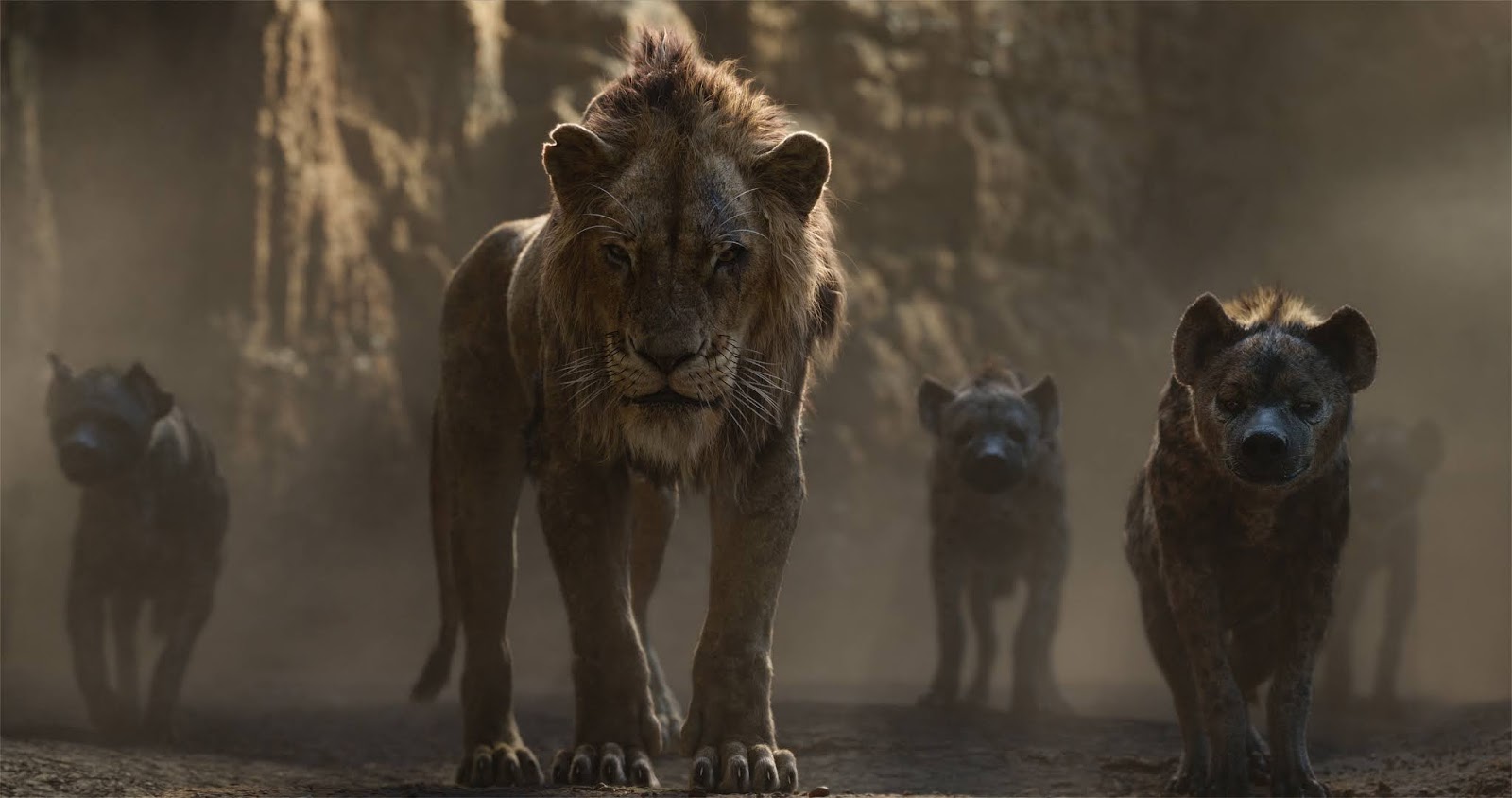
At the same time though, the new version makes a lot of changes that hurt the story. It tries to give Scar more backstory than the original by implying that he once fought Mufasa for the right to marry Sarabi, which was how he got his scar. The problem with this is that it now gives Scar a history of having challenged Mufasa in the past. That just makes Mufasa look foolish for keeping him around in this version since he can't give his brother that benefit of a doubt that he had in the original film.


We also get a new scene where Nala escapes from Pride Rock during Scar's reign to find help. This lessens the suspense of the later scene where she attacks Timon and Pumbaa because now we know who that lioness is and we have reason to think that she won't go through with killing them. Scar only introduces himself to the hyenas after Mufasa rescues Simba and Nala from them, which makes his alliance with them less compelling, and there's just a ton of extra dialogue thrown in all over the place that adds nothing and throws off the pacing of a lot of scenes.

As far as the voice-acting goes, there's not a lot to say. It wasn't as bad as a lot of reviews have made it out to be, but it still pales in comparison to the original. This is most evident in James Earl Jones, who for some reason sounds a lot less intense in this version despite reprising his role of Mufasa. Most of the actors sound like they're either going through the motions or (in the case of Billy Eichner and Seth Rogen as Timon and Pumbaa) ad-libbing so much that it sucks all the meaning out of the original dialogue. The only really noteworthy performance is Chiwetel Ejiofor as Scar, who's allowed to give a theatrically villainous line delivery every now and then.

Also, John Oliver probably laughed all the way to the bank when he got cast as Zazu, because he's joked before about how much he looks like the original version of the character.


Music-wise, the movie's all over the place in quality. The orchestral score is pretty good, but the new versions of the songs are hit or miss. I think the only song to really improve is "The Lion Sleeps Tonight," which uses a wide variety of animals with a wide variety of vocal ranges to give a pretty neat doo-wop rendition. The worst song revamp is "Be Prepared," which is only half as long now and has Scar mostly talk-singing new lyrics that fit better with the hyenas' less dim-witted depictions in this version.

And I'm just going to come right out and say this: the hyenas in the remake are a huge downgrade. Shenzi gets the best treatment out of the main three, since she keeps her original name and her role as the leader, but she's all menace and no personality in this version. Banzai and Ed technically aren't even in the remake; instead we get two other recurring hyenas in the clan named Kamari and Azizi who barely interact with Shenzi.

Apparently, the reason for these changes was because director Jon Favreau felt the hyenas in the original film wouldn't mesh with the more realistic feel that he wanted the remake to have. He wanted their characters to be dangerous instead of funny in his version.

First of all, the hyenas in the original weren't just funny. They were also dangerous, and the way they easily switched back and forth between those two gears made them even more intimidating. They were unpredictable because their silly attitudes made it easy to underestimate them, and that was the whole point of Scar's downfall.

Second of all, the hyenas in the remake are still used as comic relief. It's just that instead of having all three of them go back and forth between serious and funny, we get one who's always serious and two who handle all the comedy. But because it isn't realistic for the comic hyenas to make cartoonish gestures or anachronistic jokes, there's not a lot of funny things they can actually do or say. As a result, we get a villain "trio" where two thirds of them fall flat.


And that's the remake's biggest problem: its super realistic approach to everything. Most reviews have rightly pointed out how the animals' lack of humanlike facial expressions weakens the emotional impact of everything, but there's so much more to it than that. Everything is presented like a nature documentary, so nothing fantastical or cinematic is ever shown onscreen. Instead of a vibrant color and style change when Simba's imagination kicks in during "I Just Can't Wait To Be King," we get a regular looking scene with just more animals in it. Instead of towering skeletons and hellish red and green geysers in the Elephant Graveyard, we just get lots of brown rocks. Instead of seeing Mufasa's face in the clouds when he talks to Simba from the afterlife, we just see normal storm clouds that sometimes look a bit like a lion for a split second when the lightning flashes just right.

Even scenes taken straight from the original film like the "Circle Of Life" opening and the wildebeest stampede look smaller in scope because they're presented in a less visually dramatic way. The crazy thing about all of this is that, just like the original film, this version of The Lion King is also entirely animated. I get that they didn't want it to look 100% identical to the original, but there's just no reason why they had to make it look this much less compelling.


Bottom line, the remake of The Lion King is nothing special. It's gorgeous to look at, it fixes a few problems with the original, and it's entertaining enough for kids, but just like all the other recent Disney remakes I've seen, it clearly expects you to already know the story from the original. You're better off just watching that instead.

Long live the king.


Wednesday, July 31, 2019

The Dog Brain of Ragetti & the Secret Success of Pintel


The characters Pintel and Ragetti from the Pirates of the Caribbean franchise are no strangers to my blog. I've discussed a few things about them in past entries, mostly on how their actors and the screenwriters view them, but I've never delved into any serious analysis of the characters themselves. As hard to believe as this sounds, I actually think there's a lot to analyze about this comic relief duo, even if most of what you come up with probably wasn't intended by the writers.

Intended or not, the fact stands that in the three Pirates films that feature Pintel and Ragetti, we see a surprising amount of growth in both characters. Since the films rarely explain any of that growth, the door is left wide open for fans to speculate and fill in the narrative gaps. This essay is my own interpretation of Pintel and Ragetti's character arcs throughout the series, and if there's any truth in what I've gathered, then their subplot could be one of the more meaningful ones in the original trilogy.

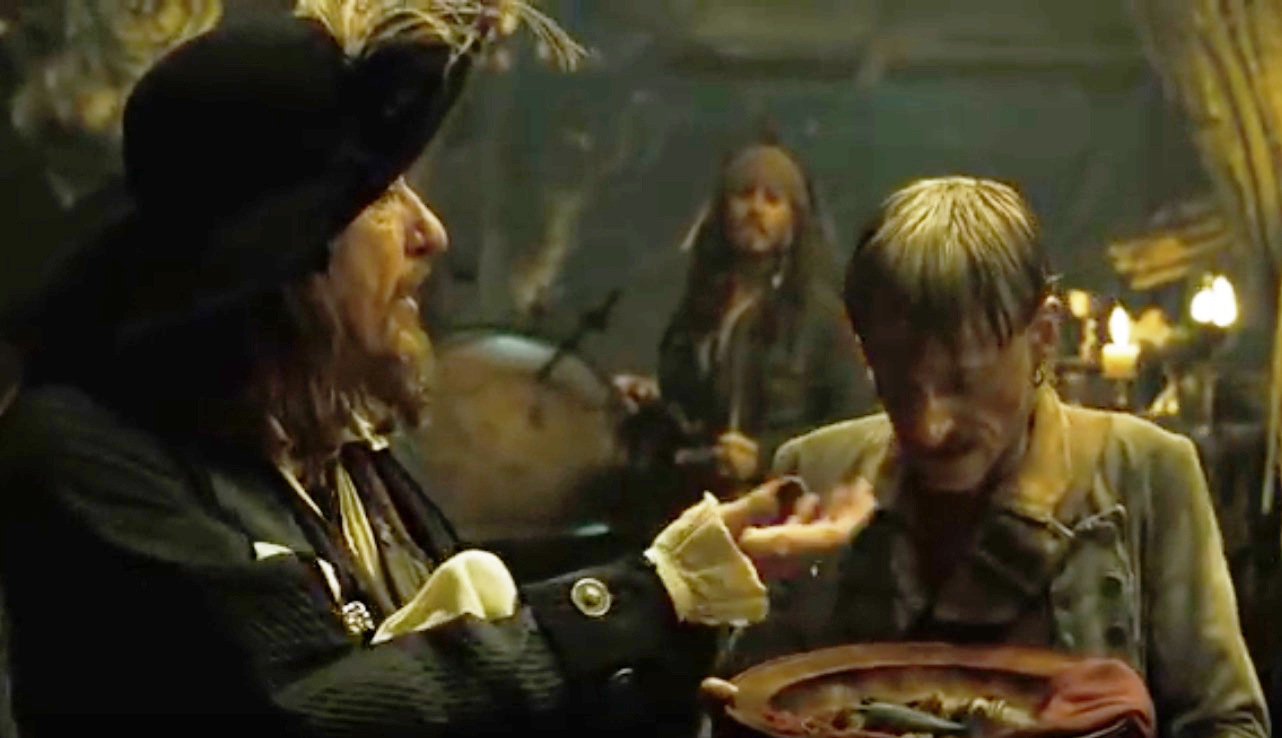
Played by Lee Arenberg and Mackenzie Crook, Pintel and Ragetti first appear in Pirates of the Caribbean: The Curse of the Black Pearl as two members of Captain Barbossa's evil, undead pirate crew. At first they seem like your typical dim-witted henchman duo, but throughout the movie, we get a lot of hints at their personalities, their backstories, their thoughts on their situation, and most importantly, their relationship with each other.


As far as that goes, there are three important things to notice:
1. Pintel and Ragetti are always together
2. Pintel frequently loses his temper and lashes out at Ragetti
3. Ragetti acts like a dog 
I don't mean that Ragetti's lewd, either. I mean that he literally barks and growls at people whenever he gets angry or excited. He also shrinks back with his head down in a very tail-between-the-legs manner whenever Pintel yells at him. He doesn't talk much in Curse of the Black Pearl, but often when he does, it's just to chime in with Pintel. Given that Pintel hits him with a parasol and throttles him purely out of embarrassment at two points in the film, you can kind of see why Ragetti tries to be so obedient.  

The only time we see another side to their relationship is roughly halfway through the film, when Barbossa's crew tries using the heroine Elizabeth Swann to break their undead curse. Right before the proceedings, the crew sorts through the piles of treasure around them, and Pintel and Ragetti more or less have a moment alone to talk. Pintel is curiously sympathetic towards Ragetti, assuring the one-eyed pirate that he can buy a glass eye once the curse is lifted and then patiently chiding him when he rubs the splintery wooden one that he does have. During the curse-lifting ritual, Pintel is seen leaning over Ragetti's shoulder at the front and center of the crowd and playfully nudging his arm to keep him excited about what's happening.


To me, Pintel comes across in these scenes like a guilty parent trying too hard to make up for letting their child down. There's sincerity there, but also a slightly selfish motive behind it. We don't know if he and Ragetti are really uncle and nephew like their actors say, but Pintel is obviously the mentor/decision maker in this relationship. Perhaps he feels responsible for getting his younger companion into this mess with the curse, and perhaps he believes he can clear his conscience by helping Ragetti have a better life after it's over.    

The problem in the meantime seems to be that they're in a situation where Pintel feels he can't afford to look weak. Barbossa and the rest of his crew are frequently shown to be bullies, needlessly mistreating their captives and sometimes turning on each other, and Pintel and Ragetti appear to be at the very bottom of the Black Pearl's ranks. As fond as Pintel is of pillaging, plundering, and shooting people in the face, we see that he's terrified of the crew's first mate Bo'sun — and because of Bo'sun's authority, that can make Pintel fear the entire crew at times. It's conceivable that he and Ragetti always stay close together for security as well as company, and that at least some of Pintel's vicious persona is just a front that he puts up to avoid harassment.

He drops the act during his talk with Ragetti in the treasure cave because despite the rest of their crew being present all around them, no one's really paying attention to them at that exact moment. As soon as Bo'sun walks by and sees them holding the frilly parasols that they've found though, Pintel panics and hits Ragetti with his parasol as mentioned before. The reason he throttles Ragetti later is because Bo'sun has ordered them to distract the British Navy by dressing up as women, and Ragetti makes him feel even more insecure by complimenting the way he looks in a dress.

Slapstick comedy aside, Pintel and Ragetti's relationship is not a healthy one. Ragetti's doglike demeanor (his "Dog Brain" if you will) is most likely a defense mechanism from all the abuse and trauma he's suffered, and unlike Pintel's murder-hungry rage, it doesn't seem to be an act. Pintel has contributed to Ragetti becoming a poorly adjusted, socially inept man with low self-esteem who can barely think for himself. That's not going to give him a better life after the curse is over.


We last see the duo getting outwitted by the hero Jack Sparrow and then arrested by the Navy right as their curse is finally lifted. In the second film, Dead Man's Chest, we first see them rowing through the ocean in a longboat with the jailhouse dog as they discuss how they escaped from prison. This takes place one year after the first film, and we get a very different Pintel and Ragetti this time around.

Here are the three important things to notice in Dead Man's Chest:
1. Ragetti is less doglike and more well-spoken than before
2. Ragetti constantly talks back to, argues with, and defies Pintel
3. Pintel never punishes Ragetti for it
He still yells at Ragetti a lot like he did in the first film, but he doesn't physically harm him anymore. And let's face it, doing that could very easily revert Ragetti back to his old self. It's possible the writers just made these changes to make Pintel more likable and Ragetti more three-dimensional since they join the heroes in this film, but this dramatic character growth can be explained in the context of the story.

For someone as naive as Ragetti, being thrown in jail with a guarantee of hanging has to be earth-shattering. It's the complete opposite of all the great things Pintel told him were going to happen after they broke their curse. What did they do to deserve something this awful instead? Ragetti probably had time to realize what they'd done to deserve it, and with all his pirate aspirations in ruins and death on the horizon, he probably turned to the only salvation he could find: religion.

Hence the Bible that he's trying to read in Dead Man's Chest (which he probably stole, by the way). His "beliefs" are flimsy at best, often getting twisted to justify the crimes that he and Pintel keep committing, but he still seems convinced  that "divine providence" was what broke them out of jail. Pintel disagrees, saying that he was what broke them out, but Ragetti doesn't relent. And why should he? Pintel was wrong about what would happen to them after the curse was lifted, so maybe he's wrong about a lot of other things. Ragetti might see it as his duty now to teach Pintel some humility and eventually steer him away from the sinful life of a pirate. This gives Ragetti some confidence, and that makes him rebellious. And I think for all his annoyance, Pintel lets him rebel because he sees it as a good thing.

If Pintel really did feel guilty for involving Ragetti in their curse, he probably also felt guilty for getting him thrown in jail — so guilty, perhaps, that it pushed him to break them out. He probably also did that to save himself, but the fact that he's stopped mistreating Ragetti (thus allowing the younger man to give him grief all the time) says a lot about his own growth. Maybe he doesn't feel the need to act tough anymore now that they're rid of Barbossa's crew. Maybe lifting the curse and losing his immortality has made him so afraid of death that he doesn't mind having a bolder sidekick to watch his back now. Or maybe he's gained some perspective since their arrest and really is trying to rein in his temper for Ragetti's sake. In the little way that he can, maybe Pintel is still trying to make life better for his friend.

Whatever the reason for this restraint, it does seem to be making a positive difference. Along with speaking up and acting out more often, we also see Ragetti perform a few duties aboard the Black Pearl without Pintel, including a hazardous one that involves clinging to the outside of the hull to hold a longboat in place during a storm. By the end of the film, he's built up enough nerve to save Elizabeth from the giant Kraken squid by chopping off one of its tentacles. He never would have taken a risk like that in the first movie.


Not that Ragetti's Dog Brain is completely gone. We see him slip back into it twice in Dead Man's Chest, both at times when he's overwhelmed with emotion. As he and Pintel move in to fight Elizabeth for the titular chest, he sticks out his tongue like he's panting and goes back to mumbling and repeating what Pintel says. During the Kraken assault at the climax, he stops talking altogether and cowers close to Pintel for most of it. These moments seem to suggest that his more mature demeanor hasn't fully found its roots yet.


And this brings us to the third film, At World's End.

I've complained in the past about how this film handles Pintel's character, especially compared to how much better it handles Ragetti's. I still take issue with some of it, but I do feel like it plays out better if you watch it with this interpretation in mind.

We first see Pintel and Ragetti with three other members of Jack Sparrow's crew as they sneak into a building through a basement sewer. Ragetti is leading the mission, impressively enough, but when they enter the basement and a huge guard walks into view, his Dog Brain sends him running to hide behind Pintel again. This time though, the first mate Gibbs intercepts him. Gibbs says they don't have time for that kind of behavior anymore, then shoves Ragetti to the front of the line again.

After this, we start to notice three new dynamics with Pintel and Ragetti's relationship:
1. Ragetti spends more time on his own
2. Pintel spends more time with Gibbs
3. Pintel frequently follows Ragetti's lead without any arguments 
We don't know if these changes have been in place for a while since the second film or if the confrontation with Gibbs suddenly triggered them. Either way, it's interesting to see Pintel spending less time with his closest friend and more time with a former enemy. It's also interesting that in spite of his growing desire to become the Black Pearl's captain, he's willing to go along with Ragetti's ideas and let Ragetti do a lot of the talking for them in this film.

Pintel could just be so overwhelmed by everything in At World's End that he's content to go with the flow for now, even if it means giving Ragetti the oars, but I also think he agrees with Gibbs that Ragetti needs to grow more independent. It could be that letting his younger pal have more space and responsibility is his way of helping that to happen, and that warming up to the Pearl's first mate in the meantime is him trying to further secure a better future for them. The fact that the duo barely argues anymore also says volumes about Pintel's anger management progress since the first film.

Take the scene where the pirates escape from Davy Jones' Locker by turning the Pearl upside-down. Not only does Pintel humor Ragetti's plan to tie themselves to the mast as the ship tips over, but he also keeps a pretty level head after that plan turns out to be terrible. What's more, when this watery escape ruins their gunpowder, Ragetti clunks him on the head with his pistol to practice wielding it as a club instead and Pintel doesn't hit him back. This is the same man who once throttled Ragetti just for telling him he looked nice in a dress. Pintel doesn't even yell at his friend for the pistol incident. He just simmers for a few seconds, then lets it go. If that isn't proof of how much their relationship has changed since Curse of the Black Pearl, I don't know what is.

And just like in Dead Man's Chest, this new approach seems to pay off in the end. The two main obstacles that Ragetti has to overcome in At World's End are his Dog Brain and his fear of people, which are both represented to him by Captain Barbossa. The former cursed captain joins the crew again in this film, and with him comes a whole boatload of Ragetti's old insecurities. Not being allowed to hide behind Pintel all the time anymore probably makes that all the more harrowing.


But after days of being pushed around, slapped around, and even made to give up his wooden eye by Barbossa, Ragetti finally summons just enough courage and confidence to show up his tormentor right before the film's climax. This involves freeing the sea goddess Calypso from her human form by reciting an incantation, which he points out that Barbossa had failed to do properly. Once he frees Calypso, Ragetti also becomes free himself. He's free of his Dog Brain, free of his fears, and is now a stronger, braver, and more capable man.

I used to dislike how Ragetti gets this big moment (and several others) all to himself in At World's End while the biggest moment Pintel gets is a throw-away scene of him chickening out after yelling at Jack and Barbossa. It just felt like the writers were sidelining him and scrapping the duo concept for no good reason. However, if his underlying arc really is about him reforming so he can see his friend better off, then Ragetti's success with Barbossa and Calypso is Pintel's success as well. That big triumphant moment secretly belongs to both of them. It's theirs to share as a duo after all.

The only downside is that Calypso doesn't end up saving the pirates like they'd hoped she would. Once she's free, she just abandons them and creates a maelstrom to add chaos to the final battle. We even get a moment where Pintel looks down over the ship's rail and laments that "she's no help at all," almost like he's disappointed for Ragetti. Despite this, the two pull themselves together for the final battle. They help to win it, part ways with the heroes when it's over, and then go back to their usual pirates' lives. The difference this time is that they seem to be working together to move their ways up in the ranks now.

Pintel and Ragetti were supposed to appear in the fourth film, but for various reasons, that didn't end up happening. The Pirates of the Caribbean Wiki site claims that their subplot would have involved them getting separated, each thinking the other was dead, and then reuniting by the end. As nice as it could have been to see their relationship finally get some dramatic focus, I don't think it's needed. Pintel and Ragetti's story on screen ends with them standing side by side as equals on the deck of the Black Pearl, carving a new wooden eye and possibly plotting a mutiny against Barbossa. And since it's been shown that other crew men have survived what happens to the ship before the fourth film, we can assume that the duo did as well. All in all, it's easy to interpret a better life for both of them on the horizon.