Friday, November 18, 2016

"Godfather Syndrome" in Movies


It's no news to anyone that movie sequels tend to pale in comparison to their original films. This can be disappointing enough to fans, but it can be all the more disappointing when a film has at least one good sequel and then a bad one. It gives us a false sense of security, a belief that the creative minds behind a franchise can do no wrong, and that makes it feel almost like a betrayal when a bad sequel finally comes along.

We've seen this happen in series like Terminator, The Dark KnightScream, Shrek, and dozens of others, but the odd thing that a lot of those franchises seem to share is that they didn't start to go bad until their third installment. This occurrence is so common that it's even come to be called "Godfather Syndrome" after one of its most infamous casualties. Why is the third time not the charm in so many franchises? The reasons vary, though a few trends do seem to crop up.

One frequent cause of Godfather Syndrome, of course, is studio interference. The second film in a series is often made as an experiment to see how fans of the original will respond to sequels. If that experiment is a huge success, like the sequel Aliens was, the studio tends to apply more pressure on the filmmakers for the next sequel in order to take the most advantage of the franchise's popularity. The result in this case was Alien 3, which had its release date announced before the script was finished and had to severely compromise its story, effects, and most other creative aspects in order to meet that deadline. There's also the case of Spider-Man 3, where the studio forced director Sam Raimi to include a popular villain from the comics despite his story already having two other villains in it. In the end, each franchise was left with a third film that most fans consider to be a convoluted letdown.

Another common cause of Godfather Syndrome is a change in the creative team behind a film series. Filmmakers have changing passions just like any other type of artist, so it's rare for them to remain involved with a franchise to the same extent throughout its entire run. However, if the director, writer, or any other major player hands the reins to someone new in between films, the change in style is usually noticeable. This isn't necessarily a bad thing, but if the key visionaries in a film series are replaced after making the first two films, a lot of their understanding of the series's themes, character arcs, and overall identity is at risk of being lost in Part 3.


For instance, the original X-Men trilogy saw a change in director from Bryan Singer to Brett Ratner for its third film X-Men: The Last Stand, and this led to a huge shift in the presentation. Major characters acted nothing like themselves, subtle undertones were replaced with ludicrous action set pieces, and storylines set up in the previous films were either badly mishandled or dropped altogether. This sequel simply didn't mesh with its predecessors, and when that happens with the third film of a trilogy that follows an ongoing story arc, it can cheapen all three films.

Probably the most disheartening cause of Godfather Syndrome, however, is when the original creators themselves simply lose their touch. Just look at the syndrome's namesake, the Godfather trilogy. The Godfather Part III was written and directed by Francis Ford Coppola just like the first two films, but more than a decade had passed in between the release of Part II and the beginning of Part III's production. No storyteller is going to have the same style or perspective after such a long time, and even though Part III tried to center itself around this idea of time changing people, the fact remained that it didn't feel like a Godfather film.

In other cases, the writers run out of ideas within the scope of the series's universe after two movies and they expand the scope too much in the third one. That's why we got a third Pirates of the Caribbean film that barely took place in the Caribbean and had more characters and storylines in it than a George R.R. Martin daydream.

These aren't even the only three causes of Godfather Syndrome. Sometimes if the second movie in a series ends in a cliffhanger, the third movie gets bogged down with having to resolve those plot threads while also telling its own story. Other times the franchise starts to become self-aware after the second film's reception and panders more in the third installment. And then there are instances where a third film isn't inherently bad, but the second film was just so good that no other sequel can measure up to it. All three of these factors seem to afflict Return of the Jedi, and while it often gets hailed as the weakest film in the original Star Wars trilogy, I really don't know any Star Wars fans who hate it.

Bottom line, making any good film is something of a cinematic miracle. It takes a perfect storm of things going right in order for the product to turn out well, and unless that film is Part 1 of a preplanned story arc, every one of those things has to go right all over again for each sequel to turn out the same way. If a franchise is lucky enough to make that happen more than once, it probably can only make it happen twice -- but that doesn't stop Hollywood from trying at least three times. We fans may see Godfather Syndrome as a stab in the back from the film world, but in the words of The Godfather (and also, sadly, the third Pirates of the Caribbean film), "It's nothing personal. It's just business."


Saturday, October 15, 2016

Grima, Son of Alfrid


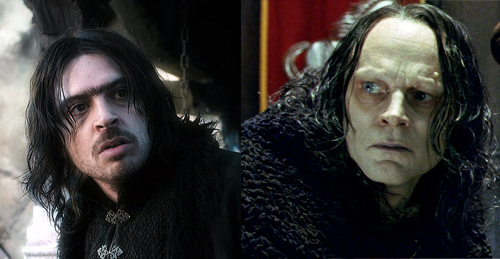
When it comes to fan speculation about a work of fiction, there are generally two types of ideas that people discuss: fan theories and headcanons. A fan theory of course is an idea about something in the work of fiction that's supported by possible evidence within the story. A headcanon, on the other hand, is an idea with no evidence to support it. It's just something that certain fans choose to believe because they like the idea. I've talked about plenty of fan theories from the Peter Jackson Hobbit films on this blog, but today I want to talk about a headcanon from the series and try to at least clear its path of anything that could contradict it. That headcanon is the idea that the character Alfrid Lickspittle is the father of Grima Wormtongue in the six Middle-earth movies.

To start off, Grima Wormtongue is a character from J.R.R. Tolkien's The Lord of the Rings book trilogy who also appears in the film adaptations. Alfrid Lickspittle is an original character created for the film adaptations of The Hobbit, a prelude to The Lord of the Rings. The two characters have a lot in common, being arrogant, sniveling, and manipulative and even having similar physical appearances. They're so similar that some fans used to speculate that they were the same character, with Alfrid changing his identity in between film trilogies to become Grima. This notion has always seemed unlikely since the two stories take place sixty years apart from each other, so the father and son headcanon seemed like a stronger alternative.

The only problem with the father and son idea (and also with the changing identity idea) is that the third Hobbit film's Extended Edition shows a bonus scene where Alfrid dies instead of making his getaway like in the theatrical cut. This doesn't destroy the father and son headcanon, like I used to think it did, but it certainly limits the possibilities.

The key to everything is Grima's age at the time of The Lord of the Rings. The only source I can find that mentions his year of birth is the website "One Wiki to Rule Them All," which claims that he was born in the year TA 2974. Since The Lord of the Rings takes place in the year TA 3019, this would make him forty-five years old and thus too young to be the son of someone who died sixty years prior. However, these dates are meant to reflect the timeline in Tolkien's books, where Alfrid's character doesn't exist. Whether or not "One Wiki to Rule Them All" is a reliable source, this timeline can be ignored because it doesn't truly relate to the movie-verse.

A source that does relate to the movie-verse, as odd as it sounds, is the Lord of the Rings Top Trumps Card Game. Available in three decks, the game features cards for each character as they're depicted in the Peter Jackson films, and those cards also offer a list of basic information on each character. According to Grima's card, he's fifty-nine years old in the movies.

This may seem like a year too short, but it's still possible that he was conceived before Alfrid's death. It would have to have happened shortly before though, and whether or not Grima's mother knew that she was pregnant, she probably would have wanted to distance herself from Alfrid and the town where he lived soon after the conception. Lowering her standards enough to spend the night with Alfrid could easily drive a woman to skip town like that. It's possible then that she traveled south in the following nine months and gave birth to Grima in the kingdom of Rohan, where we see him living as an adult. It could be that Grima hadn't quite reached his sixtieth birthday by the time of The Lord of the Rings, which could very well make him Alfrid's son in the timeline of the movies.

Like "One Wiki to Rule Them All" though, it's debatable how reliable of a source the Top Trumps card game is. And of course, it doesn't prove that Alfrid and Grima are related. It only leaves the possibility of that idea open. This is all that headcanons need though, and since that headcanon does the service of further tying together two trilogies and making the similarities between two characters feel less contrived, I still think it's worth considering.


Sunday, September 18, 2016

Theories on 1 - Part Two


> This Article Contains SPOILERS. <


1 Wears a Nazi Flag and a Death Mask

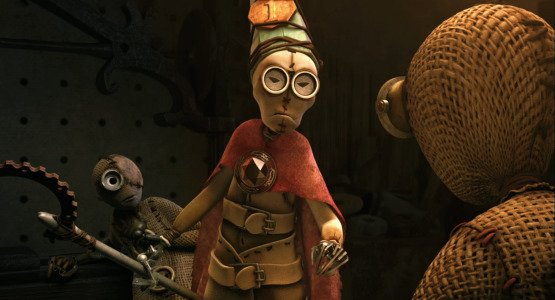
Clothes make the man, and in 1's case, this is probably a bad thing. Because of his lofty status at the start of the film, he wears a very king-like hat and cape in his first few scenes. He's presumably worn this outfit for most of his time as the group's leader, so it's fitting that he loses this attire piece by piece as his leadership fails over the course of the plot. There's symbolism to be found in his garments, and since 1 is quite the poetic type, he may have subconsciously chosen to wear them because of that symbolism.

Let's start with 1's cape. Its tattered edges imply that it was scavenged from the ruins rather than made for him, and it has a very distinct red color. The only other pieces of cloth that color in the film are the red flags with black and white symbols that we see strewn across the city where it takes place. These flags are later shown to have been the banners of a fascist dictator called the Chancellor, the man who first ordered the Scientist to create the Fabrication Machine and then corrupted it. In short, 1 might just be wearing what amounts to a Nazi flag.

It's been suggested in foreign dubs of the film that the Scientist modeled each stitchpunk after someone that he knew in lifewith 1 being modeled after the Chancellor. Why he would model one of his creations after the man who caused the machines to turn against humanity is unclear, but since bringing the stitchpunks to life involved transferring a piece of his own soul into their bodies, the Scientist may have inadvertently given his memories of the Chancellor to 1. It's possible that 1 then "recalled" these memories, liked some of the Chancellor's ideas, and decided to govern his own people in a similar fashion.

Wearing a piece of the Chancellor's flag, a symbol of power, could be 1's way of embracing his newfound ideology and giving himself the confidence that he needs to rule his group singlehandedly. It's easy to imagine how this could corrupt his noble intentions over the years. This could also explain why he's so reluctant to remove his cape when one of the machines tries to snare him by it. He isn't just letting go of an accessory or a status symbol, he's letting go of the assurance that his way of managing things still works.

Next, there's 1 hat. This garment's most notable feature is the copper one-cent coin that he has fastened to it. The first thought is that 1 wears this coin on his head because it happens to have his name embossed on one side of it. This may be true, but later in the film, that same coin is used to cover the face of a dead stitchpunk during a funeral. This suggests that the stitchpunks have some sort of belief about the afterlife and that they associate coins with death. Whether or not 1 shares these views, he could be wearing one of those death symbols as a way to intimidate the other characters into following his rule. He's reminding them without words that death is always nearby and that he alone has control over it.

Much like his cape though, this decoration seems to delude the leader in a very unfortunate way. By wearing a symbol of death on his hat, 1 literally has death hanging over his head all the time. That's not a good position for someone as insecure as 1 to be in. It may have fed his fear of the machines to the point that he became paranoid, which then pushed him to more drastic methods of keeping the stitchpunks in line. Other factors played larger roles in this of course, such as three of the stitchpunks deserting the cathedral and another one becoming more and more curious about the outside world, but that lingering dread in the back of 1's mind from his coin could have sent him on a subtle but steady decline over the years.

The fact that he doesn't start to find his courage until after the coin falls from his hat further supports that the copper piece represents death. By losing that symbol, his fear of death probably becomes more abstract and somewhat easier to live with. Again, other factors play larger roles in 1's transformation after this point, but the loss of his morbid token and its false sense of power could have forced him to finally stand tall on his own.

I think what makes 1 so interesting to 9 fans is that we know he's one of the good guys. No matter how objectionable his behavior is, he's still acting in what he believes to be the group's best interest. The challenge then is to figure out his logic from the clues around us, which is very fitting in a movie about searching for the truth. We want to understand and like 1 because at the end of the day, we all know that the calloused cermudgeon has a soul inside.


Thursday, September 15, 2016

Theories on 1 - Part One


> This Article Contains SPOILERS. <


Directed by Shane Acker, the movie 9 is an animated film about nine rag dolls trying to live in a post-apocalyptic world overrun by machines that have wiped out humanity. These rag dolls, known as stitchpunks, come to learn that they and the machines were both created by a man called the Scientist, and that their purpose is to defeat the machines and restore the Earth. The film has developed a cult following since its release in 2009, largely because it lends itself to a lot of discussion and fan theories. Today, in honor of 9's recent seventh birthday, I want to offer two fan theories about the character named "1."

All nine stitchpunks are named after the numerical order of their creation. The newcomer and protagonist is named 9 while the oldest stitchpunk who leads the group is named 1. 1 is by far the most complex character in the story, being both an arrogant coward and a tragic, failing protector. You can spend days analyzing him and come up with dozens of theories about his backstory and motivations. With that said, let's explore the first of today's two.


1 Has a Soft Spot for 6

1's main goal throughout the movie is to keep the stitchpunks safely hidden away from the machines that roam the outside world. The character 6's main goal is to direct the stitchpunks out into that world to find "the Source," their place of origin that holds the secrets of their creation. Because of this, it stands to reason that 1 would see 6 as a nuisance and resent him. However, there's actually evidence to suggest that deep beneath his cold, crabby exterior, 1 may have a hint of compassion for the eccentric little visionary.

For starters, 1 never seems to get angry at 6 for telling the others to go find the Source. He only ever gets angry at the others for taking 6's advice. This is likely because the others usually don't know what 6 is talking about when he refers to "the Source," which makes his urgings a less direct threat to their safety. It's also likely that 1 knows better than to blame the striped stitchpunk, as 6 is very childlike and detached from his surroundings. Still, scaring him into "better" behavior wouldn't be impossible. We see 6 recoil in fear from 1's brutish bodyguard 8 on one occasion, and he knows to run away from all of the machines that attack the group. He's clearly aware enough of others to be reprimanded, yet 1 doesn't resort to that. The film hints that 1 knows the Scientist used alchemy to create the machines and that he's trying to keep it a secret from the other stitchpunks so they don't dabble in "dark science" as well. Maybe he understands what a burden it is to know something that the rest of the group doesn't and sympathizes with 6's reclusiveness.

We also see that 6's room is right next to 1's throne room in the cathedral where the stitchpunks live. This is odd since 1 appears to prefer living apart from the rest of the group and is much tidier than 6. It could be that the leader is keeping him away from the others so 6 can't give them ideas to go exploring outside, but if that's the case, it appears to be all that 1's doing. 6 spends most of his time in his room drawing pictures of the Source to show to people; 1 knows this and knows how problematic it could be, but he never does anything to prevent it. Why not take away all of 6's ink and paper so he can't draw anymore? Perhaps 1 realizes that drawing is 6's favorite pastime and he doesn't want to deprive the artist of that. He almost even seems to encourage it, as we see that he has a large drawing of 6's displayed on the wall of his throne room. It's also possible that he keeps 6 close to him so the impressionable youngster doesn't get any bad ideas in turn from the other stitchpunks.

Most telling of all, it's right after 6's death that 1 finally takes charge in destroying the movie's main villain, the Fabrication Machine. Up until this point, we either saw 1 running and hiding or following someone else's lead in fighting the machinesand often being a detriment because of his cowardice. When the Fabrication Machine kills 6 though, the elder decides for himself that action must be taken against the metal monster.

Granted, he's dismissing the artist's dying plea not to destroy the Fabrication Machine even though 6 claims that the souls of the dead stitchpunks are inside of it and need to be released. It can also be argued that 1 wants to destroy the machine more to save himself than to avenge 6, but compare his reaction to the youngster's death with his reaction to the character 5's death right before it. The Fabrication Machine kills 5 at a time when 1 is reeling with shame over his failure as a leader, and when he's given a chance to help the others destroy the villain afterwards by making a bridge collapse under it, he does nothing. 6 is then lost while intervening, and 1 responds by forming his own plan to destroy the machine. 5's death didn't push him to become braver, but 6's did.

As for ignoring 6's plea to spare the Fabrication Machine and release the souls from it, 1 might think that 6 is just following instructions left by the Scientist. 1 despises the Scientist for using dark science to create the machines, and he probably blames the man for 6's obsession with the Source. When that obsession leads 6 to his death, it's possible that 1 rejects this plan involving the Scientist's agenda as a way to get revenge on his creator as well as on the Fabrication Machine.


PART TWO coming soon


Tuesday, August 16, 2016

What Made "Ice Age" Good?


With a current score of 11% on Rotten Tomatoes and a current domestic gross of only $58.7 million, it's pretty safe to say that Ice Age: Collision Course has been a disappointment. I would've said "a huge disappointment," or maybe even "a mammoth disappointment" to be witty, but I don't think anyone who's been following the Ice Age series from the beginning had high enough expectations for this film that it could be that much of a letdown. It's a shame, because the first movie actually was a solid and heartfelt piece of entertainment that deserved to have better sequels. Ever since the second movie though, the series has been trying to create a very different identity for itself, and it seems to have forgotten a lot of the key elements that made the original film good.

What are those elements? There's a lot to say in answering that, but I can narrow it down to three major points:


1. "Dramedy," Not Comedy

It's hard to believe, but Ice Age was originally pitched to 20th Century Fox as an adult drama and the studio suggested changing it to a children's comedy. The end result was a hybrid of the two that the filmmakers have always referred to as a "dramedy." You can piece together the original plot from various sources, and while I think it was smart of the filmmakers to tone down or scrap a lot of those ideas, it was even smarter of them to keep the story's more tragic elements intact. The reveal of Manny the mammoth's backstory catches just about everyone off guard the first time they see Ice Age, and dramatic surprises like that make the film challenging as well as entertaining. Because of that, we get more emotionally invested in the characters and feel a much stronger sense of reward when they succeed in the end.

The sequels, on the other hand, are pretty much straight-up children's comedies. They have very few serious moments in them, most of the new characters have quirks and gimmicks in place of personalities, and the heroes usually joke their way through perilous situations instead of reacting with fear. What's more, since the tone is lighter, the characters' personal problems are a lot smaller and less engaging.

It's said that this change was because of Scrat, the sabre-toothed squirrel who's always chasing after his acorn in wacky, Looney Toons-style fashion. He was the most popular character from the first Ice Age, so the sequels decided to make everything in them more zany like his scenes. The problem with this is that Scrat works best as comic relief, and if there isn't enough drama for him to relieve us from, then he serves no purpose. Filling an entire movie with cartoony antics makes him less unique, and now his scenes interrupt the story in the sequels more than they offset it. Drifting away from "dramedy" was just a cheap idea with a weak outcome, and it hurt the comedic elements that were already in place.


2. A Touch of Humanity

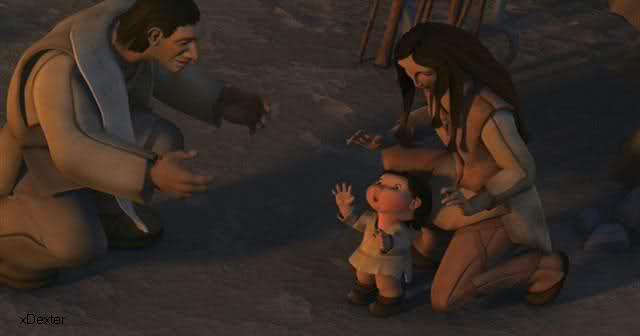
The first Ice Age film is the only one in the series to feature humans--Neanderthals, to be exact. They're one of the more interesting elements in the film, not just because they give the story its emotional core, but because they never talk. This creates more of a contrast between them and the animal characters while also allowing scenes where everything is conveyed through actions and expressions rather than dialogue. Scenes like that can add a lot of depth and subtlety to a film, and they're especially nice to see in children's movies because of that.

I've read that the filmmakers did consider bringing humans back for the second film, but they decided to drop them and explore other aspects of the Ice Age universe instead. It's kind of ironic, because all that the sequels really do is introduce new animals who are more anthropomorphic than the ones in the first film. They'e basically humans, except they have more exotic character designs and they're allowed to talk. There's nothing wrong with featuring new prehistoric creatures in each movie, but when all of the characters are animals who can speak to each other, there's no sense of wonder or suspense in any of the encounters. We know exactly where the heroes stand with everyone because everyone's motivation is said outright, and the intrigue of connecting with other species is mostly forgotten.

The closest the sequels ever come to recreating that dynamic with the humans is with the non-talking dinosaurs in the third film. Even then though, the emotion is somewhat lacking because the dinosaurs are too out of place in that time period. If the filmmakers wanted to explore other aspects of the series's universe, humans could have still offered a lot of different ideas. There were other species of cavemen living at the same time as Neanderthals, and cavemen did cause a lot of problems such as overhunting and competition for food and territory as their populations grew. However, more talking animals in the sequels meant more opportunities to cast big-name celebrities, so spectacle won out over heart once again.


3. Less is More

The first Ice Age movie was about three animals returning a lost human baby to its family while bonding with each other and trying to survive a pack of predators. That's it. There were no major global disasters, no discoveries of lost civilizations, and no magical, outer space excursions. The story was small and simple, and that gave it enough time to properly flesh out its most important elements.

There's too much of everything in the sequels. Too many characters, too many subplots, too many twists and turns, and too much at stake. It's overwhelming, and with so much crammed into each installment, none of the story elements has enough time devoted to it. There are interesting elements in the sequels, such as the character Buck in the third and fifth films and the relationship between Diego and Shira in the fourth film, but they only get superficial development. Imagine getting a flashback of what happened to Buck's family and how he came to live underground with the dinosaurs instead of just seeing a goofy story about how he lost his eye. Imagine getting a flashback of why Shira left her old pack of sabre-tooths and being reminded of what Diego's pack from the first film was like. These subplots could have been really compelling if they didn't have to share their hour-and-a-half run times with a dozen other stories.

Another issue with putting too much into the sequels is that it strains their plausibility. Ice Age: Collision Course is about averting an asteroid by launching magnetic rocks into space from a volcano while a squirrel in a spaceship plays billiards with the solar system. Not only is it nearly impossible to take that main premise seriously, it's also difficult to take the characters' personal story arcs seriously because of how ludicrous the threat to them is. I know that the first movie had a few implausible moments too, like the ice cave full of dinosaurs and spaceships and the river of lava that erupts out of nowhere, but at least those scenes were short and barely referenced again. Heck, the latter example actually sets up one of that movie's most earnest character moments, and since the lava eruption was likely caused by underground volcanoes which were common in prehistoric times, the character moment is able to overshadow the disaster. Again, less is more.


I will say this much about the Ice Age sequels: they did make a lot of money. The original film made roughly $363 million at the box office, and except for Collision Course, each of the sequels earned more than that. There is an audience for those kinds of films, but it's a different audience than the one that the series first drew in, and as we can see, the series is starting to lose that newer audience.

We're already hearing rumors that a sixth Ice Age movie will be in the works soon. If that's true, then I definitely think it should be the final installment in the series and that it should bring things full circle by reintroducing the above three points. I think it should be the film that finally brings back the baby from the original as an adult, and just as the characters speculated in the first film, he should now be a hunter who doesn't remember being rescued by animals when he was little. Have the character who first brought Manny out of his depression over his first family now pose a threat to his new family. That would be an interesting, dramatic conflict with a lot of tension and uncertainty, and the main premise could involve the humans and animals clashing with each other after a disaster at the start of the film forces them together. That way, we could still get some of the larger scale antics of the sequels while also having the drama of the original.

More likely than not though, this won't be the premise of any future movie. We'll probably get another sequel or two much like the last four until the franchise bottoms out, and then Ice Age will go on the same shelf as The Land Before Time and Home Alone as a good movie that spawned a baffling series. In the end though, that one good movie is all that matters. Hollywood could hurl a million sequels down on us that crash and burn, but however big their craters are, we can always find the original with all of its simple, "dramedic" humanity perfectly preserved in the ice below.


Tuesday, July 19, 2016

The Appeal of Tom Bombadil

How you feel about certain elements in a popular series often depends on how you were introduced to the series as a whole. When it comes to a series like the Lord of the Rings trilogy that's been adapted across more than one medium, the fans who were introduced to it through the books tend to be more devoted to Tolkien's universe than the fans who were introduced to it through the movies. I'll admit upfront that I belong to the second group, and I think it's because of this that I've never quite seen the appeal of one of the books' more beloved elements: the character Tom Bombadil.

Appearing in only three chapters of the first Rings book, Tom Bombadil is a mystical, carefree fellow of unknown origins who wears yellow boots and a blue coat and spends his days wandering the Old Forrest while singing. He saves the hobbits a few times on the first leg of their journey, shows no interest at all in the One Ring, and then bows out of the story entirely with only a brief mention afterwards at the Council of Elrond. Like a lot of minor characters from the books, Bombadil gets left out of most adaptations, but he always seems to be the one whose absence people object to.

Why is that? He doesn't contribute all that much to the plot, and even by the books' own admission, he's so disconnected from everything having to do with the Ring that it's pointless to include him in the quest. What's more, having someone that lighthearted and silly pop up so early in the story almost harms the dark tone that it's trying to set. Again though, I'm someone who already saw the story play out fine without him on film before I read the book, so maybe I need to look at merry old Tom from a different angle to see his charm.


For starters, fans of Tom Bombadil probably like him more from a worldbuilding standpoint than from a storytelling one. Having the hobbits cross paths with someone who seems to come from a separate story makes Middle-earth feel like a much bigger place, and keeping Bombadil's origins a mystery opens up all kinds of fan theories about who or what he might actually be. As I've said in past essays, fan theories provide a more interactive way of enjoying a work of fiction, and since Tolkien mapped out so much of Middle-earth's history and mythos in his other writings, it makes sense that a rare enigma like Bombadil would intrigue so many readers.

Another explanation could be that his jolly, quirky demeanor makes him more unique and memorable. In a story full of brooding, angry, and depressed people, it does turn a few heads to see someone who's more upbeat among the cast. There's also something about an ageless, magical figure who's eccentric rather than stoic that people often find interesting. We've seen that type of character everywhere from Merlin the wizard in the King Arthur legend to the Cheshire Cat from Alice in Wonderland  even Mew from Pokemon, to be topical  and a lot of character complexity can be found in that contrast of age and youthfulness.

I think that the best explanation for Bombadil's appeal may lie in the story behind his creation. The character was said to be inspired by a doll with boots and a hat that belonged to one of Tolkien's children. After an incident where the doll survived getting stuffed down a lavatory (the Forbidden Pool, if you will), Tolkien was so impressed that he would often make up bedtime stories for his children about the doll's other adventures. The Hobbit also started out as a bedtime story, so when Tolkien came up with an idea for a sequel to the book, he decided to incorporate the doll-inspired Tom Bombadil into that followup.

Given their similar origins, it's only natural that Tom's scenes in The Lord of the Rings would have the same lighthearted tone as The Hobbit instead of the dark and serious tone of the sequel. It's also possible that the character is meant to ease that transition in tone, acting as one last callback to the more innocent times of Bilbo's adventure before the Nazgul come along and ruin everything. If this is the case, then his final mention at the Council of Elrond where the heroes decide not to involve him in the One Ring's destruction can be seen as an official goodbye to that innocence. That does kind of make it sad to see him go.

At the end of the day, I still think that the Lord of the Rings movies were smart to leave out Tom Bombadil. Film is a different medium that requires a tighter narrative than literature, so minor storylines such as his have to go. The fact that some of his lines are said by Treebeard in the Extended Edition of The Two Towers at least shows that Peter Jackson's team appreciated his character and wanted to have some nod to him in their version. I may not have the same attatchment to Bombadil as fans who discovered Middle-earth through the source material, but after looking at him through a wider scope and getting to know him better, I can appreciate him too.


Monday, June 20, 2016

Of Blank Slates and Second Bananas


I saw the movie Watership Down for the first time a few months ago (right before Easter, which made all those cards with bunnies on them suddenly look very morbid). For anyone not familiar with the story, it's about a group of rabbits led by the brothers Hazel and Fiver who leave their old warren to start a new one and encounter several predators and enemies along the way. It's one of the darkest and most highly acclaimed children's movies ever made, and while I did love it, there's one nitpick about it that bugs me every time I watch it.

The rabbit Hazel is treated as the main protagonist in the story. Everyone hails his leadership skills throughout the film, he orchestrates the plan to defeat the villains during the climax, and he gets the big heroic sendoff in the final scene. What bugs me is that I don't quite understand why he's the main protagonist. He's not a particularly interesting character, and while he does have the main conflict to deal with, he doesn't really have a personal story arc. His brother Fiver, on the other hand, is a runt who gets pushed around by the rabbits in the old warren and whose connections to the spirit world help him to see the future and point the group of deserters towards their new home. Fiver is the underdog with a unique ability who incites and drives the story. He's a much more compelling and pivotal character, so why is it Hazel who gets the ultimate spotlight?

This isn't the only case of a sidekick being more interesting than the designated protagonist in a story. Eli Wallach's character Tuco Ramirez in The Good, the Bad, and the Ugly is much more colorful and engaging than Clint Eastwood's character Blondie, yet it's Blondie who always gets the last laugh as the hero with a plan up his sleeve. There's also Dennis Dun's Wang Chi in Big Trouble in Little China, who follows the lead of Kurt Russell's Jack Burton despite having more at stake. Heck, even James Bond is pretty one-dimensional compared to most of the assistants, contacts, and love interests that he's had over the years. It's odd from a writer's viewpoint to see so many dynamic figures forced to be second bananas to stiffer and blander ones, so why do so many authors and screenwriters do it?

The most likely reason is because characters like Hazel, Blondie, Jack Burton, and James Bond are more serviceable to audiences than their sidekicks are. They have less distinct personalities, so it's easier for us to project ourselves onto them and pretend that we're the ones living their lives. This type of character is often referred to as a Blank Slate, and while they're still commonly used in storytelling for the above mentioned reason, we do see a shift in their role as the protagonist every now and then.


Just look at the Pirates of the Caribbean movies. At first they seem to present another case of a Blank Slate protagonist who's going to have a dynamic sidekick, but Will Turner quickly gets demoted to a helper after he meets Captain Jack Sparrow. The two spend the rest of the original Pirates trilogy pretty much competing with each other to be the main protagonist, then Will drops out of the series altogether in the fourth film and Jack has the stage to himself. It's almost like the screenwriters were afraid to make Jack the hero at first and gave him a more standard counterpart to be safe, then when they saw how popular he was with audiences, they took off his Will Turner training wheels and edged him into the leading role. Sources say that Will is supposed to return in the fifth Pirates film, though it's unclear whether or not Jack will have the same relationship with him as before.

Another supporting character who famously became the protagonist in his film series is Peter Sellers's Inspector Clouseau, who first appeared in the 1963 crime comedy The Pink Panther. In that film, the protagonist is a jewel thief named Sir Charles Lytton who attempts to steal a famous diamond while Clouseau is simply a detective who investigates its disappearance. Clouseau was technically an antagonist in that movie, but his bumbling persona was so memorable that he took over as the hero in the next five installments of the series, though not always played by the same actor. That's not even counting the two reboot films from 2006 and 2009 that featured Clouseau in the lead with no mention of Lytton. Once again though, this more engaging character had to be broken in with training wheels before he was allowed to be the protagonist.

Judging from these examples, audiences seem to like having more memorable main characters. The recent criticism of Twilight's Bella Swan and poor performance of Hardcore Henry, an action film shot entirely in the first-person point-of-view, also seem to suggest that a lot of readers and filmgoers want more than a Blank Slate to project themselves onto. So again, why are so many three-dimensional characters relegated to sidekicks and supports for one-dimensional ones?

I was wracking my brain over this when a crazy idea finally came to me: maybe a lot of writers do this not because they want audiences to imagine being the protagonist, but because they want audiences to imagine being with the sidekick. Maybe characters like Blondie and Will Turner exist so we can experience what it's like to spend time with people like Tuco Ramirez and Jack Sparrow. Maybe Hazel the rabbit really just exists so we can observe and try to understand a character as mysterious as Fiver.

Whatever the case, it's still nice to see a second banana grow ripe and get picked every once in a while -- or a second carrot, if Watership Down ever gets any sequels.